Quick Answer
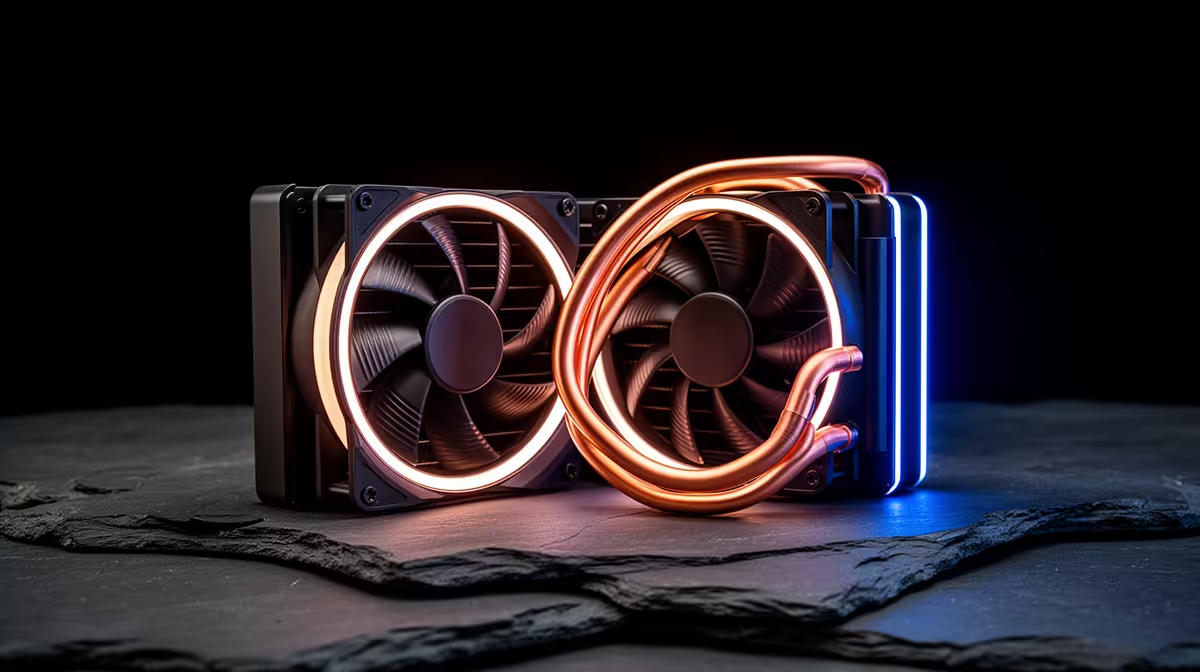
A 360mm radiator reduces CPU thermal throttling by providing three times the radiator surface area of a single-120mm cooler, dissipating heat fast enough to keep chips like the Ryzen 9 9950X under 85 degrees Celsius even under sustained all-core workloads. Thermal throttling activates when a CPU exceeds its maximum junction temperature (typically 95 degrees Celsius for AMD Zen 4/5 and 100 degrees Celsius for Intel 13th/14th Gen), reducing clock speeds to protect the chip at the direct cost of performance.
What Thermal Throttling Actually Costs You 🔥
When a CPU throttles, it reduces its boost clock to shed heat. A Ryzen 9 9900X throttling from 5.1 GHz to 4.2 GHz under a sustained Cinebench R23 run loses approximately 18 percent of compute performance. For a gamer, this manifests as dropped frame rates in CPU-intensive scenes. For a video editor, throttling adds 15 to 25 percent to render times. The root cause is almost always inadequate cooling, and a 360mm radiator addresses this directly by keeping the CPU cool enough to sustain maximum boost frequencies throughout the workload.
How Radiator Size Affects Heat Dissipation 🌡️
Heat transfer from a radiator to air is proportional to surface area, airflow, and the temperature difference between coolant and air (delta T). A 360mm radiator has approximately 50 percent more fin surface than a 240mm unit. In SA summer conditions with ambient temperatures of 28 to 32 degrees Celsius in Gauteng or the Western Cape, a narrower temperature delta between coolant and ambient air reduces a 240mm radiator's efficiency noticeably. The 360mm unit maintains sufficient delta T even at elevated ambient temperatures. This thermodynamic reality matters more in warm SA climates than in Northern European conditions where indoor temperatures rarely exceed 22 degrees Celsius.
Choosing and Installing a 360mm Radiator Correctly 🔧
For the radiator to perform at rated capacity, fan installation matters. Top-mounted radiators exhaust hot air directly out of the case, the thermally superior position in most builds. Apply thermal paste correctly: a pea-sized dot in the centre of the CPU lid spreads to full coverage under cold-plate pressure. A 360mm AIO in SA from brands like Corsair, Deepcool, NZXT, or Lian Li costs between R2,200 and R4,500 locally at Evetech, and the performance gain over a 240mm unit on a high-TDP CPU typically pays for itself in sustained workload speeds within months.
Monitor Throttling With HWiNFO64 ⚡
Download HWiNFO64 (free) and look for the "CPU Package Power" and "CPU Core Max" sensors during a sustained load. If your CPU's maximum recorded core clock drops significantly below its rated boost speed, thermal throttling is occurring. This is the fastest way to confirm whether a cooling upgrade actually solved your throttling problem.
FAQ
Can a 360mm AIO eliminate thermal throttling entirely on a Ryzen 9 9950X?
In an air-conditioned room, yes. At SA summer ambient temperatures above 30 degrees Celsius without air conditioning, a 360mm AIO reduces but may not completely eliminate throttling on a fully unlocked 9950X at its 170-watt TDP. Applying a 125-watt power limit reduces temperatures by 10 to 12 degrees with only a modest performance cost.
Does a thicker 360mm radiator perform better than a standard-thickness one?
Yes, up to a point. A 38mm-thick radiator offers more fin area and coolant volume than a 20mm unit, improving heat dissipation capacity most significantly at lower fan speeds. At maximum fan speed, airflow volume becomes the limiting factor.
Is a 360mm AIO necessary for a Ryzen 5 9600X?
No. The Ryzen 5 9600X has a 65-watt TDP handled comfortably by a 240mm AIO or even a premium air cooler like the Noctua NH-U12S. A 360mm unit on that chip is cooling headroom you will never need.
Ready to eliminate thermal throttling with a properly sized 360mm AIO?
Evetech stocks 360mm AIO coolers from leading brands with local five-year warranties. Browse the cooling section on the Evetech site to find the right unit for your CPU.