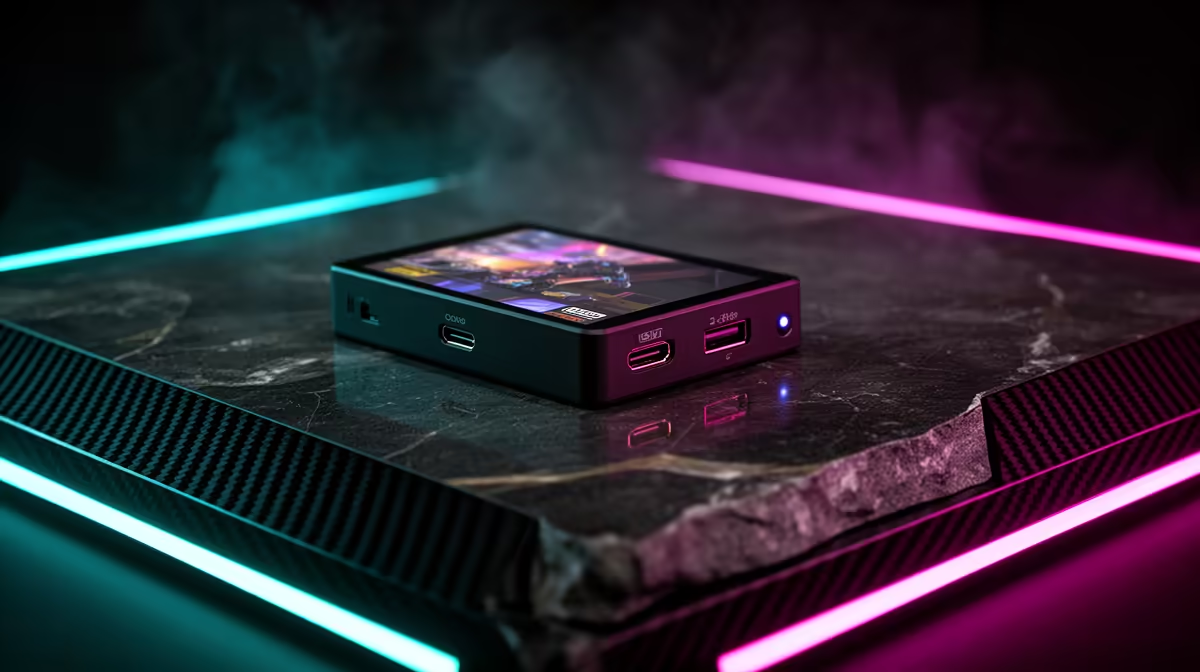
The connection between your capture card and PC is more than a cable choice. With USB-C 3.1 vs USB 3.0 game capture cards for ultra-HD video, the difference is 10 Gbps against 5 Gbps, and that gap determines whether your 4K60 recording arrives with all its detail intact or gets squeezed into a softer version of itself.
Quick Answer
USB-C 3.1 Gen 2 doubles the bandwidth ceiling to 10 Gbps, which gives a 4K60 capture card the room to record at high bitrates without heavy compression. USB 3.0 at 5 Gbps still captures 4K60 but forces tighter encoding that blurs fine detail in fast motion.
⚡ Why Bandwidth Matters for 4K60 Capture
At 4K60, a lightly compressed video stream can push past 6 Gbps. That figure alone is enough to saturate a USB 3.0 port at 5 Gbps, which means the capture card has no choice but to apply heavier H.264 encoding before data even leaves the device. The result shows up in the recording as a loss of fine texture, especially when the frame is moving fast, panning across a detailed game environment, or rendering particle effects.
USB-C 3.1 Gen 2 carries 10 Gbps, so that same 4K60 stream has roughly 4 Gbps of headroom remaining. The card can record at bitrates approaching 130 Mbps rather than being forced down to around 60 Mbps. On a side-by-side comparison, the difference is most visible in scenes with lots of movement: grass, smoke, and rapid camera pans hold their sharpness in the higher-bitrate recording and blur slightly in the constrained one.
For anything below 4K, this distinction largely disappears. A 1080p60 stream needs well under 1 Gbps, which USB 3.0 handles with bandwidth to spare. The spec matters exclusively at ultra-HD.
🔧 What Heavy Compression Actually Costs You
H.264 compression is not inherently bad. Streaming platforms use it, and billions of hours of 1080p footage have been encoded with it to excellent results. The issue is compression ratio. When a USB 3.0 card has to hit a 60 Mbps target for 4K60, it is discarding a significant amount of visual data per frame.
The artefacts that appear are called mosquito noise and blocking, and they cluster around edges and high-frequency detail. In a racing game, the trackside text goes soft. In a first-person shooter, the wall texture pattern becomes a blurry approximation. A viewer watching on a 4K monitor will notice; a viewer on a phone at 1080p probably will not.
For creators who upload at 4K or archive footage for editing, the USB 3.0 ceiling is a genuine constraint. For streamers whose platform tops out at 1080p60 in any case, that ceiling is invisible.
🔌 Practical Port Compatibility
Buying a USB-C 3.1 capture card only pays off if the PC has a matching port. Most modern PCs and laptops shipping in 2023 onward include at least one USB 3.1 Gen 2 Type-C connector, but older builds often have USB 3.0 Type-A ports across the board. Plugging a USB-C 3.1 card into a USB 3.0 hub or a 5 Gbps Type-C port immediately drops performance to the slower standard.
Check the motherboard spec sheet for the exact port generation before purchasing. On a desktop, adding a PCIe USB 3.1 expansion card is a straightforward upgrade if native ports are all 3.0. On a laptop, verify the Type-C port's rated speed because not every Type-C connector runs at 10 Gbps.
Pro Tip ⚡
Before buying a USB-C 3.1 capture card, open Device Manager on your PC and expand the Universal Serial Bus controllers section. Look for any entry labelled USB 3.1 Gen 2 or 10 Gbps. If you only see 5 Gbps entries, consider a PCIe expansion card first to avoid limiting the capture card before it starts.
🎯 Which Connector Should You Actually Buy
The answer depends entirely on your target resolution. If you record at 1080p60 and have no plans to move above that, USB 3.0 is sufficient and the extra cost of a USB-C 3.1 card brings no measurable recording improvement. Save the Rand.
If 4K60 is the goal now or in the near future, the bandwidth advantage of USB-C 3.1 is real and verifiable in the footage. Paying the premium for a 10 Gbps card is justified. Between those two points, 1440p60 sits comfortably within USB 3.0 limits, but 1440p120 brushes against the 5 Gbps ceiling enough that a USB-C 3.1 card starts to offer noticeably cleaner files.
The connector choice is not about marketing. It is about whether the pipe between your capture card and PC is wide enough to move the data your recording quality actually requires.
Frequently Asked Questions
How much faster is USB-C 3.1 than USB 3.0?
USB-C 3.1 Gen 2 runs at 10 Gbps, exactly double the 5 Gbps ceiling of USB 3.0. That extra 5 Gbps is what allows a 4K60 capture card to record at bitrates near 130 Mbps rather than being compressed down to around 60 Mbps to fit within the narrower lane.
Does a USB 3.0 capture card actually degrade 4K footage?
Not to the point of being unwatchable, but the compression required to meet the bandwidth ceiling does cost detail. In fast motion, edges and fine textures lose sharpness. At moderate speeds and low movement, USB 3.0 4K footage looks very good. The limitation becomes noticeable in action-heavy games and rapid camera pans.
Is USB-C 3.1 worth buying for 1080p capture?
No. At 1080p60, the data rate sits well below 1 Gbps, which means USB 3.0 transfers it with the majority of its bandwidth idle. Spending extra Rand on a 10 Gbps card for 1080p capture brings no visible recording improvement and is not money well spent.
Can a USB-C 3.1 card run in a USB 3.0 port?
Yes, the card will function. The connection negotiates down to 5 Gbps, so all the USB-C 3.1 capability becomes irrelevant until the port is upgraded. If you plan to buy a 10 Gbps card today, confirm that the destination port actually runs at that speed before committing.
Which resolution marks the real turning point for this upgrade?
4K60 is the inflection point. Below 4K, the bandwidth gap between the two standards is academic. At 4K60, the 5 Gbps cap forces enough compression to appear in the final file, and stepping to 10 Gbps keeps that compression light enough to preserve the detail that ultra-HD is supposed to deliver.
Ready to capture 4K60 footage with the detail it deserves?
Browse the game capture card range and match the right USB standard to your recording resolution so your footage looks exactly as sharp as the gameplay.