Quick Answer
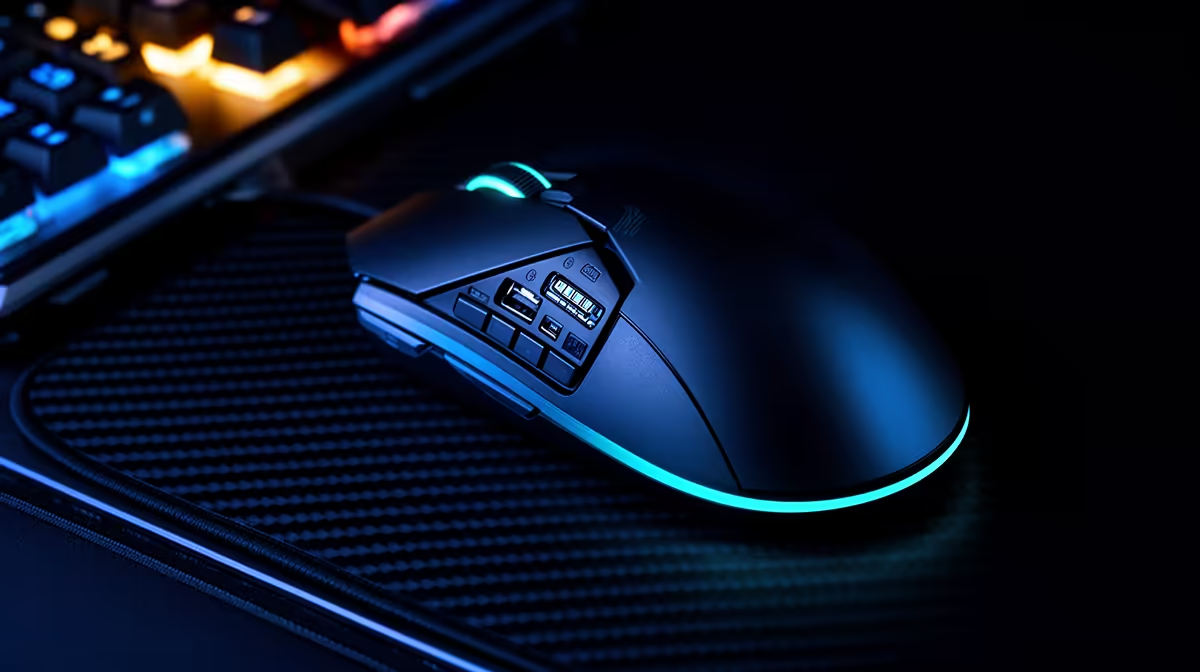
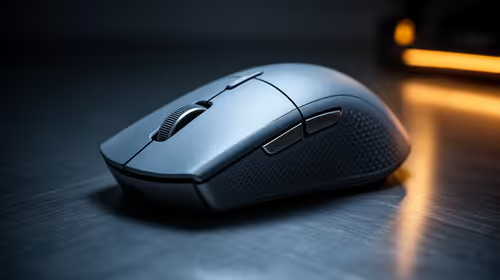
50K DPI sensors are not essential for precision aiming at standard settings, but the technology behind them is. A genuine 50K DPI optical sensor uses a higher-resolution imaging array and advanced signal processing that delivers cleaner tracking, lower jitter, and better low-speed precision even at the 400 to 1,600 DPI range most competitive players actually use.
What the 50K DPI Rating Actually Signals 🔬
The peak DPI rating of a sensor partly reflects the underlying quality of its image processing pipeline. A sensor capable of resolving 50,000 dots per inch has a higher-resolution photoarray and faster onboard DSP than one rated to 12,000 DPI. Even when both are set to 800 DPI in use, the higher-resolution sensor benefits from better signal averaging and more sophisticated noise filtering. The PixArt PAW3950, which approaches this DPI ceiling, processes surface images at a higher frame rate and applies better angle prediction algorithms than earlier PAW3395 designs.
For precision aiming specifically, the benefit appears at low movement speeds. During slow target tracking, older sensors exhibit low-speed jitter where the cursor drifts in small random arcs rather than tracking the imperceptibly slow hand movement accurately. Premium sensors with 50K DPI-class processing handle low-speed motion more cleanly.
Where 50K DPI Does and Does Not Help 🎯
At 400 to 1,600 DPI, no player can perceive the difference between a 16,000 DPI native sensor and a 50,000 DPI sensor in terms of raw cursor movement. The difference lives in quality metrics: acceleration (should be zero), jitter (lower on premium sensors), and tracking speed above 250 IPS. These specs, not the DPI ceiling, determine aiming precision.
Where 50K DPI does directly matter is in macro photography, video editing, or CAD applications where someone actually works at 16,000 DPI or above on a 4K or 8K display. For gaming, treat the 50K figure as a quality indicator rather than a feature you will use directly.
Current Generation 50K-Class Sensors in SA 📊
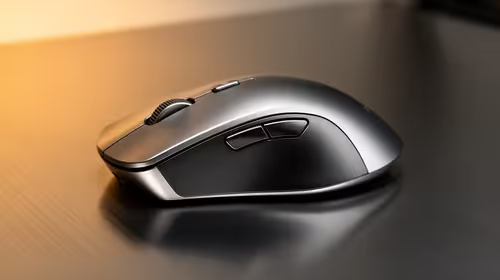
In South Africa in 2026, mice using 50K-class sensors are available from around R1,800 for wired options to R3,000 for wireless flagships. Razer's Focus Pro 30K and the PixArt PAW3950 (found in several OEM designs) represent the current top tier. These sensors include smart tracking features like asymmetric LOD and surface-type detection that adjusts the tracking algorithm automatically without requiring software configuration.
Set Your DPI to a Native Step ⚡
Premium sensors have a confirmed native DPI ceiling above which they interpolate. Setting your mouse to 800 DPI (well within native range) guarantees zero interpolation. Exceeding the native ceiling adds no real precision benefit and may introduce jitter on some surfaces.
FAQ
Is a 50K DPI mouse overkill for competitive FPS gaming?
For competitive FPS at 400 to 1,600 DPI, the 50K ceiling is effectively irrelevant in direct use. What you are paying for is the quality of the sensor's image processing, not the DPI number itself. Many of the best competitive mice top out at 25,000 to 30,000 native DPI and outperform lower-quality 50K sensors in every real-world metric.
Does higher DPI drain battery faster in wireless mice?
No. DPI setting does not significantly affect power consumption. Polling rate is the primary battery life variable. A mouse at 50,000 DPI and 1,000 Hz uses nearly identical power to the same mouse at 800 DPI and 1,000 Hz.
Are 50K DPI sensors available at mid-range prices in South Africa?
The PAW3950 and equivalent sensors are beginning to appear in mid-range mice in the R1,200 to R1,800 range as the technology matures. Check the sensor model in the spec sheet rather than assuming by price.
Find a precision gaming mouse that delivers where it counts.
Evetech stocks mice with the latest high-resolution optical sensors across a range of budgets. Browse the selection at Evetech to find the right sensor spec for your aiming style.