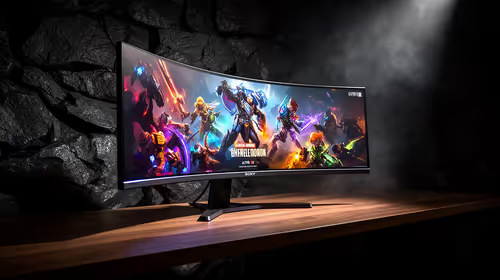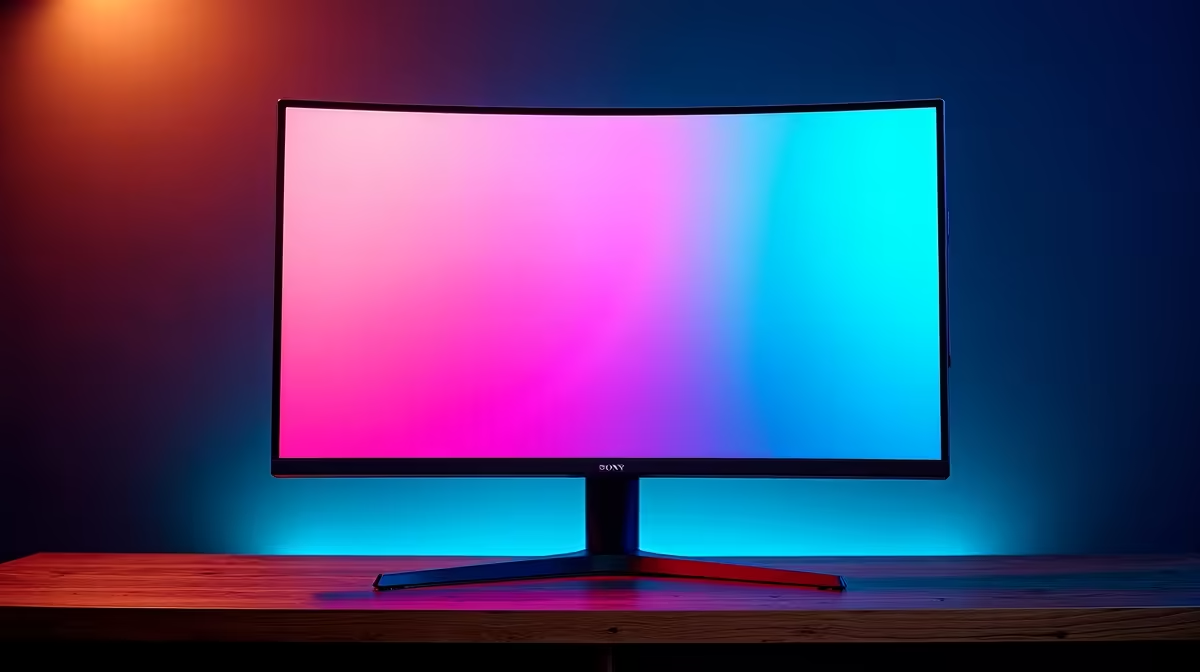
So, you’ve dropped some serious ZAR on a beastly gaming rig. Your GPU is ready to pump out glorious frames, but it’s all for nothing if you’re staring at a blurry, laggy screen. Choosing the best gaming monitor isn’t just an upgrade; it’s unleashing your PC’s true potential. In South Africa, where every rand counts, getting the right display for gaming means balancing performance and price. Let’s decode the specs and find your perfect visual partner.
The Holy Trinity: Resolution, Refresh Rate & Response Time
Forget the marketing hype for a second. To choose the best gaming monitor, you need to master three core concepts. Getting these right for your setup and budget is 90% of the battle won.
Resolution: The Sharpness of Your World
Resolution is the number of pixels on your screen. More pixels mean a sharper, more detailed image.
- 1080p (Full HD): The long-standing standard. It's easy for most graphics cards to run, making it perfect for high-frame-rate competitive gaming in titles like Valorant or CS:GO.
- 1440p (QHD): The current sweet spot. It offers a significant visual upgrade over 1080p without demanding a top-tier GPU like 4K does. It's the ideal choice for most gamers looking for a crisp, immersive experience.
- 4K (UHD): The pinnacle of detail. It looks breathtaking in cinematic games like Cyberpunk 2077 or Alan Wake 2, but you'll need a powerful (and pricey) graphics card to get smooth frame rates. It's a fantastic choice if you have the hardware to back it up, especially with some of the latest Intel laptops on special that can power external 4K displays.
Refresh Rate (Hz): How Smooth is Smooth? ⚡
Refresh rate, measured in Hertz (Hz), is how many times your monitor updates the image per second. A standard office monitor is 60Hz. A good gaming monitor starts at 144Hz. This spec is crucial for fast-paced games. A higher refresh rate makes motion look incredibly fluid, giving you a competitive edge because you see things happen fractions of a second sooner. For competitive gamers, 144Hz is the minimum, while 240Hz is the pro-level goal.
Response Time (ms): Eliminating Blur and Ghosting
Response time, measured in milliseconds (ms), is how quickly a pixel can change colour. A low response time (like 1ms) prevents "ghosting" or motion blur, where fast-moving objects leave a faint trail. For gaming, you want the lowest response time possible to keep your image sharp and clear, no matter how chaotic the action gets.
Panel Tech: The Soul of the Display
The type of panel in a monitor determines its colour accuracy, viewing angles, and speed.
- IPS (In-Plane Switching): The king of colour. IPS panels offer the best colour reproduction and viewing angles. Their response times used to be slow, but modern IPS gaming displays are now incredibly fast, making them a superb all-around choice.
- VA (Vertical Alignment): The contrast champion. VA panels have the best contrast ratios, meaning deep, inky blacks and bright whites. They're great for gaming in a dark room.
- TN (Twisted Nematic): The speed demon. TN panels are the fastest, offering the highest refresh rates and lowest response times. However, they sacrifice colour accuracy and viewing angles to achieve that speed.
First-Step Calibration Tip ✨
Your new monitor's default settings are rarely optimised. Before you even launch a game, go to your display settings and make sure it's running at its advertised refresh rate (Windows sometimes defaults to 60Hz!). Then, search for "Calibrate display color" in Windows and run the built-in tool. It’s a quick way to get a much better picture.
What About Adaptive Sync? (G-Sync vs. FreeSync)
Ever seen your screen "tear" during intense action? That's your GPU and monitor being out of sync. Adaptive Sync technology solves this.
- NVIDIA G-Sync: Requires a compatible NVIDIA GPU.
- AMD FreeSync: Works with AMD GPUs. Many modern "G-Sync Compatible" monitors are FreeSync displays that also work flawlessly with NVIDIA cards.
Both technologies deliver tear-free, buttery-smooth gameplay. FreeSync is often found on more affordable monitors and is a feature worth having, especially if you're pairing it with one of the powerful GPUs found in modern AMD laptops on special. This tech is a must-have for any serious gamer trying to find the right display for gaming. And with an unexpected outage always a possibility, having a powerful laptop setup means the game doesn't have to stop; check out some of the best gaming laptop deals to keep you in the fight.
Ready to See the Difference? Choosing the best gaming monitor transforms your entire PC experience. Now that you know what to look for, you can make a smart investment. Apply that same knowledge to your whole setup. Explore our massive range of laptop specials and find the perfect machine to conquer your world.