Staring down the final chicane in F1 23, lining up a perfect header in EA FC 24, or sinking a clutch three-pointer in NBA 2K... the last thing you want is a performance stutter. It can ruin the moment and cost you the win. Often, the hidden culprit is your system's memory. So, how much RAM for sports gaming do you really need to guarantee a smooth, championship-worthy experience? Let's break it down.
The 16GB Sweet Spot: Today's Gold Standard
For the vast majority of South African gamers, 16GB of DDR4 or DDR5 RAM is the current sweet spot. This amount provides more than enough headroom for today's most popular sports titles while also handling your operating system, Discord, and a few browser tabs in the background without breaking a sweat.
Wondering how much RAM is enough for sports gaming without overspending? 16GB hits the perfect balance of price and performance. It ensures you won't face memory-related bottlenecks in games like FIFA, Madden, or NBA 2K. It's also a fantastic baseline for other popular titles, ensuring you're well-equipped for a session of Fortnite after your main match.
When to Upgrade to 32GB of RAM
So, if 16GB is the go-to, is 32GB ever necessary? Absolutely. The upgrade to 32GB makes sense for a few key types of gamers:
- The Power Multitasker: If you're streaming your gameplay on Twitch, recording 4K footage, and running multiple applications simultaneously, 32GB will provide the smooth, lag-free experience you need.
- The Simulation Enthusiast: More complex simulation titles are a different beast. A game like Microsoft Flight Simulator can easily consume large amounts of RAM, especially with high-resolution textures and add-ons. ✈️
- The Future-Proofer: Investing in 32GB today means you're setting your rig up for the next several years of gaming, ensuring you're ready for whatever demanding titles come next, whether it's the next open-world epic like GTA V or a graphically intensive adventure like Cyberpunk 2077.
Essentially, while 16GB is perfect for playing the game, 32GB is for playing the game... and doing everything else at the same time.
Pro Tip: Check Your Own RAM Usage 🔧
Curious how much memory you're actually using? While in a game, press Ctrl+Shift+Esc to open the Windows Task Manager. Click on the "Performance" tab and select "Memory". This gives you a real-time look at your RAM consumption, helping you decide if an upgrade is truly necessary for your specific use case.
Beyond Capacity: Speed and Channels Matter
The sports gaming RAM requirement isn't just about the gigabytes. Two other factors are crucial for optimal performance:
RAM Speed (MHz)
RAM speed, measured in megahertz (MHz), determines how quickly data can be read and written. Faster RAM can provide a noticeable FPS boost, especially in CPU-bound scenarios. For modern systems, aiming for at least 3200MHz for DDR4 or 5200MHz for DDR5 is a solid choice. This ensures your processor isn't left waiting for data, which is vital in fast-paced shooters like Counter-Strike 2 or Overwatch 2.
Dual-Channel Configuration
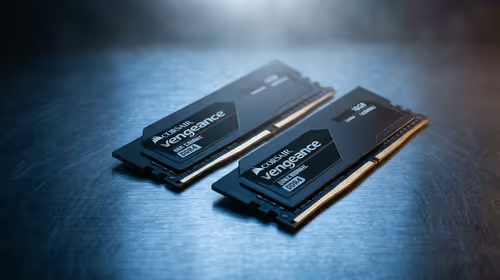
Always try to run your memory in a dual-channel configuration (i.e., using two sticks of RAM instead of one). This simple step effectively doubles the data transfer bandwidth between your RAM and CPU, providing a significant performance uplift for free. A balanced system is key, whether you're dropping into PUBG or fighting off zombies in Call of Duty: Warzone 2.0. Even a creative game like Minecraft with heavy mods benefits immensely from it. ✨
Ultimately, the answer to "how much RAM for sports gaming" is clear: 16GB is the champion's choice for today, while 32GB is for the pros and future-proofers.
Ready for a Flawless Victory?
Knowing your ideal RAM is the first step. The next is finding a rig that's perfectly balanced for your favourite games and budget. From esports-ready machines to 4K powerhouses, we've got you covered. Explore our massive range of custom gaming PCs and build your dream machine today.