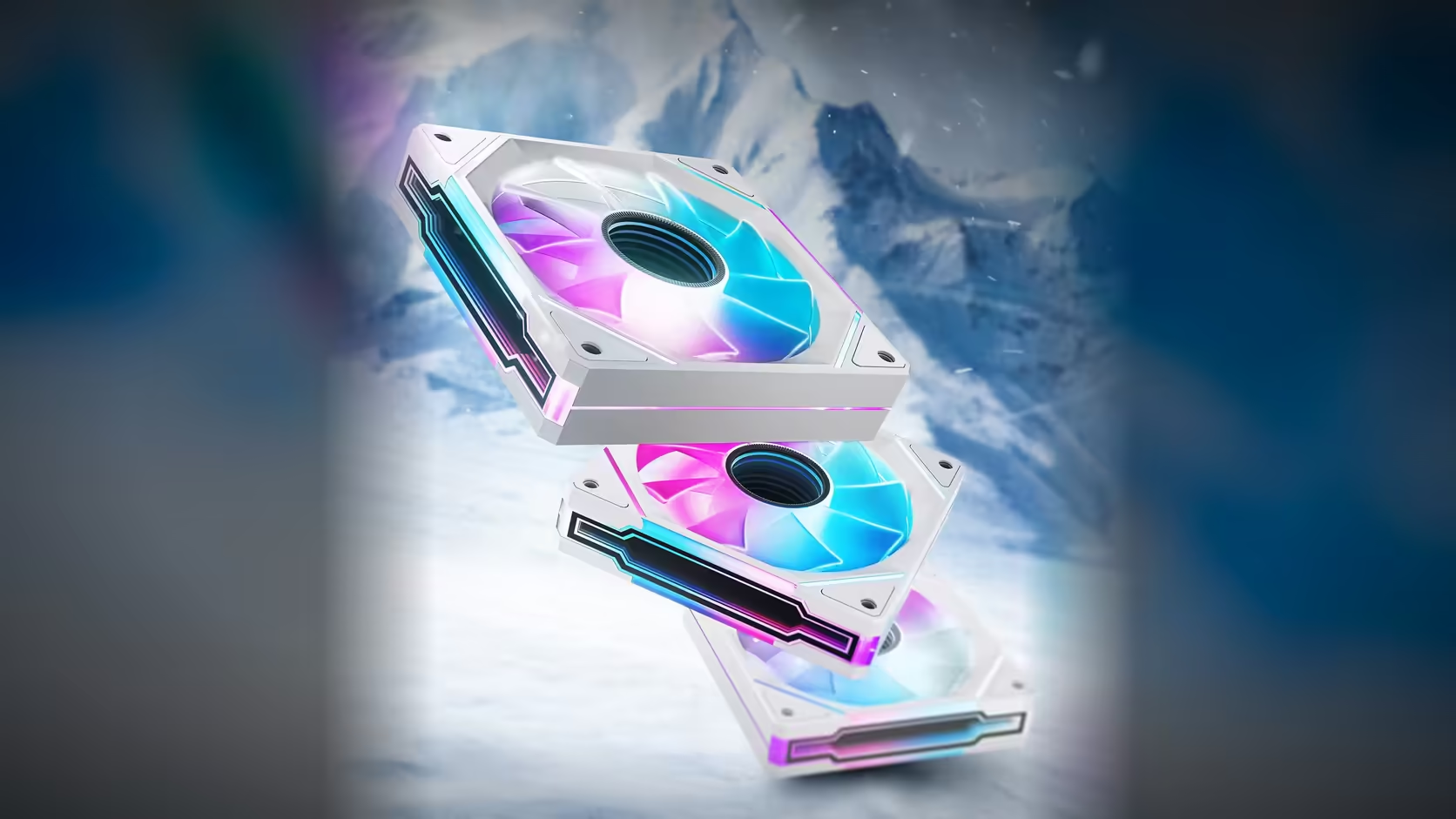
The word "pack" makes some buyers picture a fixed strip of three fans joined into one unit. That is not how the Amici 5GT three-pack is built, and the difference matters for anyone planning where the fans will actually sit.
Quick Answer
An Amici 5GT three-pack arrives as three separate, individual fans, each with its own 4-pin PWM cable and its own 5V 3-pin ARGB lead. They are not physically joined, and any lighting connection between them is something the builder sets up by choice rather than a fixed feature of the pack. That means a R449 three-pack can be split across different areas of a case rather than mounted as one continuous row.
Three units, not one assembly
Unbox a three-pack and there are three individually boxed or bagged fans, each complete with its own cables. There is no bracket or frame holding them together, and no single cable connects all three to the board. The "pack" describes how they are sold, not how they arrive physically joined.
What that flexibility allows
Because the three fans are independent, they do not need to sit next to each other. A case with fan positions in separate areas, front and top for instance, can take one fan from the pack in each area without any compromise, since nothing about the pack assumes adjacency. The only thing that becomes slightly harder with distance is linking the ARGB leads, since those are sized with a row of neighbouring fans in mind rather than positions on opposite sides of a case.
Comparing with a joined design
Some fan products sell a row as a physically interlocked assembly, which looks tidy in a straight line but loses flexibility the moment positions are not adjacent. The Amici 5GT trades that built-in tidiness for the freedom to place each fan wherever the build calls for it, which suits cases where fan bays are not arranged in one continuous run.
Running fans from the same pack on different curves
Because each fan carries its own PWM cable, fans from the same three-pack can be connected to different headers and run on entirely different fan curves. A fan buried deep in a case might be set more aggressive than one in an exposed intake position, even though both came from the same R449 purchase.
Frequently Asked Questions
Does the three-pack ship as one connected unit?
No. It ships as three individual fans, each with its own cables, with no physical connection between them out of the box.
Can pack fans be split across different case areas?
Yes, nothing in the product design requires them to sit together, so splitting them across separate bays is a normal use of a three-pack.
Does splitting the pack affect the ARGB lighting?
It can make linking harder if the fans end up too far apart for the leads to reach, since the leads are sized for a row rather than for widely separated positions.
Is the three-pack cheaper than buying three separate singles?
Yes, R449 for the pack against R199 for each single, which comes to R597 bought individually, so the pack is the cheaper route to three fans.
Do the three fans in a pack have to run the same speed curve?
Only if they share a fan header. Connected to separate headers, each can run its own curve independently.
What does each fan in the pack offer on its own?
The same specification as a single purchase: up to 1800 RPM, up to 61.5 CFM, 30 dBA or less, and a 24-LED infinity mirror.
Where can I check the current three-pack listings?
Evetech's case fans section carries them, and case accessories covers mounting extras if the case needs more than what ships with it.
Planning to spread a three-pack across your case?
Have a look at Evetech's current case fans before deciding where each unit will sit.