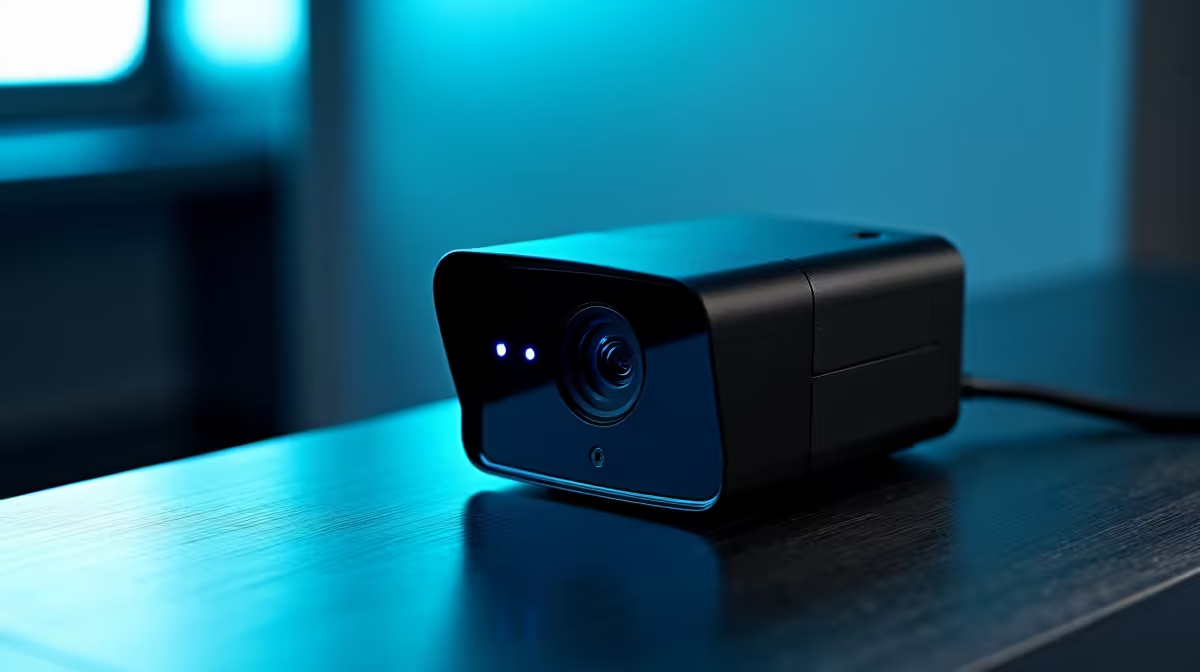
A camera that powers on, shows a few seconds of feed, then resets and repeats the cycle is not faulty hardware most of the time. It is starving. A PoE camera that boot-loops is almost always drawing more wattage at startup than the switch port has agreed to supply, because the power class negotiated between the two sits below the camera's real peak demand.
Quick Answer
The fix is to give the camera enough power. Confirm the switch port is negotiating 802.3at (PoE+, up to 30W) rather than 802.3af (up to 15.4W), power-cycle both the switch and camera to force a fresh negotiation, and swap in a PoE+ injector or higher-class port if the camera needs more than the port allocates.
Why underpowering causes the loop
PoE devices and switches negotiate a power budget when they connect. IEEE 802.3af delivers up to 15.4W per port. 802.3at, known as PoE+, supplies up to 30W. 802.3bt, or PoE++, reaches 60W or more. A simple 1080p fixed camera may draw only 5 to 7W and sit happily on 802.3af, but a motorised PTZ unit with an IR illuminator or a built-in heater can spike to 30W and demand 802.3at.
When the negotiated class falls short of the camera's startup draw, the camera boots, hits its peak current as motors and IR LEDs fire up, and the port cannot deliver. Voltage sags, the camera browns out and resets, then tries again, producing the endless loop. If your switch reports a PoE+ device as running at 802.3af, that mismatch is the smoking gun.
The fix, step by step
Start with a clean power cycle. Unplug both the switch and the camera (or the NVR powering it) for about ten seconds, then reconnect. This forces a fresh PoE negotiation cycle and often resolves a class that latched too low after a previous restart.
If the loop continues, check the negotiated class in your switch interface. Many managed switches let you enable LLDP power negotiation or hardcode a static power level on the port so the camera always gets the wattage it needs. On unmanaged gear without that control, the answer is hardware: move the camera to a true 802.3at port, or drop in a dedicated PoE+ injector rated for the camera's peak draw. The right switch and injector options live across the smart home and appliances range.
Cable quality matters too. Long runs on thin or unshielded cable cause voltage drop that pushes a borderline camera into brownout, so a quality shielded Cat6 or Cat6A run can be the difference between stable and looping, and decent cable is easy to find in the accessories best sellers.
Frequently Asked Questions
How do I tell if my camera needs 802.3af or 802.3at?
Check the camera's spec sheet for its PoE class and peak wattage. Fixed cameras often need under 15W (802.3af), while PTZ units, heaters and strong IR usually require 802.3at at up to 30W.
Why does the camera work for a few seconds then reset?
It boots fine on idle power, then resets when motors or IR LEDs draw peak current the port cannot supply. The voltage sags, the camera browns out, and the cycle repeats.
Can a long cable cause a PoE boot loop?
Yes. Voltage drop over long or thin cable runs reduces the power reaching the camera. A quality shielded Cat6 or Cat6A cable minimises that loss and can stop a borderline camera looping.
Will a PoE injector fix it?
Often, yes. A dedicated 802.3at injector rated above the camera's peak draw guarantees enough power independent of an underpowered switch port, which resolves loops caused by class mismatch.
Should I power-cycle the switch or just the camera?
Cycle both. Unplugging the switch and camera for around ten seconds forces a fresh negotiation, which fixes a port that previously latched onto the wrong, lower power class.