Quick Answer
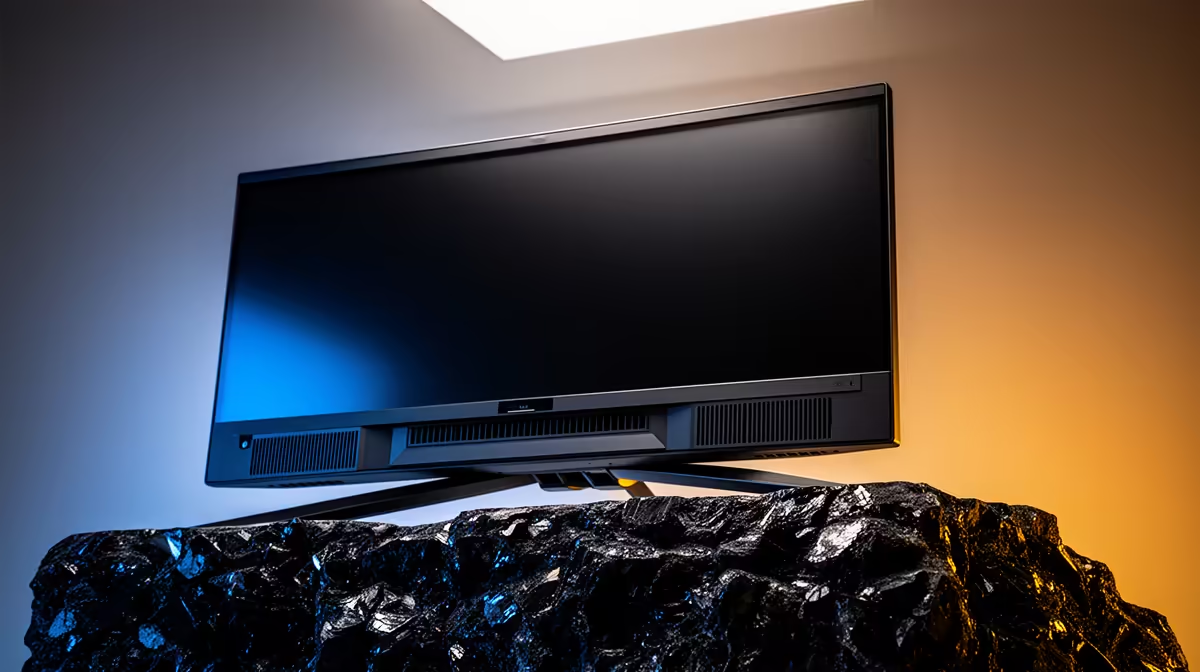
The Neo Proximity Sensor and custom heatsink are two OLED-specific engineering features that directly extend panel lifespan.
How the Neo Proximity Sensor Works 📡
OLED panels degrade through use.
For a South African professional using an OLED monitor at a home office desk, where stepping away for meetings, breaks, or family interruptions is common, the proximity sensor can reduce daily panel-on time by 15 to 25% compared to a monitor left running without it. Over a three to five year ownership period, that represents meaningful real-world reduction in cumulative pixel wear.
Custom Heatsink Design: Engineering for OLED Longevity 🔧
OLED panels operate at higher sustained temperatures than LCD panels under equivalent brightness loads because each pixel generates its own light and heat. A custom heatsink bonded to the back of the OLED panel draws heat away from the organic light-emitting layer and dissipates it through the monitor chassis or a dedicated thermal pad system. This keeps the panel operating within a lower temperature range during sustained high-brightness gaming sessions.
The practical benefit is most relevant during long gaming sessions at high brightness, where an unmanaged panel temperature would accelerate organic compound breakdown.
Pixel Refresh Cycles: The Third Longevity Feature 💡
Alongside proximity sensing and heatsink cooling, most premium OLED monitors include automated pixel refresh cycles. These routines run when the monitor powers off or at programmed intervals, and they electronically exercise each pixel to even out minor wear differences across the panel. The process takes between 6 and 15 minutes depending on the monitor and is inaudible and entirely automatic.
These three features together (proximity sleep, custom heatsink thermal management, and pixel refresh cycling) form a complete OLED longevity system. On a monitor priced between R20,000 and R35,000 in South Africa, they are the engineering equivalent of a service interval for a vehicle: routinely necessary to maintain the investment's long-term performance.
Run Pixel Refresh at Shutdown Every Night ⚡
Schedule your OLED monitor's pixel refresh cycle to trigger automatically when you shut down your PC for the night. Most monitors can be configured to run this cycle on power-off rather than requiring a manual start, ensuring the routine happens consistently without adding any effort to your daily workflow.
FAQ
Does the proximity sensor work through glasses or when you are not directly facing the screen?
Proximity sensors on most monitors use infrared detection and read heat signatures or movement rather than facial recognition. They generally detect presence reliably within a 60 to 90 degree horizontal cone in front of the display, including when glasses are worn. Reading at a slight angle to the screen will still register as presence on most implementations.
How much does a custom heatsink design actually matter for burn-in risk?
Thermal management directly reduces the rate of organic compound degradation. Lower panel temperatures extend the time before noticeable brightness loss occurs. While burn-in risk from static content is the more headline concern, long-term luminance retention (how bright the panel remains after years of use) is also affected by thermal load. A monitor with active heatsink management will typically retain higher peak brightness for longer.
Are these longevity features available on all OLED monitors stocked in South Africa?
Not all models. They are predominantly found on premium tier monitors from Samsung, LG, and Asus above R20,000. When comparing models at similar price points, confirm specifically whether the proximity sensor and custom heatsink are included rather than assuming they are standard features.
Looking for an OLED monitor built for long-term reliability at your SA desk?
Evetech stocks premium OLED displays with advanced longevity features and full local warranty. Browse the range and invest with confidence.