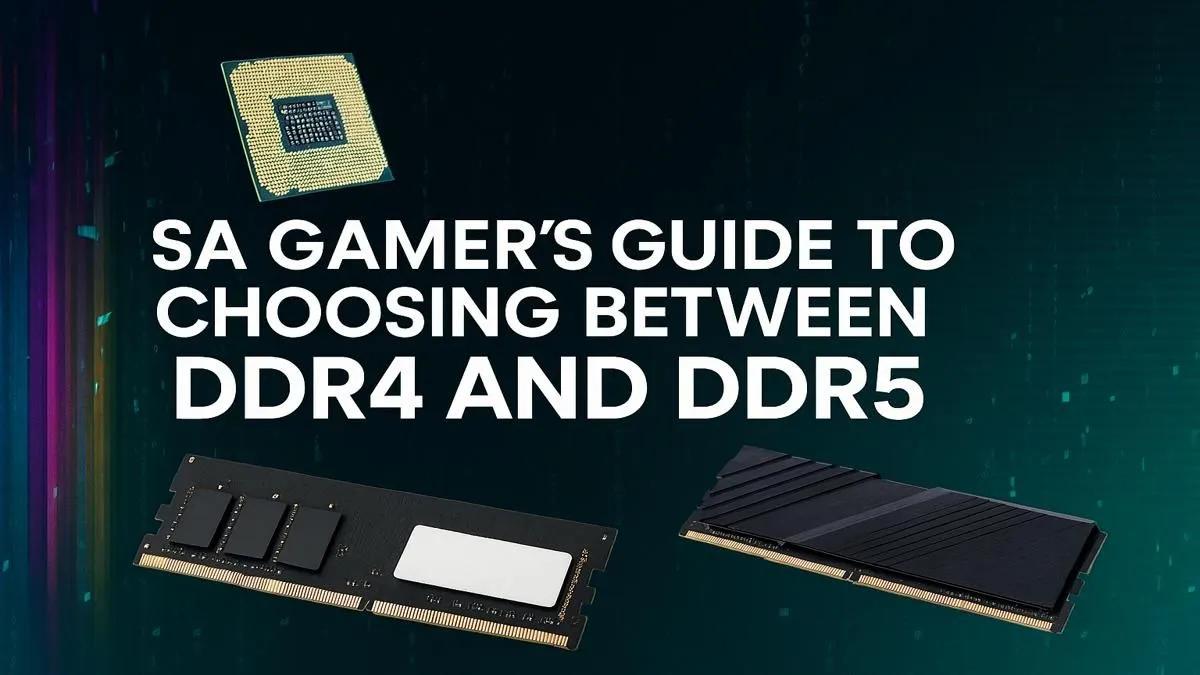
Building a new rig or feeling that your PC is lagging behind in the latest titles? You're not alone. The DDR4 vs DDR5 gaming debate is heating up across South Africa, leaving many gamers wondering: is the jump to the new standard worth the extra Rands? It’s a crucial choice that impacts your budget and your future performance. Let's break it down and find the right fit for your battle station. ✨
Understanding RAM: Your PC's Short-Term Memory
Before we dive into the DDR4 vs DDR5 showdown, let's quickly recap what RAM (Random Access Memory) actually does. Think of it as your PC's high-speed workspace. When you launch a game, its assets are loaded from your slower SSD or hard drive into your super-fast RAM for the CPU to access instantly.
More RAM lets you run more applications, but for gaming, the speed of that RAM is what often translates to smoother frame rates and a more responsive experience.
DDR4 vs DDR5 Gaming: The Head-to-Head Breakdown
This is where the real battle begins. While they look similar, DDR4 and DDR5 are built on fundamentally different technologies. You can't just plug a DDR5 stick into a DDR4 motherboard, so this choice is tied to your entire platform.
Speed and Bandwidth: The Raw Power 🚀
The most significant upgrade DDR5 brings is a massive leap in data transfer speeds.
- DDR4: Typically operates between 2133MT/s and 3600MT/s, with enthusiast kits pushing higher.
- DDR5: Starts where DDR4 leaves off, commonly running at 4800MT/s and soaring past 6000MT/s.
This extra bandwidth means your CPU gets the data it needs from the RAM much faster, which can reduce stuttering and boost frame rates, especially in CPU-intensive games. If you're building a top-tier rig for the future, exploring the latest DDR5 memory kits is the logical first step.
Latency and Timings: It's Not Just About Speed
You might see DDR5 kits with higher CAS Latency (CL) numbers (like CL40) compared to DDR4 (like CL16) and think it's slower. However, that's only half the story. Because DDR5's overall clock speed is so much higher, its true latency (the actual time it takes to respond) is often on par with, or even better than, high-end DDR4.
Check Your Motherboard! 🔧
Before you buy any RAM, double-check your motherboard's specifications on its product page. It will clearly state whether it supports DDR4 or DDR5—they are not cross-compatible. For Intel's 12th, 13th, and 14th Gen CPUs, some motherboards support DDR4 while others support DDR5, so choose carefully! AMD's AM5 platform is DDR5-only.
The Real-World Impact for South African Gamers
So, what does this all mean for your performance in Warzone, Apex Legends, or Baldur's Gate 3?
For now, the DDR4 vs DDR5 gaming performance gap can be subtle. In many GPU-limited scenarios (like playing at 4K with max settings), the difference might only be a few frames per second. However, in CPU-bound situations (like playing competitive shooters at 1080p aiming for 240+ FPS), DDR5's extra bandwidth can provide a more noticeable and crucial advantage.
For gamers on a tight budget, a high-quality DDR4 memory kit remains an unbeatable value proposition. It delivers fantastic performance for a fraction of the cost, allowing you to allocate more of your budget towards a more powerful graphics card.
Planning Your Upgrade Path
Your choice heavily depends on where you are in your PC building journey.
- Sticking with an AM4 or older Intel build? DDR4 is your only option, and it's a great one! There's no need to feel left out; it's still incredibly capable.
- Building a brand-new PC? This is the tough question. If you're investing in a new AMD AM5 or high-end Intel platform, going with DDR5 is the smart, future-proof move. The performance gap will only widen as new games are optimised for it.
It's amazing to see how far memory tech has come. Not long ago, many of us were running systems with trusty DDR3 gaming RAM, where even an upgrade to entry-level DDR4 felt like a night-and-day difference. The jump to DDR5 represents a similar leap forward for the next generation of gaming.
The Verdict: Which Memory is for You? ⚡
Ultimately, the best choice in the DDR4 vs DDR5 gaming debate comes down to your budget and goals.
- Choose DDR4 if: You are on a strict budget, upgrading an existing AM4/LGA1700 system, or prioritising GPU power over all else. It offers the best bang-for-your-buck in South Africa right now.
- Choose DDR5 if: You are building a new high-end PC from scratch, want the absolute best performance possible, and are looking to future-proof your investment for years to come.
Either way, you're getting a powerful foundation for an incredible gaming experience.
Ready to Boost Your FPS?
Whether you're squeezing every drop of value from DDR4 or future-proofing with the latest DDR5, the right RAM makes all the difference. Explore our massive range of PC components and find the perfect memory to conquer your favourite games.