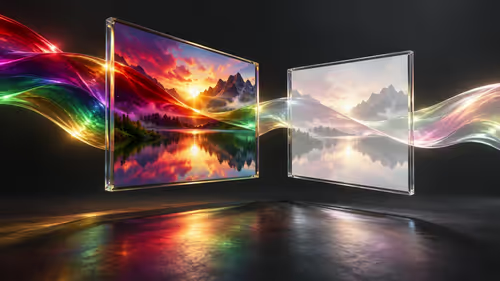
So, you’ve saved up your hard-earned Rands for a shiny new monitor. You’ve pictured the glorious 4K landscapes or the buttery-smooth 240Hz gameplay. But a few days after unboxing, a sinking feeling hits… the colours look washed out, or your games feel choppy. This is classic buyer's remorse, and it often stems from a few common monitor buying mistakes. Let's make sure your next upgrade is a victory, not a regret. 🖥️
Mistake #1: Ignoring the Panel Type
One of the most critical yet overlooked aspects of a monitor is its panel technology. It dictates everything from colour accuracy to response time. Choosing the wrong one is a frequent monitor purchase error.
- IPS (In-Plane Switching): The artist's choice. IPS panels deliver the most vibrant and accurate colours, along with wide viewing angles. If you do creative work or love visually stunning single-player games, this is for you. Their one-time weakness, slower response times, has largely been solved in modern gaming models.
- VA (Vertical Alignment): The king of contrast. VA panels produce deep, inky blacks that make dark scenes in movies and games truly immersive. They offer a great middle-ground on colour and speed but can sometimes exhibit "ghosting" in very fast-paced scenes.
- TN (Twisted Nematic): The speed demon. TN panels are all about raw speed, offering the fastest response times and highest refresh rates for the lowest price. This makes them a favourite for competitive esports athletes. The trade-off? Weaker colour reproduction and poor viewing angles.
Many brands like AOC offer excellent options across all three panel types, so you can find one that fits your primary use case.
Mistake #2: Chasing Resolution Over Refresh Rate (or Vice Versa)
It’s easy to get caught up in the 4K hype, but a high resolution isn't always the best choice. This is a classic dilemma, and the right answer depends entirely on your GPU and the games you play.
- High Refresh Rate (144Hz+): If you mainly play fast-paced shooters like Valorant or Apex Legends, a higher refresh rate (measured in Hertz) is non-negotiable. It results in smoother motion, reduced blur, and a tangible competitive edge. A 1080p 240Hz monitor will serve a competitive gamer better than a 4K 60Hz one.
- High Resolution (1440p/4K): For those who prefer breathtaking visuals in games like Cyberpunk 2077 or need more screen real estate for productivity, a higher resolution is key. Pixels create detail, making worlds more immersive and text sharper.
The biggest mistake is a mismatch. Buying a 4K 144Hz monitor is pointless if your GPU can only push 50 frames per second at that resolution. Balance is everything. Check out the wide variety of PC monitors available to find the perfect balance for your rig.
Mistake #3: Getting Tangled in Adaptive Sync Tech
Screen tearing… that ugly horizontal line that appears when your monitor and GPU fall out of sync… is a massive immersion breaker. Adaptive Sync technology solves this, but the different names can be confusing. This is a technical monitor buying mistake that's easy to make.
G-Sync vs. FreeSync vs. Adaptive Sync
At its core, all Adaptive Sync technology does the same thing: it syncs your monitor's refresh rate to your graphics card's frame rate output for tear-free, smooth gameplay.
- NVIDIA G-Sync: This is NVIDIA's proprietary tech. A monitor with a dedicated G-Sync module often comes at a premium but guarantees a top-tier, rigorously tested experience. For Team Green, a G-Sync compatible monitor is a fantastic choice.
- AMD FreeSync: This is AMD's open-standard alternative. It's more common and generally more affordable. If you're running an AMD Radeon GPU, a FreeSync display is a no-brainer.
- Adaptive Sync: This is the VESA open standard that FreeSync is built on. Many modern NVIDIA cards can now run on Adaptive Sync monitors, giving you more flexibility than ever.
Quick Tip: Enabling Adaptive Sync ✅
Don't forget to turn it on! Plugging in your monitor isn't enough. For NVIDIA, go to the NVIDIA Control Panel > Set up G-SYNC. For AMD, open the AMD Radeon Software > Gaming > Display. Ensure the feature is enabled to get the tear-free experience you paid for!
Mistake #4: Forgetting About Connectivity and Ergonomics
You can have the best panel in the world, but it won't matter if you can't plug it in properly or if it gives you neck pain. 뻐
- Ports Matter: For high refresh rate gaming, DisplayPort is generally the best choice. While modern HDMI 2.1 can handle high resolutions and refresh rates, DisplayPort 1.4 is more common and reliable for PC gaming. Check that the monitor's ports match what your GPU offers.
- Ergonomics: A stand that only tilts is a recipe for discomfort. Look for height adjustment, swivel, and pivot (for vertical orientation). A good stand lets you position the screen perfectly at eye level, which is crucial for long gaming or work sessions. Brands like HP often excel at providing highly adjustable and ergonomic stands.
Mistake #5: Buying Based on Price Alone
We all love a good deal, but when it comes to monitors, "goedkoop is duurkoop" (buying cheap is expensive). The absolute cheapest screen you can find online is often a minefield of poor build quality, inaccurate colours, and terrible backlight bleed.
An uncalibrated, low-quality panel can make even the most beautiful games look dull and lifeless. Furthermore, you're often sacrificing warranty and customer support. Instead of chasing the lowest price tag, focus on the best value. Reliable brands like Dahua offer a fantastic balance of performance, features, and price, ensuring you get a quality product without breaking the bank. Making a smart investment upfront is far better than having to replace a disappointing monitor a year down the line.
Ready to Upgrade Your View? Avoiding these common monitor buying mistakes is the first step to a truly epic setup. Now that you're armed with the right knowledge, you can choose a screen that perfectly matches your games, your rig, and your budget. Explore our massive range of PC monitors and find the perfect display to conquer your world.