Building an AI powerhouse in South Africa? Awesome. But before you start generating incredible art or running complex models, there's a problem... our local climate. Pushing your CPU with AI tasks generates immense heat, and standard coolers just can't keep up. Without proper CPU cooling for AI, you're not just losing performance to thermal throttling; you're risking your entire investment. Let's make sure your rig stays frosty. ���️
Why AI Puts Your CPU in the Hot Seat
Gaming is intense, but it often comes in bursts. An AI workload is a different beast entirely. It’s a marathon, not a sprint. Training a model or rendering a complex scene can hammer your processor at 100% utilisation for hours on end. This sustained load creates a relentless build-up of heat that overwhelms the stock coolers bundled with many of the latest CPU processors.
When a CPU gets too hot, it automatically slows itself down to prevent damage—a process called thermal throttling. For AI tasks, this means longer render times and slower processing. An effective CPU cooling for AI setup isn't a luxury; it's essential for unlocking the full potential you paid for.
Air vs. Liquid: The Great Cooling Debate for AI
Choosing the right thermal solution is critical. The two main camps are traditional air coolers and All-in-One (AIO) liquid coolers. Both have their place in an AI rig, depending on your needs and budget.
Air Coolers: The Reliable Workhorse
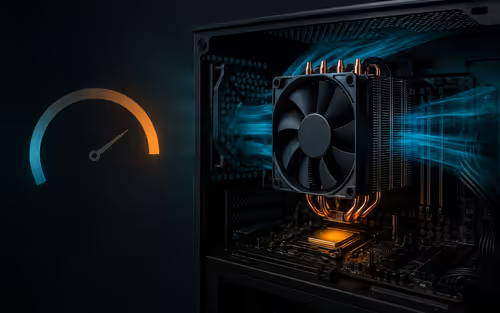
Don't underestimate a high-quality air cooler. Modern designs with large heatsinks and multiple heat pipes are incredibly efficient. They are known for their reliability and simplicity... there are no pumps to fail or liquids to worry about. For many powerful AMD Ryzen processors that are popular for multi-core AI tasks, a premium air cooler from a brand like Noctua or be quiet! is often more than enough to keep temperatures in check.
- Pros: Ultra-reliable, easier to install, often more affordable.
- Cons: Can be bulky, potentially interfering with tall RAM modules or case space. Top-tier performance might lag slightly behind a large AIO.
AIO Liquid Coolers: The Performance Kings 🚀
For those pushing the absolute limits, an AIO liquid cooler is the way to go. By using a liquid to transfer heat from the CPU to a radiator, AIOs can dissipate heat more effectively than air coolers, especially in compact cases. This superior thermal performance is ideal for taming the heat from flagship Intel Core CPUs during prolonged, heavy AI workloads. A 240mm or 360mm AIO ensures your processor can maintain its maximum boost clocks for longer.
- Pros: Excellent cooling performance, sleek aesthetics, quieter operation under load.
- Cons: More expensive, more complex installation, and a (very small) potential risk of leaks.
Pro Monitoring Tip 🔧
Use free software like HWiNFO64 or Core Temp to monitor your CPU temperatures in real-time. During a heavy AI task, your CPU core temps should ideally stay below 85-90°C. If they're creeping higher, it's a clear sign your AI CPU cooling solution needs an upgrade or your case airflow needs a rethink.
More Than Just a Cooler: Optimising Your Rig's Airflow
Your new cooler can't do its job in a hot box. Proper case airflow is a vital part of the CPU cooling for AI equation. Ensure you have a clear path for air to travel through your case—cool air drawn in from the front or bottom, and hot air exhausted out the back and top. Investing in a good quality case with plenty of ventilation and a decent set of case fans can drop your CPU temperatures by several degrees, giving your cooler an easier job.
Ready to Beat the Heat? The right cooling unlocks the true potential of your AI PC, ensuring you get every ounce of performance you paid for. Don't let thermal throttling slow you down. Explore our wide range of CPU coolers and find the perfect solution to keep your system cool and fast.