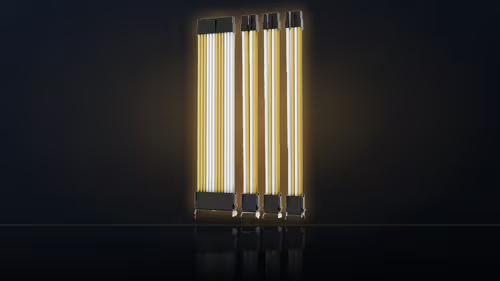
Two comb colours spread randomly across six separate cable runs rarely reads as a deliberate design choice - more often it reads as leftovers, scattered wherever a comb happened to land during a rushed fitting session. A two-colour comb set only earns its keep when the second colour is clearly marking something specific.
Quick Answer
Two comb colours across six runs works best when the second colour marks something rather than appearing at random. Pick a rule and hold to it. Using the accent on the card runs only, or at one matched height, reads as design where scattered colour reads as leftovers.
📐 Rules that genuinely work
Two approaches consistently read as deliberate rather than accidental: accenting one clearly defined group of cables, such as reserving the second colour for the three card runs only, or placing the second colour at one consistent height across every single one of the six cables regardless of which group they belong to. Both give the viewer's eye something coherent to latch onto - a clear pattern rather than an unexplained inconsistency scattered through the build.
🎲 Why random placement looks wrong even when technically neat
The human eye instinctively searches for a pattern in any repeated visual element, and finding none in a randomly distributed second colour, it defaults to reading that colour as an accident or an oversight - which quietly undoes much of the tidiness the combs were fitted to create in the first place. A build can have every strand perfectly spaced and still look unplanned if the comb colour choice itself carries no discernible logic a viewer can pick up on.
🔗 Tying the accent to something else in the build
Linking the accent colour choice to something else already present elsewhere in the build - a fan ring's colour, an accent strip on the motherboard itself, an RGB profile already established - gives the whole choice a visible reason that a viewer can actually connect to something real, rather than an arbitrary decision that exists in isolation. This single step turns a comb colour choice from decoration into something that reads as coordinated design across the whole interior.
🎯 How much accent is too much, and whether it is reversible
A single colour used consistently throughout remains the safest option of all and genuinely never looks wrong, which is particularly valuable in an already visually busy interior where a second competing colour scheme risks adding noise rather than interest. There is a real ceiling on accent proportion too: once more than roughly a third of the total combs across the build carry the accent colour, it stops functioning as an accent at all and starts competing as a full second scheme against the first, undermining the very effect it was meant to create. The sleeve finish itself changes how strongly this all reads too - on the clear transparent series, comb colour shows considerably more strongly than it does against dark, textured braid, so a lighter touch with the accent goes considerably further on a transparent build than the same ratio would on a braided one. And none of this is a permanent commitment either: because combs slide freely on and off the sleeved section, the entire colour scheme remains fully reversible any time the side panel comes off, so there is little risk in experimenting with a placement before settling on a final arrangement. cable solutions has the wider range this comb kit belongs to, and a bespoke alternative for a colour scheme beyond a standard two-colour comb set sits at individually sleeved premium cables.
📝 Writing the rule down before you start
Deciding the accent rule on paper before touching a single comb makes it far easier to stay consistent across all six runs, rather than improvising as you go and ending up with a scheme that drifts partway through the build.
Frequently Asked Questions
What rules actually work?
Accenting one group, such as the card runs, or placing the second colour at one consistent height across every cable. Both read as deliberate.
Why does random placement look wrong?
The eye looks for a pattern. Finding none, it reads the colour as an accident, which undoes the tidiness the combs were fitted for.
Should the accent match something else?
Tying it to an existing colour in the build, whether a fan ring or a board accent, gives the choice a reason the viewer can see.
Is using one colour throughout a safe option?
Entirely. A single colour is the conservative choice and never looks wrong, which matters in an already busy interior.
How many accent points are too many?
Once more than a third of the combs carry the accent, it stops being an accent and becomes a second scheme competing with the first.
Does the sleeve finish change the answer?
On the clear series colour shows more strongly, so a lighter touch goes further than it would on dark braid.
Can the choice be changed later?
Combs slide off and on, so the scheme is reversible whenever the side panel comes off.
Planning a two-colour comb scheme across six runs?
Browse Evetech's power supply range and pick a rule for your accent colour before fitting a single comb.