Recline changes the relationship between seat and backrest, while multi-directional support changes how contact can follow the user. This 145 degree stepless recline and adjustable support guide keeps those mechanisms separate. The R14,999 HBADA X7 provides multi-directional support without receiving that recline specification.
Quick Answer
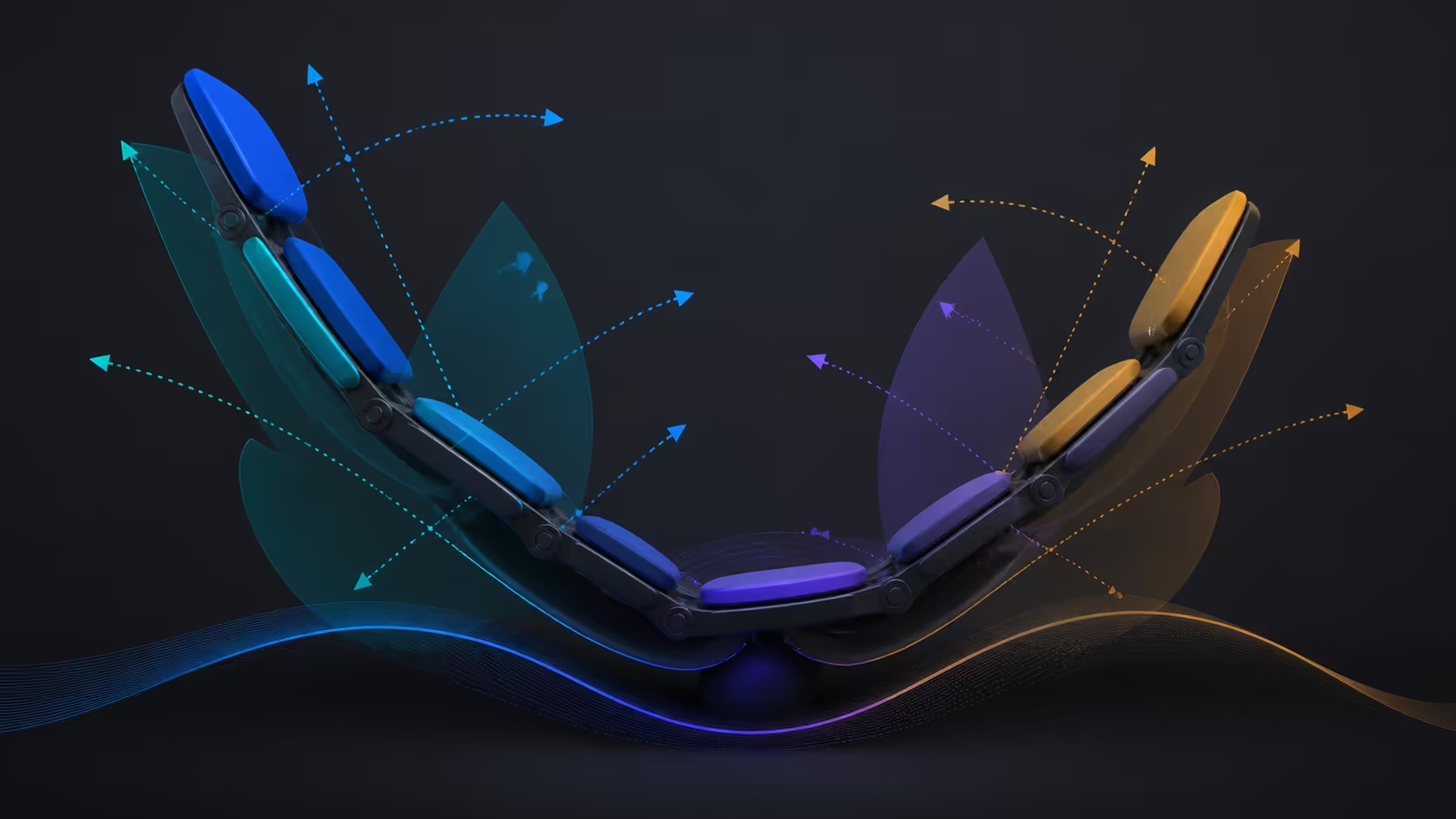
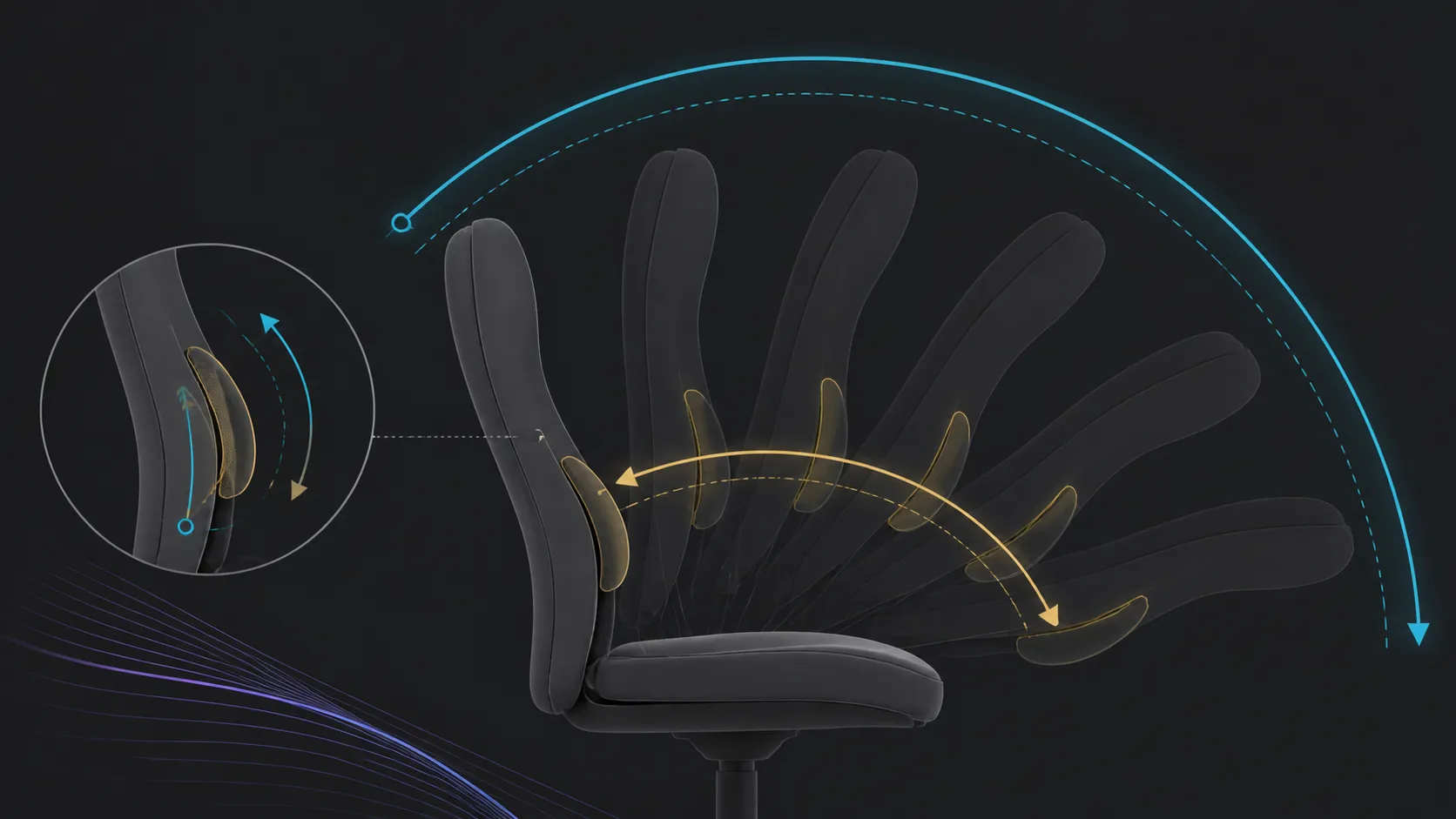
The X7 sustains lumbar contact throughout reclining. Its support moves five centimetres forward or back, 45mm vertically and through a 10-degree tilt, but it does not establish a 145-degree stepless range.
A 145-degree stepless recline offers value only when an exact chair documents that range and lets the user move safely to useful positions without fixed interruptions. Multi-directional support serves a different job by changing support contact around posture. The HBADA X7 costs R14,999 and includes adjustable support with automated lumbar tracking, while its recline range and stepless mechanism must not be assumed.
🧭 Understand recline as task geometry
Recline opens the angle between the user and the working environment. A near-upright profile may support keyboard and pointer reach, while a deeper position can suit a break once active desk work stops. The largest range is not automatically the most useful.
Define work, gaming and rest positions before comparing chairs. For each one, record screen visibility, control reach, foot contact and head position. A chair that reaches 145 degrees but disrupts every return to the desk may offer less practical value than a smaller, well-controlled range.
Verify stepless operation on the exact chair
Stepless generally means the user can choose positions across a continuous range rather than only several predefined stops. It does not reveal resistance, locking behaviour, stability or adjustment control. Verify those details directly and follow the chair instructions.
Search exact movement specifications in Evetech's office-chair selection. Treat a 145-degree or stepless recline as a separate model requirement; the X7 comparison rests on its multi-directional support.
🧭 Treat multi-directional support as contact control
The X7 combines multi-directional adjustable support with fully automated smart lumbar tracking. Test this through normal shifts rather than trying to map undocumented directions or angles. The result should be judged by useful contact and pressure.
Set a neutral desk posture, turn toward a side task, lean forward briefly and settle back. Record whether the support remains broad and whether the user can return to centre easily. Reset before changing another control.
Keep rotation as a separate check
Multi-directional does not establish a 45-degree lumbar range or a named internal mechanism. If an exact rotation figure is mandatory, keep it as an unresolved row until a candidate documents it. The X7 can still be evaluated for the support functions it does provide.
The tracking sensor, detection speed and response path are also unnecessary assumptions. Measure corrections avoided and contact maintained, not hidden technical details.
🧭 Combine movement only after separate tests
First approve the exact recline range on its own. Return to a task-ready profile, then test multi-directional support through the movement sequence. Combining both from the start makes a new pressure point difficult to diagnose.
Check room clearance before deeper recline. Walls, cables, desk edges and other furniture can limit the useful range. Exact dimensions, base footprint, lock positions and load capacity remain chair-specific checks.
Keep active comfort outside the movement verdict
Massage, heat and the ventilated cushion may influence perceived comfort, but they do not prove recline or support mechanics. Switch active functions off during the movement test. Add them later as separate break and airflow rows.
Browse Evetech's HBADA chair range for smart support comparisons. Remember that the X7 battery is not included, so powered comfort carries an additional setup requirement.
🧭 Build an activity-by-activity decision
Create a comparison table with work, gaming and break rows. Mark the required backrest range, support contact, clearance and return effort for each activity. A candidate passes only when it clears every mandatory row relevant to that buyer.
Use the preferred profile for a full session, then reproduce it after standing up. Stepless movement has limited value when the user cannot find the successful position again. A brief setup note can preserve the accepted control and desk relationship.
Review frequency before paying for range
Count how often the deepest recline and multi-directional support are used after a week. Daily support continuity may deserve more value than an occasional endpoint, or regular breaks may make the recline central. Let the routine decide.
Compare continuous movement with useful endpoints
An exact stepless chair may allow many positions, but the buyer still needs only a few that serve real activities. Mark the task-ready point, preferred media or gaming point and rest point. Test whether each can be found again without a long search.
Record movement through the range as well as the endpoint. Unclear resistance or difficult return can matter more than the headline maximum. Use only the exact candidate's documented controls and never push the mechanism beyond its guidance.
Rehearse a busy-room setup
Place the normal bag, cables and nearby furniture where they usually sit. Move among the accepted recline positions while watching for contact. This is more realistic than a test in an empty area and can show that a smaller angle is the practical maximum for the room.
Repeat the multi-directional support sequence at the task-ready point. If contact stays useful, note that X7 result separately from recline. Do not let the room's limitation become a false criticism of automated lumbar behaviour.
Preserve a safe recovery route
Write how to return to the physical work baseline with active massage and heat off. A second user should be able to restore desk reach and support before touching powered comfort. Keep the verified battery requirement in a separate note.
Review recovery after another person uses the chair. A wide range has limited ownership value when the successful position is difficult to reproduce, while a well-documented smaller set of positions can serve the routine reliably.
Preserve the accepted work, gaming and rest positions with the exact candidate name. A later user can then reproduce the range without treating the X7's directional support as evidence of 145-degree stepless recline.
The known multi-directional system follows posture through pressure sensors and a precision motor. Lower-back contact can shift five centimetres in depth, move 45mm vertically and change its tilt by 10 degrees. Use the 4D headrest and 720-degree arms to support the chosen position, while treating exactly 145 degrees and a stepless mechanism as requirements for another documented chair.
The distinction matters because multi-directional support describes contact changes, while stepless recline describes how the chair moves between angles. One cannot be used as proof of the other, even when both influence relaxation.
Frequently Asked Questions
How do recline and support differ?
Recline changes the user's angle relative to the seat and desk. Adjustable support changes contact around the user's posture.
What does stepless adjustment mean generally?
It usually describes position choice across a continuous range. Exact control, resistance and locking behaviour still need model verification.
Is a 145-degree stepless range on the X7?
Do not assign 145-degree stepless recline to the X7. Its back support adjusts across directions and follows lumbar posture automatically.
How should recline and support be tested?
Test each independently with clear space, then combine only after both pass. Record desk reach, contact and return effort.
Can a deep recline serve every activity?
No. A rest angle may make precise desk work awkward, while a task-ready position can be better for typing or gaming input.
What other X7 functions need separate scoring?
Massage, heat and seat ventilation answer different comfort questions. The battery required for powered operation is not included.
Ready to separate chair movement from support contact?
Explore Evetech seating with exact recline requirements, room clearance and activity profiles documented.