An air cooler and a 360mm AIO both do the same job, which is to carry heat away from the processor, but they get there by different routes. The air cooler puts a heatsink and fan straight on the chip, while the AIO moves the heat along a loop to a radiator that sits somewhere else in the case. The right choice depends less on which one cools better and more on what your case can hold, how much noise you will tolerate and how you feel about a pump in the system. Here is how a dual-tower air cooler and a 360mm AIO compare for a real build.
Quick Answer
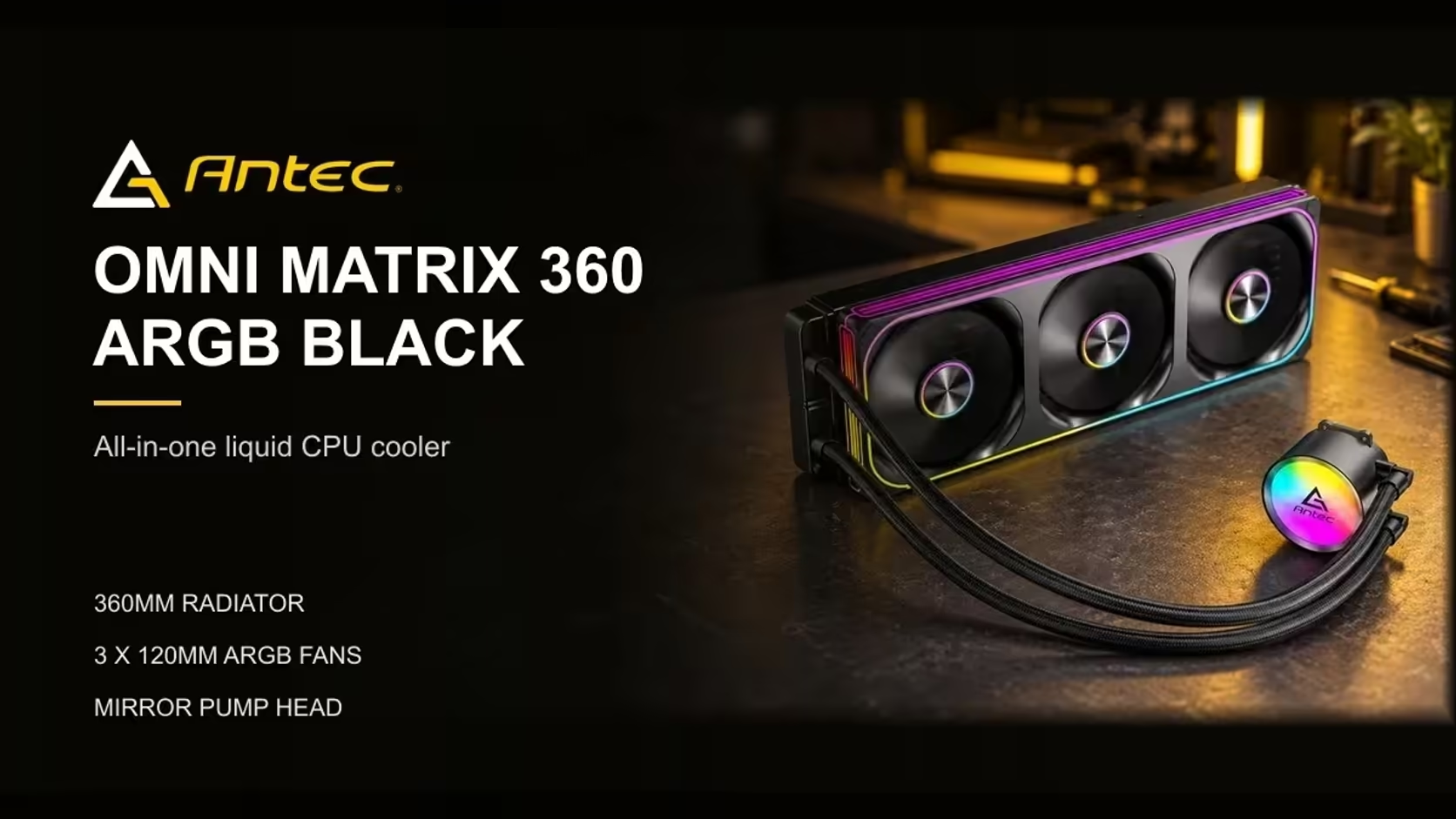
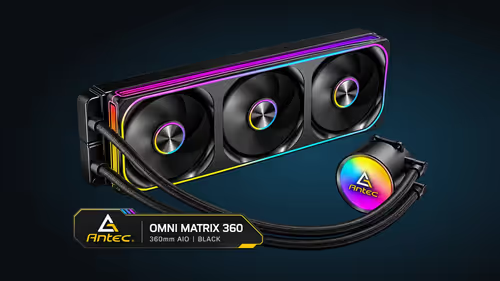
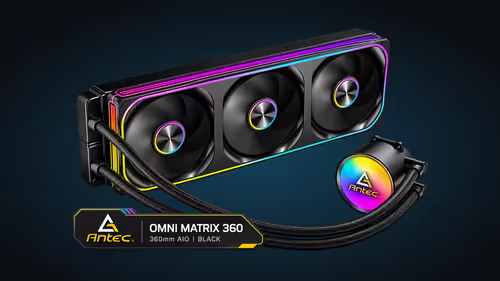
An air cooler mounts a heatsink and fan directly on the CPU, so it has no pump to hear and no loop to fill. A 360mm AIO moves heat to a radiator on the case, which frees the space around the socket. The Antec Omni Matrix 360 at R999 suits builders who have the radiator room, while a dual-tower air cooler suits a case that is tight around the CPU.
🌬️ How each design moves heat
A dual-tower air cooler is a stack of metal fins on two columns, with one or two fans pushing air through them. The heat travels from the CPU into a copper base, up through the heatpipes and out through the fin stacks, and the fans carry it away into the case. Everything happens in one place, and the cooler's height above the board is the main constraint on fit. A typical dual-tower design stands roughly 160mm tall, and its two 120mm fans sit on the fin stacks.
An AIO works on a different path. The block sits on the CPU, coolant carries the heat to a radiator, and fans on the radiator push the heat out of the case. The pump runs the loop, and the radiator can sit at the front or top of the case, which moves the bulk of the cooler away from the socket. The result is a tall block with a short, slim body rather than a tower over the board.
Those routes explain most of the trade-offs. An air cooler has fewer parts that can fail, and it has no coolant to leak. An AIO spreads the heat over a larger radiator, so under long loads it can keep the processor cooler than an air cooler of similar cost in the same room. Both designs depend on airflow through the case, and neither one can remove heat faster than the room air can take it.
🔇 Noise, maintenance and the pump
Air coolers tend to be quieter in the way that matters most day to day. With no pump, the only moving parts are the fans, so the sound is a steady airflow that rises with the load. A pump adds a second source of noise, and a poorly mounted pump or a tube that rattles against the case can make an AIO sound worse than its fans.
Maintenance is different too. An air cooler needs its fins cleaned of dust, and that is a job you can do with a brush and a few minutes. An AIO also needs dust cleared from the radiator, and its loop needs no coolant changes for normal use. The real question is whether you want a closed system at all. Some builders prefer a sealed loop with a radiator and a pump. Others would rather have nothing to inspect beyond the fans.
The Antec Omni Matrix 360 uses a pump that turns at 2700RPM, and its fan set sweeps from 800RPM to 1800RPM. Those are the sounds to expect. Set a fan curve that holds the fans low at idle and raises them under load, and the pump's steady hum becomes the main sound at rest. Quiet builds come from matching the fan curve to the pump rather than from the cooler type alone.
🏠 A dual-tower air cooler in a small Johannesburg flat
In a small Johannesburg flat, the case often sits on a desk or in a corner of a living room. Space is tight, and a dual-tower air cooler can be a better fit than a 360mm radiator, which needs a full slot at the front or top of the case. A tower sits over the CPU and draws its air from the case fans, so it does not need a clear run at the case wall.
That tower does have a height limit. Check the total height of the cooler against the case's clearance under the side panel, and check the clearance against the RAM and the top fan if you plan one. A tower that fits the case on paper can still clash with a tall memory module, so measure before you buy.
For a flat with a shared desk, an air cooler also removes the question of where a radiator should sit. The tower is the same shape from every angle, and nothing about it needs to be planned around the desk or the cable run.
🧭 Choosing between the two
Start with the case. If the front or top of the case has room for a 360mm radiator, an AIO is a real option. If the case has only a narrow top mount or a tight front, an air cooler saves a lot of frustration. Measure the radiator slot and the tower height before you decide, because the case often settles the question for you.
Then think about the processor. A high-end chip under a long load benefits from the extra radiator area of an AIO, while a midrange processor often does well with a good air tower. The cooler should match the heat the chip makes, and the spec sheet tells you the rated power.
Finally, consider the look. An AIO adds a lit pump head and a clean line over the board, while an air cooler adds a tall, dark mass beside the RAM. Neither look is wrong. Pick the one you will be happy to see every time you open the side panel.
Our liquid CPU coolers range shows the AIO options side by side, and the CPU cooler range covers the air coolers. The wider CPU coolers category puts both types in one place, so you can compare the sizes before you commit.
Frequently Asked Questions
Is an AIO always better than an air cooler?
No. An AIO can keep a processor cooler under a long load, but it adds a pump and a loop to maintain. An air cooler is simpler, and for many midrange builds it is the better choice.
Do air coolers make more noise than AIOs?
Not necessarily. An air cooler's fans run at a speed that tracks the load, and a pump adds its own sound to an AIO. A quiet air cooler with a good fan curve can be quieter than an AIO with a loud pump.
Can an air cooler fit in a small case?
Often, yes. A tower sits over the CPU and does not need a radiator slot, but it needs height clearance under the side panel. Measure the tower and the case before you buy.
What happens to an AIO when the room is warm?
The radiator passes heat into the room air, so the room sets the baseline for every reading. An air cooler faces the same limit, because its heat also ends up in the same air.
Choosing between a tower and a radiator?
Browse our CPU coolers, check the clearance in your case, and pick the design that fits the space you have.