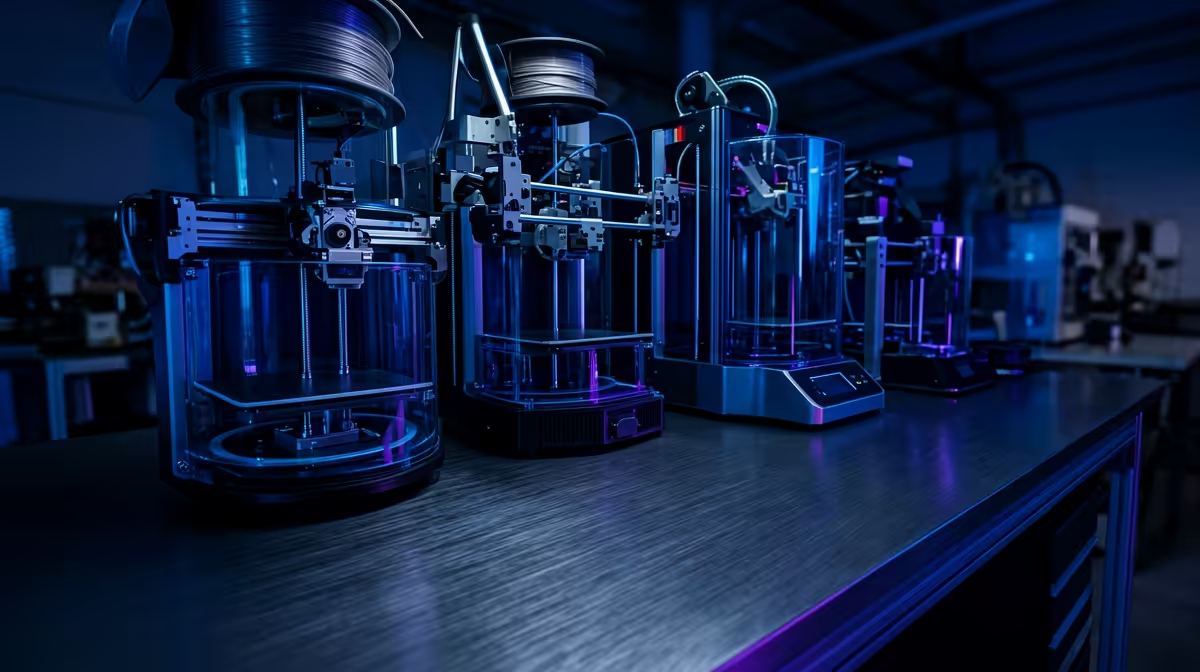
A single industrial-grade FDM machine looks impressive on a spec sheet, yet for most South African workshops it quietly underperforms a row of cheaper ones. 3D printing for business scales best horizontally: several mid-priced printers, networked and running the same job, push out more parts per Rand than one premium unit costing the price of a small car. The maths favours volume, redundancy, and parallel output over a single point of failure.
Quick Answer
Build a print farm of mid-range FDM printers at roughly R8,000 to R15,000 each instead of one industrial machine at R150,000 plus. Five networked printers running in parallel produce five times the throughput, survive one machine failing without halting production, and pay back faster on cost per part. That is the model SA makers and small manufacturers are already proving.
Why Cost Per Part Beats Sticker Price
The number that matters in production is not the price of the printer. It is the cost of each finished part, which folds in machine depreciation, electricity, filament, failure rate, and how many units come off the bed per day. One R150,000 industrial printer with a single nozzle still only lays one bead at a time. Five R12,000 printers lay five beads at once, for less total outlay, and if one drops a print the other four keep going.
That redundancy is the real argument. A solo machine that jams overnight loses you a full shift. A farm absorbs the hit. You can browse the current FDM lineup through the 3D printer range stocked at Evetech to see where the mid-tier price band actually sits before committing capital.
Sizing The First Farm
Start with three identical machines, not one of each brand. Identical printers share the same slicer profiles, the same spare nozzles, the same bed levelling routine, and the same failure modes you learn to predict. A mixed fleet multiplies your maintenance knowledge requirement for no real gain.
Three machines is enough to prove the workflow, smooth out filament logistics, and measure your true cost per part with real numbers rather than a spreadsheet guess. Scale to five or eight once the process is boring and predictable.
Networking And Monitoring
A farm is only a farm if you are not babysitting each printer. Open-source tools like OctoPrint or Klipper with a fleet dashboard let you queue jobs, watch every bed from one screen, and get alerted when a print fails. A single Raspberry Pi or a small mini PC per machine, or one host managing several, turns a shelf of printers into a managed production line.
Camera monitoring matters more than it sounds. A spaghetti failure caught in the first ten minutes wastes a few grams of filament. The same failure caught three hours later has welded itself to the nozzle and cost you a cleaning session.
Power And Placement For SA Workshops
Plan your circuit load. A mid-range FDM printer draws modest power at steady state but spikes when the heated bed warms up. Stagger your bed pre-heats across machines so they do not all pull peak current at the same instant on one wall socket. Keep the farm in a ventilated room: PLA is benign, but ABS and ASA need airflow, and a row of machines generates real heat in a closed Cape Town garage in summer.
Materials, Throughput And Margin
Filament is your consumable cost and your quality lever. Buy in bulk from a consistent supplier so colour and diameter stay uniform across the fleet, because a farm that mixes batches will show it on customer-facing parts. PLA covers most prototypes and display pieces; PETG handles functional parts that flex or live outdoors; ABS and ASA suit parts that take heat or UV.
Throughput is a function of nesting and uptime, not just print speed. Fill the bed. A part that prints in the corner alone wastes the rest of the plate. Group small parts into single jobs so each machine finishes a full bed per cycle rather than one lonely component.
Who This Model Suits
Print farms make sense for makers selling on volume: custom enclosures, tabletop terrain, replacement parts, signage, jigs and fixtures for other workshops, and short-run product manufacturing. If you sell ten of something a week, one printer is a bottleneck. If you sell a hundred, a farm is the only sane answer that does not require industrial capital.
It suits the SA reality especially well, since you sidestep the import cost and lead time of a single heavy industrial unit and instead assemble capacity from machines you can replace locally and quickly. To round out a build, the spares, tools, and add-ons worth keeping on hand sit in the accessories best sellers at Evetech.
Maintenance Is The Hidden Job
A farm lives or dies on uptime, and uptime is a maintenance discipline rather than a feature you buy. Standardise on one nozzle size and keep a drawer of spares, because a clogged or worn nozzle on a busy machine should be a five-minute swap, not a half-day diagnosis. Keep spare hotends, build plates, belts, and a couple of complete spare machines if your volume justifies it, so a failure never stops the whole line.
Track each machine. A simple log of print hours, nozzle changes, and failures per printer tells you which unit is drifting before it ruins a batch. Identical printers make this easy because a fault on one usually warns you about the same wear coming on the others. Schedule bed levelling and belt checks rather than waiting for a print to fail, and the farm rewards you with predictable, boring reliability, which is exactly what production needs.
Calculating Your True Cost Per Part
Work the real number out properly before you scale. Add the printer's price spread over its expected life, the filament weight per part, the electricity per print hour, and a realistic allowance for failed prints, then divide by parts produced. Most makers are surprised that filament and failure rate, not machine cost, dominate the figure once a farm is running. That insight is why bulk filament buying and good support discipline pay back faster than chasing a slightly cheaper printer, and it is the number to revisit every time you add a machine.
Frequently Asked Questions
How many printers make a viable print farm?
Three identical machines is the practical minimum to call it a farm and start measuring real cost per part. It gives you redundancy if one fails and enough parallel output to test your job-queuing workflow before scaling to five or more.
Is a cheap printer reliable enough for production?
Mid-range FDM printers in the R8,000 to R15,000 band are reliable for production when you run identical units and maintain them on a schedule. Reliability in a farm comes from redundancy and consistent maintenance, not from any single machine being flawless.
What software runs a print farm?
OctoPrint and Klipper, often with a fleet management dashboard, let you queue jobs, monitor every printer from one screen, and receive failure alerts. They turn a shelf of separate printers into one managed production line.
Should I buy one industrial printer or several smaller ones?
For most small businesses, several mid-priced printers beat one industrial unit on throughput, redundancy, and cost per part. The exception is parts that demand industrial materials or a build volume no consumer machine can reach.
What materials should a maker farm stock?
Keep PLA for prototypes and display pieces, PETG for functional and outdoor parts, and ABS or ASA for heat and UV resistance. Buy filament in bulk from one supplier so colour and diameter stay consistent across every machine.