Flying a heavy jet on final approach into a stormy Cape Town International... it's a scenario that separates the amateurs from the aces. What's the secret? It’s not just stick-and-rudder skills; it’s superior situational awareness. For pro flight sim pilots, mastering this mental game is everything. It’s about knowing where you are, where you're going, and what might go wrong next. Let's explore some advanced situational awareness techniques to elevate your virtual flying. ✈️
Master Your Instruments: The Core Scan
Before you can look outside, you must have an unbreakable command of what's happening inside. True situational awareness begins with an efficient instrument scan. Pro pilots don't just glance at their screens; they follow a disciplined pattern to gather critical data—airspeed, altitude, heading, vertical speed, and engine parameters. This constant flow of information builds a mental model of the aircraft's state.
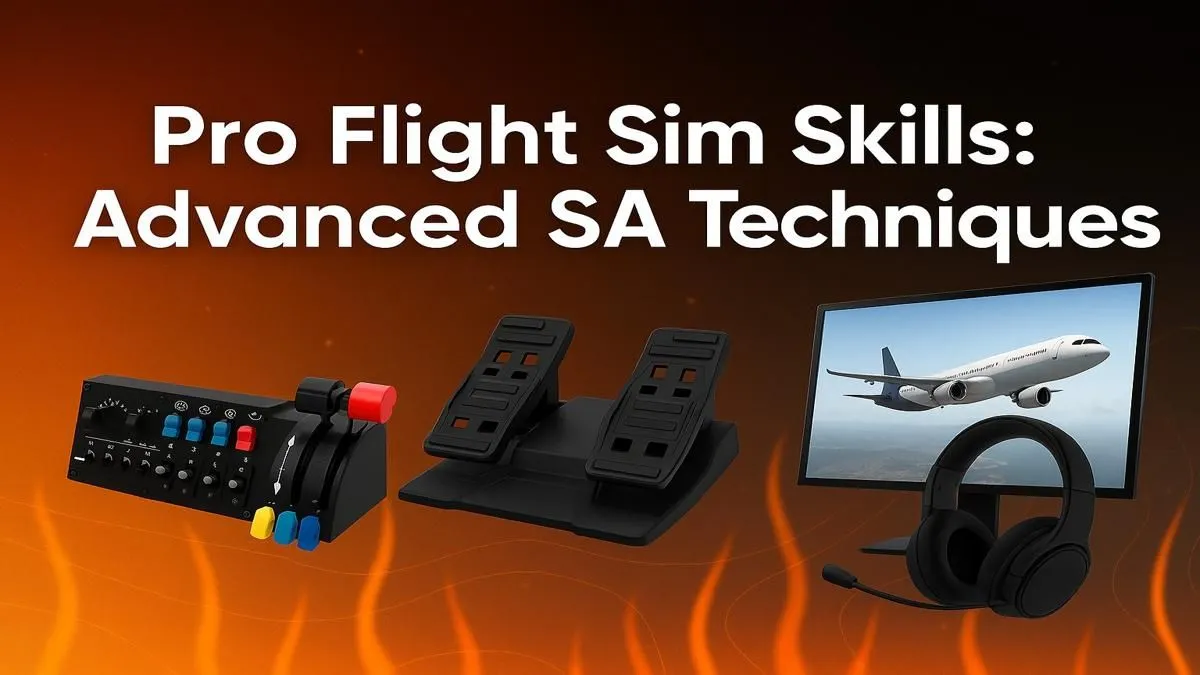
Developing this skill requires practice... and the right hardware. A responsive yoke or a high-quality HOTAS from Thrustmaster provides the tactile feedback needed to translate instrument readings into precise control inputs, making your scan more effective and intuitive.
Expand Your View: Seeing the Bigger Picture
While instruments tell you what your plane is doing, your view outside tells you why. Peripheral vision is key. Are you drifting off the centreline? Is your descent angle looking too steep relative to the runway? A wider field of view dramatically improves your ability to make these judgements.
This is where hardware makes a massive difference. Upgrading to one of the latest immersive curved monitors can wrap the simulation around you, engaging your peripheral vision just like a real cockpit. For the ultimate setup, many pro simmers use a multi-monitor configuration to keep their main flight display front-and-centre while dedicating side screens to maps, charts, or external views. This technique for improving situational awareness is a direct investment in your performance.
Audio Awareness Pro Tip 💡
Don't just rely on your eyes! Configure your sim's audio to give you clear callouts for gear, flaps, and altitude milestones (e.g., "1,000 feet"). Furthermore, learn to recognise the subtle changes in engine noise and wind sounds. These audio cues are a powerful, passive way to maintain situational awareness without needing to look at an instrument.
Cognitive Techniques for Peak Performance
Advanced situational awareness is fundamentally a mental exercise. It's about thinking ahead of the aircraft. Before you even begin your descent, you should be visualising the entire approach: the waypoints you'll cross, the altitudes you need to hit, and the potential for a go-around.
This level of focus, especially on long-haul flights, requires endurance. Fatigue is the enemy of awareness. Ensuring your setup is comfortable is not a luxury; it's a necessity for maintaining peak cognitive function. Investing in an ergonomic gaming chair can prevent the physical discomfort that leads to mental lapses during critical flight phases. Remember to brief your approaches out loud, even when flying solo. This verbalisation reinforces the plan in your mind.
The Right Rig for Ultimate Awareness ✨
Ultimately, all these advanced situational awareness techniques are amplified by a PC that can handle the load without breaking a sweat. A smooth, stutter-free simulation allows your brain to focus on flying, not on troubleshooting lag spikes. When you can run high-fidelity aircraft, complex weather, and detailed scenery at a high frame rate, your immersion is complete.
This is where a purpose-built machine shines. The processing power and graphical fidelity offered by optimised Microsoft Flight Simulator gaming PCs ensure that your hardware is an asset, not a limitation. It allows you to fully implement every technique and fly the aircraft with the precision and awareness of a seasoned professional.
Ready to Upgrade Your Cockpit?
Mastering situational awareness is a blend of skill and the right equipment. A powerful, stable PC is the foundation of an immersive simulation experience. Explore our powerful Microsoft Flight Simulator Gaming PCs and find the perfect rig to take your flying to new heights.