Quick Answer
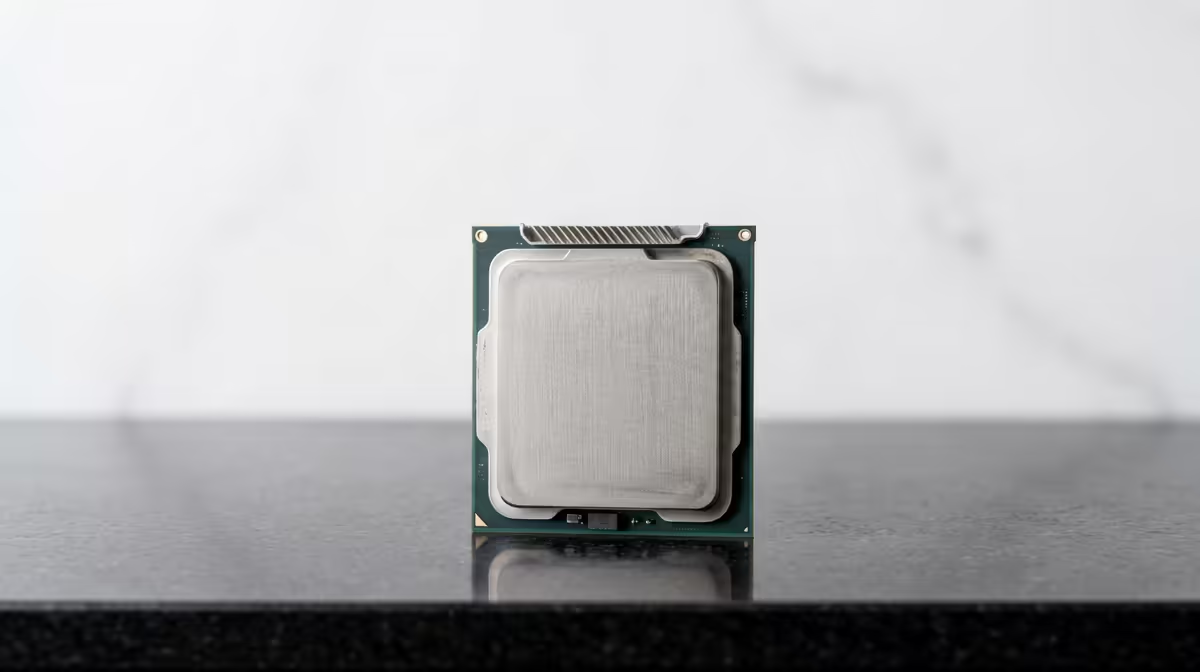
On an Intel Core i3-14100F build you want the XMP profile, not EXPO - EXPO is AMD's equivalent and Intel boards use XMP to apply rated DDR5 speeds. A quality DDR5-6000 kit with an XMP profile costs around R1,600 to R2,200 at Evetech. Enabling XMP in BIOS is a one-click step that unlocks the full 6000 MT/s instead of the 4800 default.
XMP vs EXPO on the Core i3-14100F
XMP (Extreme Memory Profile) is Intel's standard for storing a kit's rated speed and timings, while EXPO is AMD's. Many modern kits ship with both profiles, so an 'EXPO/XMP' kit works fine on your LGA1700 - you simply select the XMP entry in BIOS. Without enabling either, the RAM runs at JEDEC 4800, leaving free gaming performance on the table.
Getting it right in BIOS
Boot into BIOS, find the XMP or 'Memory Profile' option, and select Profile 1 (usually the rated 6000 setting). Save and reboot, then confirm the speed in Task Manager or CPU-Z. Stick to kits on your motherboard's QVL for a guaranteed clean boot, and a 32GB DDR5-6000 kit is the value sweet spot for a Core i3-14100F. If the board fails to post after enabling the profile, clear CMOS and update to the latest BIOS - newer firmware almost always improves memory compatibility on this platform.
FAQ
Should I use EXPO or XMP with a Core i3-14100F?
XMP - it is Intel's profile standard. EXPO is the AMD equivalent, and although dual-profile kits include both, your Intel board applies the XMP entry.
What happens if I don't enable a profile?
The RAM defaults to JEDEC 4800 MT/s, slower than its rated speed. You lose a few percent of gaming performance for no reason, so always enable XMP.
Will any DDR5 kit work on this board?
Most do, but check the motherboard QVL for guaranteed compatibility. A 32GB DDR5-6000 kit around R1,600 to R2,200 at Evetech is the safe, high-value choice.
Core i3-14100F, select the XMP profile (not EXPO) in BIOS to run your DDR5-6000 kit at full speed instead of the 4800 default.