Quick Answer
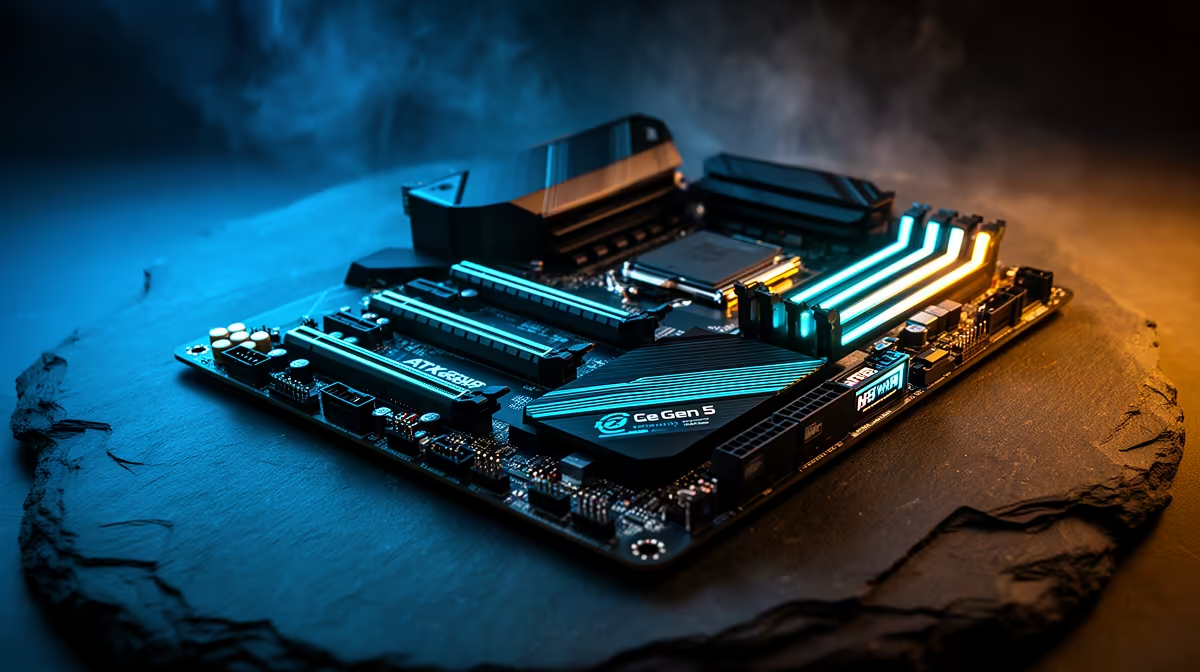
The best motherboard with dual PCIe 5.0 M.2 slots for the Core i5-14600K is the MSI MEG Z790 ACE (R8,000 at Evetech) or the Gigabyte Z790 AORUS MASTER (R6,500) — both Z790 boards offer two PCIe 5.0 M.2 slots, 20+ phase VRMs capable of handling the i5-14600K's 180 W OC draw, and premium connectivity. Each PCIe 5.0 M.2 slot supports SSDs like the Samsung 9100 Pro (~R3,200 per 1 TB) at up to 12,400 MB/s sequential read.
PCIe 5.0 M.2 and the i5-14600K: What's Actually Possible
The Core i5-14600K (LGA 1700) provides one PCIe 5.0 x16 lane for the GPU. PCIe 5.0 M.2 slots on Z790 boards route through the Z790 chipset via the DMI 4.0 x8 interface. The practical effect: both PCIe 5.0 M.2 slots are available and operational, but they share DMI bandwidth with other chipset-connected peripherals. For sustained large file transfers, you'll rarely saturate DMI bandwidth; for random IO gaming loads, there's no bottleneck.
Z790 Boards With Dual PCIe 5.0 M.2 for the i5-14600K
Gigabyte Z790 AORUS MASTER DDR5 (~R6,500): Two PCIe 5.0 M.2 + three PCIe 4.0 M.2. 20-phase VRM. DDR5 required — factor in R1,600+ for a DDR5-6000 kit.
MSI MEG Z790 ACE DDR5 (~R8,000): Two PCIe 5.0 M.2 + three PCIe 4.0 M.2. 24-phase VRM — the strongest on the platform for aggressive OC. Wi-Fi 6E, dual 2.5GbE.
ASUS ROG MAXIMUS Z790 APEX (~R9,500): Two PCIe 5.0 M.2 + multiple PCIe 4.0 M.2. 24-phase VRM. Extreme OC board with dedicated OC features (ProbeIt voltage points, BIOS flashback). Top pick for maximum i5-14600K OC.
Recommended PCIe 5.0 SSDs for the i5-14600K
- Samsung 9100 Pro 1 TB (~R3,200): 12,400 MB/s read, 11,800 MB/s write
- Crucial T705 1 TB (~R2,800): 13,600 MB/s read — fastest PCIe 5.0 SSD currently
- WD Black SN850X as second SSD: Continue using a PCIe 4.0 SSD (R1,350) in one PCIe 5.0 slot — it runs at PCIe 4.0 speed but the platform accommodates it
FAQ
Is it worth buying dual PCIe 5.0 M.2 SSDs for a gaming i5-14600K build?
For gaming specifically, no — game loading time improvements from PCIe 5.0 over PCIe 4.0 are 5–15 seconds at most. The R3,000+ premium per PCIe 5.0 SSD is better spent on a GPU upgrade that directly increases FPS. Dual PCIe 5.0 M.2 makes strong sense for 4K video editors, large dataset researchers, or users who regularly transfer 100+ GB files between SSDs — not for gaming-first builds.
Does the i5-14600K's DMI 4.0 interface bottleneck dual PCIe 5.0 M.2 performance?
DMI 4.0 x8 provides approximately 16 GB/s of total bidirectional chipset bandwidth. Two PCIe 5.0 M.2 SSDs each capable of 12,400 MB/s can theoretically exceed this — but only during simultaneous sustained sequential reads on both drives. In practice, mixed workloads (gaming, browsing, file transfers) never push both drives to maximum simultaneously, making DMI bottleneck a non-issue for real-world use.
What Z790 board is best for an i5-14600K build that might upgrade to an i9 later?
The MSI MEG Z790 ACE's 24-phase VRM and premium power delivery handles the Core i9-14900K (125–253 W) without modification — the same board accommodates the most demanding LGA 1700 CPUs. If you plan a future CPU upgrade, start with an ACE-tier board and a budget CPU now, then upgrade the CPU when prices drop.
.0 M.2 SSDs run significantly hotter than PCIe 4.0 equivalents — the Crucial T705 and Samsung 9100 Pro can reach 70°C+ under sustained writes. Always use the board's provided M.2 heatsinks or add aftermarket M.2 thermal pads to keep drives under 65°C for sustained performance.