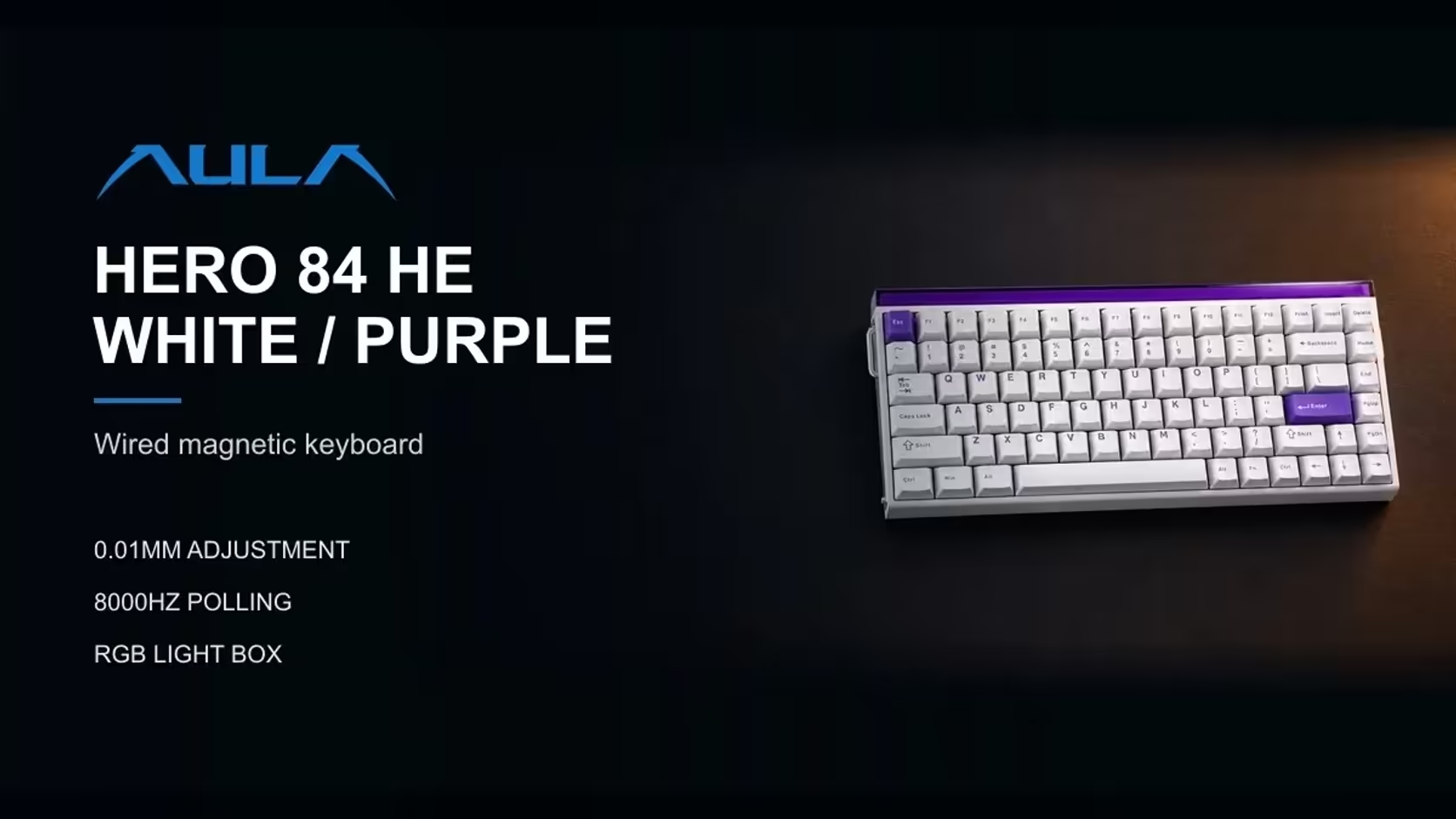
AULA builds two HERO keyboards on almost the same skeleton. Each has 84 keys in a 75% frame, a strip of light across the top edge and magnetic switches you can tune. What separates them is the road each one takes to your PC, so this is really a choice between a cable-only or cordless magnetic 75%, not between two unrelated keyboards.
Quick Answer
Choose the AULA HERO 84 HE if your keyboard never leaves the desk and you want one fewer thing to charge: its angled USB lead is the only way it connects. Choose the AULA HERO 75 HE if you also want cordless links: a 2.4GHz receiver plus Bluetooth that remembers three devices, running from an 8000mAh battery. Both poll at 8000Hz over their main link, both scan keys at up to 128kHz, and both have a 36-LED light box on top. Evetech has the HERO 84 HE at R719 and the HERO 75 HE at R899.
🔌 How each one talks to the computer
This is the section that actually decides the purchase, so start here.
The HERO 84 HE: one lead, one job
The HERO 84 HE ships with an L-shaped cable that runs from a USB-A port on your PC to the USB-C socket on the board. There is no other link. That sounds limiting until you think about what most desktop gamers do: plug the keyboard in once and leave it there for years. With the cable as the only path, the board draws power from the PC, reports at 8000Hz and never asks you to top anything up.
The angled plug is a small but practical detail. It turns the cable sideways as it leaves the board, which helps it lie flat and keeps it out of the way of a monitor stand or a mouse cable.
The HERO 75 HE: three routes to choose from
The HERO 75 HE keeps a USB-C cable but adds two cordless options. Its 2.4GHz receiver matches the wire's 8000Hz, which is the headline feature of the board: going cordless does not cost you report rate. Bluetooth pairs up to three devices and runs at 125Hz, which is plenty for a laptop, a tablet or a work machine, but not the link to game on.
AULA powers those cordless modes from an 8000mAh battery. AULA leaves runtime unrated on this edition, so how often you charge will come down to your lighting and which link you lean on.
🧲 Switches and tuning, where they differ
Both boards use Hall Effect switches, meaning a magnet in each stem and a sensor under it that measures how far the key has travelled. That is what allows the actuation point to move, and it is what makes Rapid Trigger possible. The details differ.
The switches themselves
The HERO 84 HE uses pre-lubed Black King switches, which AULA also names Black Emperor. A press registers at 33gf, and by the end of the 3.4mm stroke the spring pushes back at 53gf. The HERO 75 HE switch depends on colour: the black board gets Stormrise switches and the orange and green boards get Spiritcloud. AULA's Thai distributor rates those two for 60 million presses.
Step size
Both boards let you set actuation anywhere between 0.1mm and 3.4mm. The HERO 84 HE moves through that range in 0.01mm increments. The HERO 75 HE goes finer, in 0.005mm increments. In practice, both are far finer than a finger can reliably separate, so treat this as a small spec-sheet win rather than something you will feel mid-match.
Key modes
The HERO 84 HE page lists Rapid Trigger, plus Mod-Tap, Dynamic Keystrokes and key remapping in its web driver. The HERO 75 HE page goes further, adding SOCD, Toggle, END and Multi-Point Trigger to Rapid Trigger, DKS and Mod-Tap, with live calibration and a key travel display. If a specific mode matters to how you play, check it against each page before you choose.
💡 What is identical on both
Plenty is shared, and none of it should sway the decision.
- Layout: 84 keys in a 75% arrangement, keeping the function row and the arrow cluster.
- Report rate: 8000Hz over the cable on both.
- Scanning: 48kHz when reading the full board, rising to 128kHz when one key is read alone.
- Light box: a 36-LED RGB strip across the top edge, controlled separately from the south-facing per-key backlight.
- Hot-swap: keycaps and magnetic switches come out without soldering, and mixed switch setups are supported.
- Dampening: five layers inside the case on each.
- Mac support: Fn + S puts either board into Mac mode and Fn + A returns it to Windows.
Because the layouts match, keycap sets and muscle memory carry across. Someone who starts on the wired board and later wants a cordless one for a second desk will find the keys exactly where they left them.
🎨 Finish, colour and the rest of the decision
The HERO 84 HE comes in one finish, white with purple. The HERO 75 HE comes in black, orange and green, and remember that colour also chooses its switch. Anyone who wants a white desk setup has, in effect, already picked the HERO 84 HE.
A few questions help settle the rest:
- Does the keyboard ever move? If it lives on one desk for good, the HERO 84 HE covers everything you need and removes charging from your routine.
- Do you share a keyboard between machines? Bluetooth pairing for three devices is the HERO 75 HE's real advantage for a PC plus a laptop setup.
- Is cable clutter the issue? The HERO 75 HE's receiver gives you a clear desk without dropping below 8000Hz.
- Do you want the longest list of key modes? The HERO 75 HE page names more of them.
Both sit in Evetech's gaming keyboards range, and both carry a 2 Years Local Warranty, the cover AULA's magnetic boards get through Evetech. Because the switches on either board can be pulled and replaced, it is worth browsing keyboard switches too, keeping in mind AULA's advice to stay within the same magnetic switch family. Pricing for both boards will be on each product page.
Frequently Asked Questions
Which HERO board suits a desk that never changes?
The HERO 84 HE. It connects by cable only, so there is no battery to manage and nothing to pair.
Is the HERO 75 HE slower when it runs cordless?
Not on the receiver. AULA rates its 2.4GHz link at 8000Hz, the same as the cable, while Bluetooth runs at 125Hz for everyday devices.
Can I tell the 0.01mm and 0.005mm steps apart?
Very unlikely. Both are much smaller than the movement a finger can control on purpose, so the switch feel and your chosen actuation point matter far more.
Do the two boards share a switch?
No. The HERO 84 HE uses Black King switches, and the HERO 75 HE uses Stormrise on black and Spiritcloud on orange and green.
Will keycaps from one fit the other?
Both use an 84-key 75% layout, so a set sized for one should suit the other. Check the set's own layout list before buying.
Does the light box work the same way on each?
Yes. Each has a 36-LED strip along the top with its own modes, colours, speed and brightness, apart from the key lighting.
What cover comes with them?
The same on both, and claims for either board go through Evetech.
Settled on cable or cordless?
Compare both HERO boards against other magnetic 75% layouts in Evetech's gaming keyboard range, then check each product page for pricing.