Ever stared at your OLED screen, lost in the perfect, inky blacks of a space sim or the blindingly vibrant colours of a fantasy world, and thought... how? It’s not magic, but it’s close. It’s a breathtakingly precise journey from simple materials to the stunning display on your desk. We’re pulling back the curtain on the OLED manufacturing process, revealing exactly how your favourite gaming portal is born. Prepare to be amazed. 🔧
What Makes an OLED Screen So Special?
Before we dive into how they're made, let's have a quick refresher. Unlike traditional LCD/LED screens that use a single, big backlight that shines through a panel of pixels (like a projector), each tiny pixel in an OLED (Organic Light-Emitting Diode) screen creates its own light.
When a pixel needs to be black, it simply switches off. Completely. No backlight bleed, no murky greys... just pure, perfect black. This simple-sounding difference is why the OLED manufacturing process is so radically different and complex.
The Intricate OLED Manufacturing Process: A Step-by-Step Guide
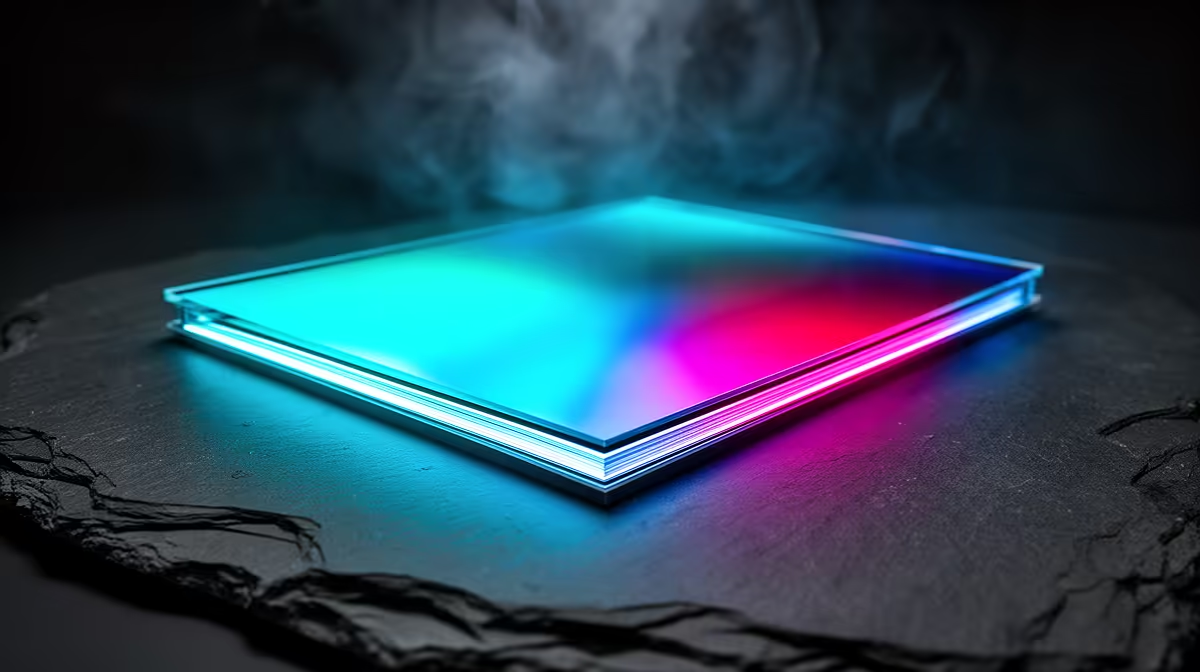
Think of building an OLED screen like constructing a microscopic city of lights on a sheet of glass. Each building (pixel) has its own power supply and can light up in red, green, or blue. Here’s how that city gets built.
Step 1: The Foundation (Substrate Preparation)
Every screen starts with a foundation, or substrate. This is usually a highly polished sheet of glass or, increasingly, a flexible plastic polymer. This plastic base is the secret behind those incredible immersive curved monitors that wrap you in the game, allowing the screen to bend without breaking. The substrate is meticulously cleaned to be free of any dust or imperfections, as a single speck could ruin thousands of pixels.
Step 2: Building the 'Grid' (Backplane Fabrication)
Next, manufacturers build the electrical grid for our pixel city. This is the backplane, a complex network of Thin-Film Transistors (TFTs) layered onto the substrate. Each tiny transistor acts as a switch, telling an individual sub-pixel when to turn on, how brightly to shine, and when to switch off. This intricate wiring is fundamental to the function of all modern PC monitors, but for OLEDs, the precision required is on another level.
Step 3: The Magic Layer (Organic Material Deposition) ✨
This is the heart of the OLED panel production. Using a technique called Vacuum Thermal Evaporation (VTE), the organic light-emitting materials are deposited onto the backplane. Inside a massive vacuum chamber, these materials are heated until they become a gas. This vapour then settles onto the substrate through a stencil-like screen called a fine metal mask.
This process is repeated for the red, green, and blue organic layers. The alignment of this mask has to be perfect... we're talking sub-micron accuracy. It's this incredible precision that allows for the pixel density needed for today's high-resolution 4K monitors.
Step 4: Sealing the Deal (Encapsulation)
The organic materials that make OLEDs so brilliant are also very sensitive. They degrade quickly when exposed to oxygen or moisture. To protect them, the entire structure is sealed off in a process called encapsulation. A thin layer of glass or plastic is placed on top and sealed around the edges, creating an airtight barrier that ensures the monitor has a long and vibrant life.
OLED Care Pro Tip ⚡
OLED burn-in is much less of a concern on modern panels, but it's smart to take precautions. Use a rotating wallpaper, set your taskbar to auto-hide, and enable your screen's pixel-shifting or screen-saver features. This prevents static images from "imprinting" on the organic materials over thousands of hours, keeping your display pristine.
Step 5: Final Assembly and Testing
The massive sheet of processed substrate, called the "mother glass," is now cut into individual screen sizes. Each screen is then bonded with driver circuits, control boards, and polarising films. Finally, every single one of the quality gaming monitors that leaves the factory undergoes rigorous testing to check for dead pixels, colour accuracy, and uniform brightness, ensuring it meets the highest standards.
Why Understanding How OLED Screens Are Made Matters
Knowing the complexity behind the making of an OLED display helps you appreciate why they deliver such a premium experience.
- Perfect Blacks: Because pixels can turn off completely.
- Incredible Contrast: The difference between the brightest white and the darkest black is virtually infinite.
- Faster Response Times: With no liquid crystals to move, pixels respond almost instantly... perfect for competitive gaming.
- Thinner Designs: The lack of a backlight allows for ultra-slim profiles, which is how we get amazing tech like compact portable monitors.
Is an OLED Monitor Worth It for a South African Gamer? 🚀
Absolutely. The meticulous OLED manufacturing process results in a display technology that is, simply put, superior for gaming immersion. The vibrant colours make worlds feel more alive, and the perfect blacks add incredible depth and realism to darker scenes. While the technology is advanced, fierce competition means you can often find some of the best PC monitor deals in South Africa right here at Evetech.
For anyone serious about visual quality, the investment in an OLED is one you won't regret.
Ready to See the Difference for Yourself?
Understanding the science behind OLED just makes the visual payoff even sweeter. From inky blacks to explosive colours, nothing beats an OLED for pure gaming immersion. Explore our incredible range of gaming monitors and find the perfect screen to upgrade your setup.