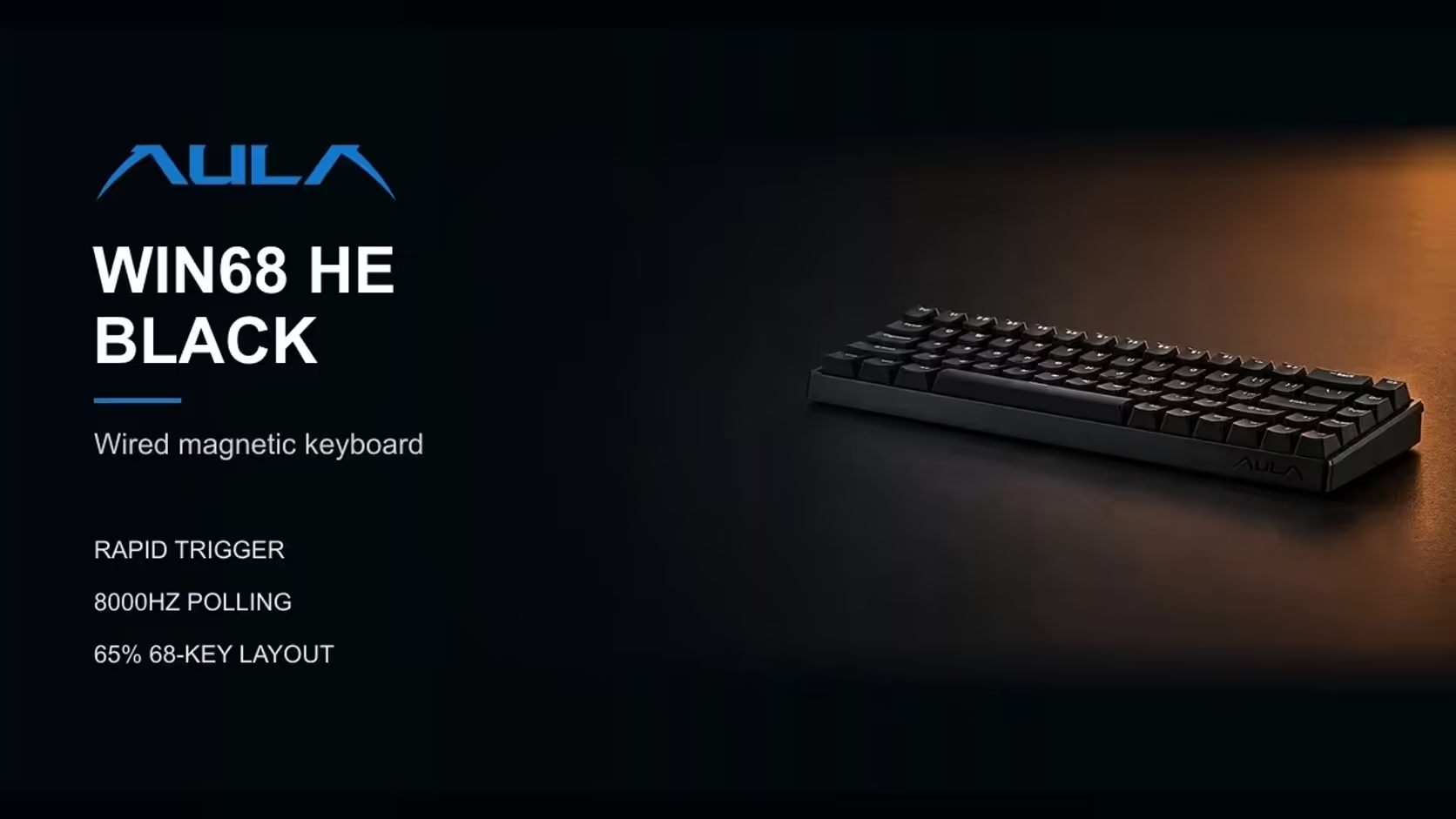
Put the two boards side by side and you would struggle to tell them apart from across the room. Both are compact 65% layouts with 68 keys, both plug in over a detachable USB-C cable, and both report to the PC at up to 8000Hz. The real story of WIN68 HE vs WIN68 MAX sits under the keycaps and inside AULA's web driver, where the two editions part ways on switch feel and on how much each key can be told to do.
Quick Answer
The AULA WIN68 HE runs Gray Wood magnetic switches that trigger at 32gf and offers Rapid Trigger with per-key actuation. The AULA WIN68 MAX swaps in Wing Chun switches at 36gf, rates its Rapid Trigger at 0.01mm and layers five modes on top: SOCD, Mod-Tap, DKS, Rapid Switch and Toggle. Pick the HE for a lighter, simpler magnetic board and the MAX if you want every competitive key mode in the driver. At Evetech the HE costs R449 and the MAX R699.
🧲 Gray Wood and Wing Chun: four grams and a finer trigger
Both switches are Hall Effect designs. Instead of two metal leaves touching, a magnet in the stem moves past a sensor, and the board reads how far down the key has travelled. That is what makes adjustable actuation possible.
The difference starts with force. A Gray Wood switch in the HE registers at 32gf and reaches 50gf at the floor. The Wing Chun switch in the MAX asks for 36gf and tops out at 49gf. Four grams sounds tiny, yet fingers notice it over a long session: the HE feels more eager at the top of the stroke, while the MAX starts firmer and climbs more gently to the bottom.
Travel is identical. Both quote 3.4mm total travel with a tolerance of 0.1mm either way, so neither board is a short-throw design. What changes is how precisely that travel can be carved up:
- On the MAX, AULA lets you set actuation anywhere from 0.1mm to 3.4mm, and rates Rapid Trigger precision at 0.01mm.
- On the HE, actuation and release points are adjustable per key and Rapid Trigger is there, but AULA publishes no precision figure and no actuation range for it.
That matters if you shop by specification sheet: the MAX gives you numbers to plan around, while the HE gives you the feature without the published fine print.
Where zero dead zone fits
The MAX page also lists a dead zone that can be set to zero. A dead zone is a small slice of travel at the top where the board ignores movement, so a finger resting on a key does not trigger it. Removing it means the key responds across its whole travel. The HE page does not list this option, so treat it as a MAX feature.
🎛️ The driver gap: five modes the HE leaves out
Both boards are configured in AULA's web driver, which runs in a browser with nothing to install. AULA states the driver supports Windows only. On the HE, it handles key remapping, macros, lighting and Rapid Trigger settings. On the MAX, the same tool opens up five more modes.
SOCD decides what happens when two opposite keys are held together, such as strafe left and strafe right. Rather than both cancelling out, the board resolves the conflict so one direction wins.
DKS lets one key send different actions at different depths of the same press, which only makes sense on a switch that reports its position continuously.
Mod-Tap gives a key one job on a quick tap and another when held, a handy trick on a 68-key board where space is tight.
Toggle turns a key into a latch, so one press holds an action on until the next press.
Rapid Switch sits alongside SOCD in the MAX's list of competitive modes and is set in the same driver.
The MAX also exposes seven polling levels up to 8000Hz, plus a scan rate AULA quotes at 4kHz across the full board and up to 32kHz for a single key. The HE simply runs at 8000Hz over its cable, without published steps.
Whether these modes are allowed depends on the game. Some competitive titles and events have ruled on SOCD-style inputs and some have not, and those rules change. If you play ranked or in tournaments, read the current rules for that specific game before you switch a mode on.
⚙️ The parts they share, and the parts only one page lists
Strip away the switches and the driver and you are left with a lot in common. Both editions are 65% boards in an ANSI US arrangement: letters, number row and arrow keys stay, while the function row and some navigation move onto Fn combinations. Both are hot-swappable, so switches come out and go back in without a soldering iron, and the MAX page adds that its keycaps are plug and play too. Both carry per-key south-facing RGB in about 16.8 million colours.
Looks differ a little. The HE comes in black and ships with a WIN68 ribbon in the box. The MAX is finished in black and red, with its ribbon on the side of the board.
A few details appear on only one page, and it pays to read them that way rather than assume the other board matches:
- The HE lists Poron sandwich foam, a bottom foam layer, a thickened plastic shell and a metal positioning plate. The MAX page does not describe its internal build.
- The HE box holds the board, a USB cable, a keycap puller and two spare magnetic switches along with the ribbon. The MAX page does not list its box contents.
- The MAX has a Mac mode: holding Fn with S for five seconds swaps the Windows and Alt keys, and Fn with A switches back. The HE page does not mention one.
If any of those points decides your purchase, check the live product listing on Evetech before you commit rather than filling the gap with a guess. You can compare both next to the rest of the range in the gaming keyboards category.
🧭 Choosing by how you actually play
Ask which of the MAX's extras you would actually switch on during your opening week with the board.
If the answer is none, the HE makes more sense. Its lighter Gray Wood switch suits someone moving over from a membrane or standard mechanical board, and Rapid Trigger alone changes how quickly you stop and change direction in a shooter.
If you play ranked shooters or anything where opposite directions get pressed in quick succession, the MAX earns its place. SOCD, the 0.01mm rating, the zero dead zone and adjustable polling are tools for consistency on fast inputs, and Mod-Tap and DKS pack more actions onto a small layout.
Switch feel is the tiebreaker. Because both boards are hot-swappable, the switch is not a permanent decision, and browsing the keyboard switches on offer shows how wide the choice is once you start experimenting. Stick to magnetic switches on either WIN68, since the sockets are built around magnet sensing.
Evetech lists both editions under the same 2 Years Local Warranty, so the cover does not tilt the decision either way.
Frequently Asked Questions
Which of the two boards can resolve opposite key presses?
Only the MAX. SOCD sits in its driver along with DKS, Mod-Tap, Toggle and Rapid Switch, while the HE keeps to Rapid Trigger and per-key actuation.
Is the switch weight difference noticeable in play?
Slightly. The HE's Gray Wood switch registers at 32gf against 36gf for the MAX's Wing Chun, so the HE feels a little lighter at the top of each press.
Do both boards poll at the same rate?
Both reach 8000Hz over USB-C. The MAX adds seven selectable polling levels in the driver, which helps if a busy PC needs a lower setting.
Does the HE have a published Rapid Trigger precision?
No. AULA rates the MAX at 0.01mm and leaves the HE without a precision figure, although per-key actuation and Rapid Trigger are both present.
Can a Mac run either board?
The MAX has a Mac mode that swaps the Windows and Alt keys. AULA states its web driver is Windows only, so tuning still needs a Windows PC.
Could I fit Wing Chun switches to the HE later?
Both boards are hot-swappable for magnetic switches, but AULA does not publish a switch compatibility list, so confirm a specific swap before buying extra switches.
Ready to choose your WIN68?
Line up both editions against other compact magnetic boards in Evetech's gaming keyboard range and decide which switch and mode set fits your game.