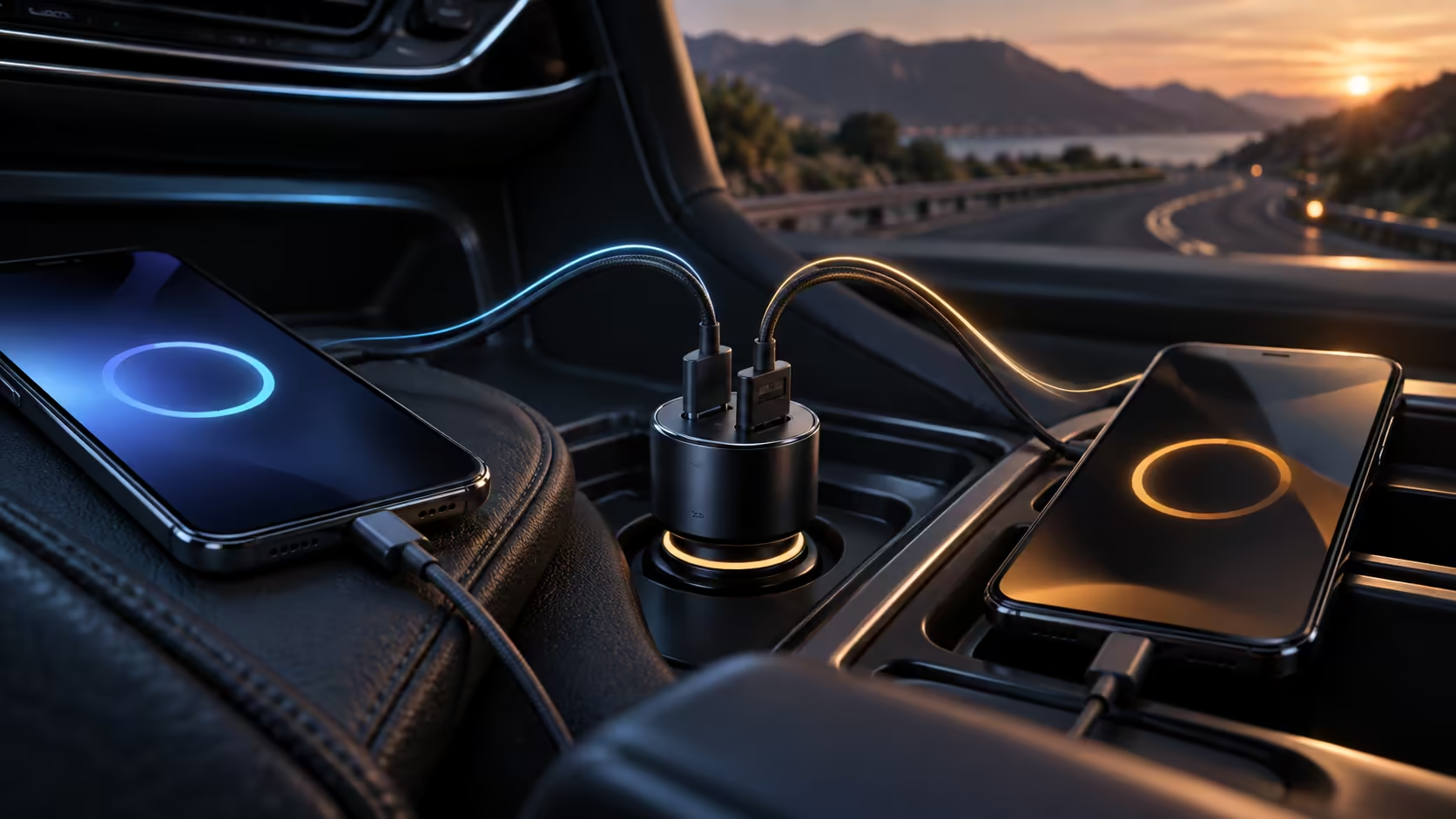
Two ports on one car charger sound like double the hardware, but underneath the shell there is usually only one power supply doing the actual work. Building it that way is not a shortcut; it is the sane engineering choice once you look at how rarely both ports actually run flat out at the same time.
Quick Answer
A shared-power design means one internal converter, not two, feeds both output ports, so their combined draw is capped by what that single converter can produce rather than by adding each port's individual rating together. On Anker's two-port unit each side can reach its full figure alone, 30W with PPS on USB-C or 22.5W on USB-A, and both settle to 12W apiece the moment they are drawing together. It costs R349.
🛠️ Why nobody builds it the expensive way
A converter sized to give both ports their individual maximum at the same time would need to handle close to 52.5W continuously, which means bigger components, more heat to shed inside a small plastic shell, and a higher bill of materials for a scenario that happens far less often than a single device charging alone.
Most car charging sessions involve one phone, one port, most of the time. Sizing the internal converter for the common case, and letting it split fairly when a second device joins in occasionally, is the same trade every compact multi-port charger, laptop dock or USB hub on the market makes. It is not unique to one brand; it is how small, affordable power electronics get built everywhere.
🔌 How the split gets decided in practice
The negotiation runs at the protocol level, invisible to the driver. Each port talks to whatever is plugged into it using standard USB Power Delivery, and the charger's internal controller watches total demand across both sides and adjusts what each port is allowed to offer as that demand changes.
This is a live, continuous process rather than a one-time decision made at plug-in. A phone drawing close to a 30W allowance on its own can see that figure step down toward 12W within moments of a second device connecting elsewhere on the same charger. The reverse is equally true: remove the second device and the remaining phone's allowance climbs back up almost immediately, because the shared budget the controller is managing has just grown.
📱 Comparing it to a charger you already know
A laptop's USB-C dock behaves the same way for the same reason: several downstream ports, one upstream power brick, and a controller dividing what is available among whatever is plugged in at that moment. Nobody expects a four-port dock to give every connected device its individual maximum simultaneously, because the alternative would mean an oversized, overpriced brick for a case that rarely happens.
A power bank sidesteps the whole trade-off for a device that always needs its own supply, a dashcam that never gets unplugged, since it draws from its own reserve instead of adding a third claim to the car charger's shared converter. Anyone running several always-on gaming accessories off one 12V socket meets the same shared-budget arithmetic, whichever device sits behind the plug.
🕰️ Where this design came from
Car chargers were not always this clever. The original cigarette-lighter USB adapters offered a single fixed 5V output and no negotiation of any kind, because nothing on the market yet asked for more. Adding a second port to those early designs was genuinely additive, since splitting a fixed, low-current supply between two low-draw devices barely stressed the converter either way.
Modern phones changed that arithmetic entirely by asking for far more current than those early designs were ever built to provide, which is exactly why a shared, negotiated converter replaced the old fixed-voltage approach. The negotiation and the sharing are two sides of the same upgrade: once devices started asking for meaningfully different amounts of power depending on the model, a charger needed both a way to detect what each one wanted and a way to fairly divide a single, larger supply between however many are plugged in at once.
🔍 What to check on a spec sheet before buying
A trustworthy listing states three figures separately: each port's individual maximum, the combined total when both are active together, and whether Power Delivery with PPS is genuinely present rather than implied by a wattage number alone. A unit stating 30W and 22.5W solo but only 24W combined is telling you the real story in one line; a listing that quotes only the two solo numbers and never states a combined one is hiding the figure that matters most to anyone regularly charging two devices at once.
Comparing chargers on that combined figure, rather than on the bigger of the two solo numbers printed in large type, is the single most useful habit for judging whether a given unit actually suits a household that regularly uses both ports rather than one.
Frequently Asked Questions
Is a shared-power charger a sign of a cheaper design?
No. It is standard practice across nearly all compact multi-port chargers and hubs, because sizing a converter for both ports' simultaneous maximum would add cost and heat for a scenario most sessions never reach.
Does the split happen instantly when a second device connects?
Within moments. The controller recalculates what each port can offer as soon as it detects a change in total demand, without any input from the driver.
Can I avoid the split by using two separate single-port chargers instead?
Only if each one plugs into a genuinely separate 12V socket. Feeding two single-port chargers off one socket through a cheap splitter runs straight back into the same underlying supply ceiling as a dual-port unit, just with an extra connector to fail.
Does a laptop charging dock split power the same way?
Broadly, yes. Any device offering several downstream ports from one upstream supply has to divide that supply's output among whatever is connected, following the same logic.
Will the charger ever refuse to charge a second device rather than sharing power with it?
No. A well-designed shared-power charger always keeps both ports functional; it lowers what each one can offer rather than cutting a port off entirely once a second device joins in, so nobody is left with a dead socket for having plugged in second.
Ready to fit a charger that suits how many devices actually share your car?
Have a look at the car charger range before deciding how many ports you need.