Quick Answer
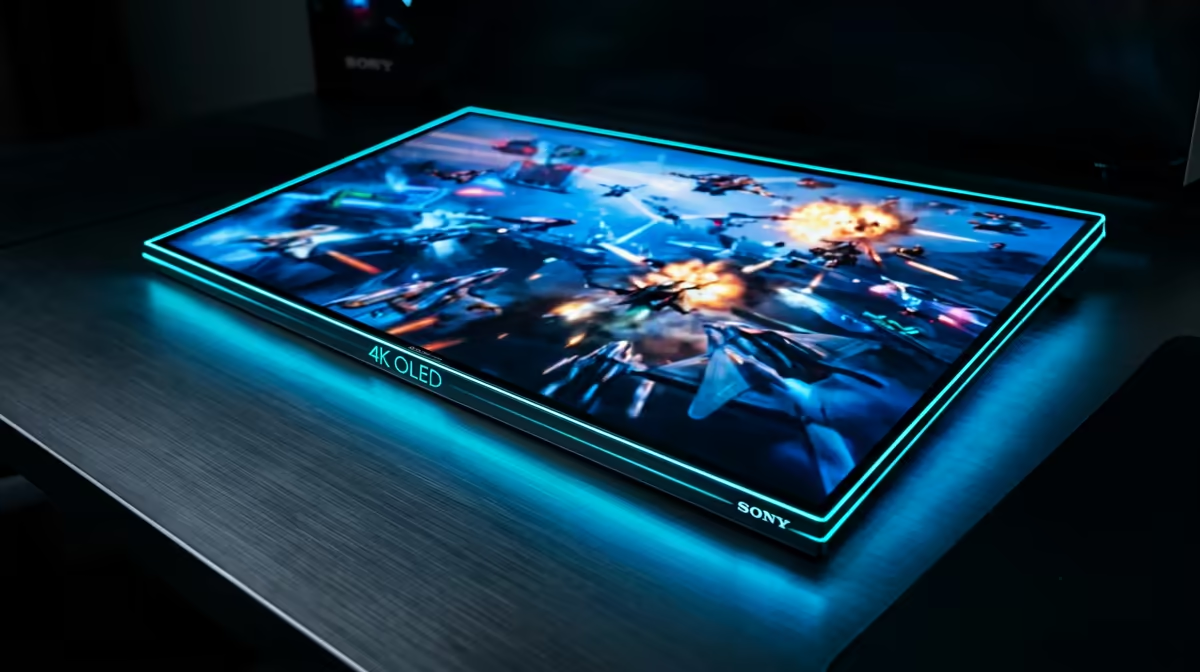
Kempton Park gamers after an OLED gaming monitor should order through Evetech, where 27-inch QHD OLED panels are currently stocked from around R9,500 and 34-inch ultrawide OLED options reach above R15,000. OLED delivers 0.03 ms response, true-black contrast, and 120–240 Hz refresh — the measurable upgrade over IPS for fast gaming and immersive single-player titles.
OLED vs IPS: The Performance Gap at 27 Inches
A 27-inch IPS monitor at 165 Hz typically measures 1–4 ms GTG response and 300–500 nits brightness. An OLED panel at the same size hits 0.03 ms response and 1,000+ nits peak brightness (HDR burst), with infinite contrast ratio from true black pixels. In fast-paced FPS games, OLED's response advantage reduces motion blur to near zero, and the contrast makes enemies visible in dark areas that IPS panels wash out. The price premium is R4,000–R7,000 over comparable IPS — significant, but the gap is real.
Burn-In Risk: Real but Manageable
OLED pixel wear (often called burn-in) from static interface elements is a legitimate concern for gaming monitors. Modern gaming OLEDs include pixel refresh cycles, logo brightness reduction, and built-in pixel-shift features that significantly reduce the risk. Using Windows taskbar auto-hide and varying content types prevents static element exposure. Current gaming OLED technology shows burn-in only after thousands of hours of static content under stress test conditions — practical gaming use rarely approaches the threshold.
GPU Pairing for 1440p OLED
An RTX 4060 Ti or RX 7800 XT handles 1440p OLED at 80–100 fps in demanding titles, sufficient for 120–165 Hz utilisation. For consistent 240 Hz in demanding games, an RTX 4070 or above is the recommended pairing. Confirm the monitor uses DisplayPort 1.4 (with DSC compression) or HDMI 2.1 for full-resolution 240 Hz output.
FAQ
Is an OLED gaming monitor worth it over IPS for gaming?
For competitive FPS and visually immersive titles, OLED's advantages — 0.03 ms response, true blacks, and peak HDR brightness — are genuine and visible. At current prices above R9,000, it's a worthwhile upgrade if your GPU can drive 1440p at high fps. Below R7,000, a quality IPS is the better value.
How do I prevent burn-in on an OLED gaming monitor?
Enable the monitor's built-in pixel refresh cycle (typically runs when the screen is powered off), use Windows taskbar auto-hide, and avoid leaving static screens paused for extended periods. Modern gaming OLEDs include aggressive burn-in reduction features that weren't available in early OLED TV panels.
What resolution and refresh rate do OLED gaming monitors come in?
Most 27-inch OLED gaming monitors ship in QHD (2560x1440) at 165–240 Hz. 34-inch ultrawide OLED panels typically run 3440x1440 at 165–175 Hz. 4K OLED monitors are available above R15,000 and suit RTX 4080/4090 GPU pairings.
OLED monitor's built-in pixel refresh cycle — it typically runs for a few minutes after the monitor powers off and significantly reduces static-element pixel wear risk over years of use. Never disable this feature.