



SecureGrip Vent Clip Mounts: Understanding the Clamp Mechanism
Discover how SecureGrip vent clip mounts provide superior stability for your smartphone. Learn the mechanics behind the clamp and why it matters for your daily drive. 📱🚗
Read moreDeciding on a USB vs XLR mic for streaming can be tough. 🎙️ USB offers plug-and-play simplicity, perfect for beginners, while XLR provides superior audio quality and future-proofing for pros. We break down the costs, setup, and performance to help you choose the best mic. 🚀
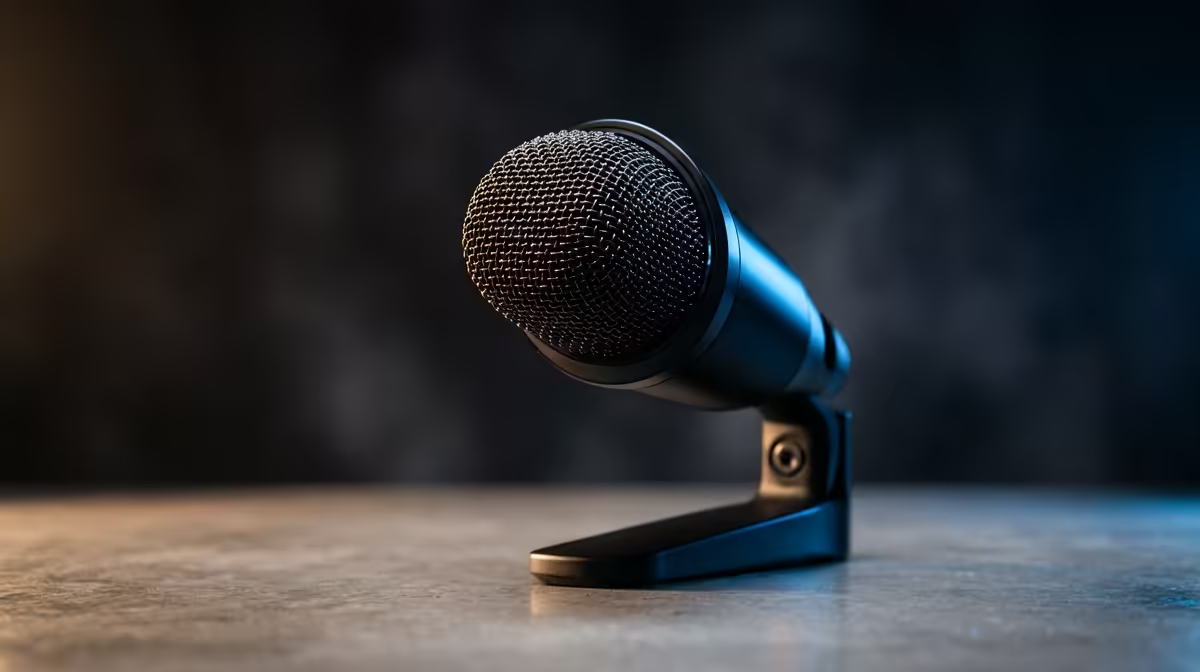
So, your gameplay is top-tier and your commentary is fire, but your audience says you sound like you're broadcasting from a tin can in a tunnel. Sound familiar? For South African streamers, choosing the right microphone is a massive step up. The biggest debate always comes down to this: USB vs XLR mic for streaming. It’s not just about tech specs; it’s about your budget, your space, and your ambition. Let's break it down.
A USB mic is the definition of convenience. It’s an all-in-one solution: the microphone capsule, the preamp (which boosts the signal), and the analogue-to-digital converter are all housed in one sleek unit. You simply plug it into your computer’s USB port, your PC recognises it, and you’re ready to go live. It's the perfect starting point for anyone serious about upgrading from a headset mic without getting tangled in cables.
For most aspiring streamers in Mzansi, a quality USB mic is the most logical first step. They deliver excellent audio quality for their price, making them a fantastic value proposition. You can find brilliant options from brands like Corsair that offer crisp, clear sound right out of the box.
An XLR mic is what you’ll find in professional recording studios, radio stations, and the setups of top-tier streamers. Unlike its USB cousin, an XLR mic only captures the sound. It sends an analogue signal through a thick, three-pin XLR cable to a separate piece of hardware, typically an audio interface or a mixer. This interface then converts the signal to digital and sends it to your PC.
This modular approach is the XLR mic's greatest strength. It gives you immense control over your sound—you can adjust gain, add effects, and mix multiple audio sources on the fly. While the initial setup is more complex and costly, the potential for broadcast-quality audio and future upgrades is unmatched. It's part of a bigger ecosystem of essential streaming gear.
No matter which mic you choose, placement is key. Position it about 15-20cm from your mouth, slightly off to the side to avoid harsh 'plosive' sounds (like 'P' and 'B'). A good pop filter is a non-negotiable part of your setup for clean, professional audio.
Let's put them side-by-side to see which streaming mic is right for you.
Winner: USB There's no contest here. A USB mic is the champion of simplicity. Plug it in, select it as your audio device in OBS or Discord, and you're golden. An XLR setup requires an audio interface, at least two cables (XLR and USB for the interface), and driver installation. It’s not rocket science, but it’s a definite learning curve.
Winner: USB A solid entry-level USB streaming mic can be found for under R2,000. An XLR setup requires you to buy the mic and an audio interface, which can easily push the starting cost to R3,000 or more. For those just starting out, the value of a USB mic is hard to ignore.
Winner: XLR While high-end USB mics sound fantastic, XLR microphones generally offer superior sound quality. They often have better components and dynamic range. More importantly, the audio interface gives you granular control over your sound. You can fine-tune your voice to perfection, which is a significant advantage for a professional-sounding stream. A great voice needs to be paired with great visuals, so don't forget a crystal-clear webcam to complete the package.
Winner: XLR With a USB mic, what you buy is what you get. If you want to upgrade, you have to replace the entire unit. With an XLR setup, every component is modular. You can start with a budget-friendly mic and interface, then upgrade just the microphone later, or add a more powerful mixer. This scalability is a huge plus for streamers with long-term ambitions. You can even enhance your setup's vibe with cool ambient lighting from Cololight for that pro look. ✨
The USB vs XLR mic debate doesn't have one right answer... only the right answer for you.
🚀 Choose a USB Mic if: You're a new or intermediate streamer, you value simplicity and a quick setup, and you're working with a tighter budget. You want great audio without the technical hassle.
🔧 Choose an XLR Mic if: You're serious about achieving the best possible audio quality, you enjoy tweaking settings for the perfect sound, and you want a setup that can grow with your channel.
Ultimately, both options can make you sound amazing. The key is to pick the one that fits your current needs and future goals.
Ready to Sound Like a Pro? Whether you're Team USB or Team XLR, crystal-clear audio is non-negotiable. The right mic makes all the difference. Explore our massive range of streaming essentials and find the perfect microphone to make your voice heard across South Africa.
For pure audio quality and future upgrade options, yes. XLR mics capture a wider frequency range, offering richer sound, but require an audio interface and more setup.
No, you do not. USB microphones have a built-in converter and connect directly to your PC, making them a simple plug-and-play solution for beginner streamers.
The main advantage is simplicity. USB mics are easy to set up, affordable, and connect directly to your computer, making them the best choice for new streamers or those on a budget.
An entry-level XLR setup in South Africa, including the mic, an audio interface, and a cable, typically starts from R2500 and can go up significantly for pro-grade gear.
It depends. Dynamic XLR mics do not require phantom power, but condenser XLR mics, which are popular for streaming, do need it. Most modern audio interfaces provide this.
If you're serious about improving your stream's audio quality and want more control and flexibility for future upgrades, upgrading from USB to XLR is a worthwhile investment.
For budget-conscious streamers, a high-quality USB mic often provides the best value, offering great sound without the added cost of an audio interface and cables.
Most professional streamers use an XLR condenser or dynamic microphone, like the Shure SM7B or Rode Procaster, connected through an audio interface for maximum quality and control.
Discover how SecureGrip vent clip mounts provide superior stability for your smartphone. Learn the mechanics behind the clamp and why it matters for your daily drive. 📱🚗
Read more
For a stable RTX 5070 starting point, use 1440p, the High preset, Ray Tracing Medium and DLSS Balanced, then measure the base frame rate before adding Frame Generation. Path tracing is a separate showcase mode, not the default.
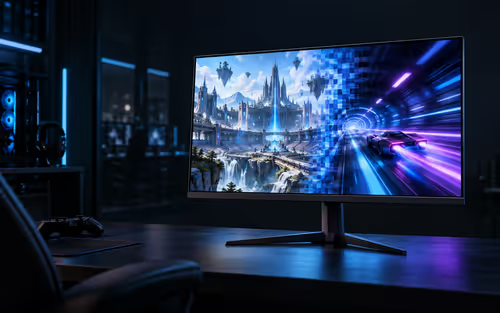
HKC's 27-inch Shield 27Q560 runs QHD at 560Hz or 1280 x 720 at up to 1060Hz. The headline rate is specialised: resolution, sustained frame rate, ports and eventual South African support decide whether it is useful.
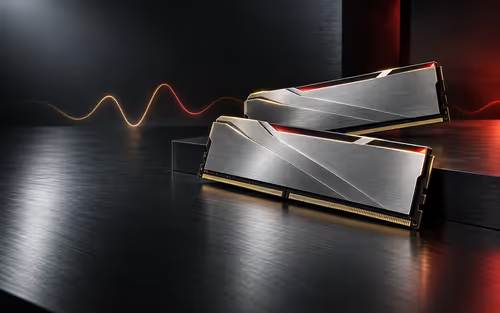
G.Skill's Trident Z5 Royal NeoX range pairs DDR5-6000 with timings from CL36 down to CL26 and adds an AMD EXPO ULL profile. Buyers still need a supported CPU, motherboard and BIOS before treating the lowest timing as guaranteed.
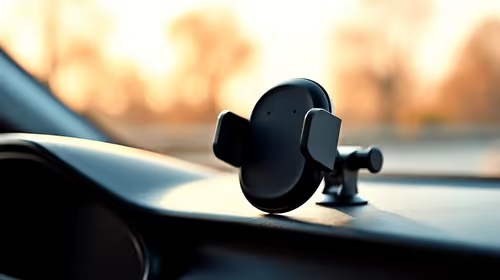
Stop struggling with bulky mounts. We break down the essential compact car phone holder features that ensure stability, safety, and ease of use for your daily commute. 🚗💨 Find your perfect fit.
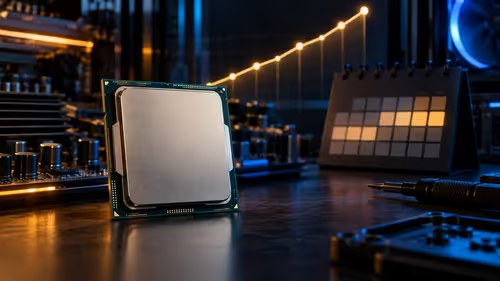
Industry reports point to another roughly 10 percent Intel processor increase from 5 October, but Intel has not published a consumer price list confirming the scope. South African buyers should treat it as a risk signal, not a guaranteed Rand change.
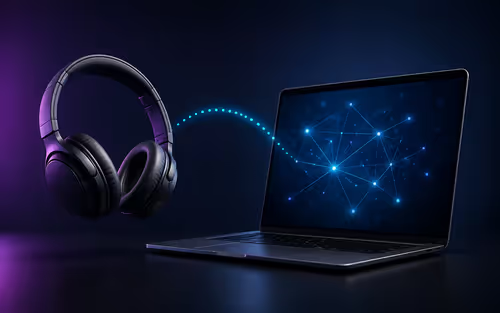
Put the headphones in pairing mode, open Bluetooth and devices in Windows 11, then add the headset. If it fails, remove the old pairing and check charge, range and drivers.
Microsoft says upcoming Windows 11 work will target memory use on 8GB PCs and improve boot and sign-in responsiveness. There is no public release date or measured uplift yet.
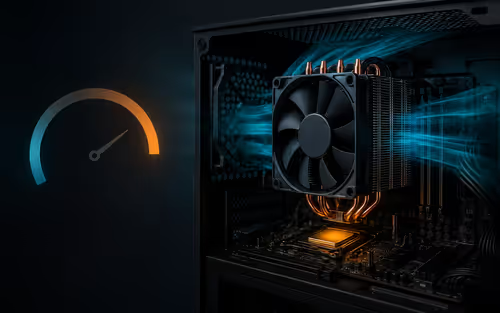
Windows 11 does not show CPU temperature in its standard Settings pages. Use your CPU maker's supported utility or a trusted monitor, then read idle and loaded temperatures in context.

Diablo 4 HDR settings work best after Windows and the display are calibrated, then the game's black point, brightness and white point are adjusted in that order. Use visible shadow detail and controlled highlights, not copied values from another screen.

The best HOTAS for Elite Dangerous is a separate stick-and-throttle set with enough analogue axes for pitch, roll, yaw and thrust, plus local support. Evetech's captured flight-simulation sample lists the complete Logitech X56 at R4,999.
The Alienware AW3926QW is a 38.9-inch 5120 x 2160 OLED monitor that runs at 165Hz or 2560 x 1080 at 330Hz. Dell lists it at $1,099.99 in the US, while South African price and availability remain unconfirmed.
Nintendo Switch 2 docked VRR arrives with system version 23.0.0 and also requires a dock update. The connected TV or monitor and the running software must support VRR before the output can follow changing frame rates.