The RAM Revolution: Why 16GB is Becoming the Minimum
Remember deleting Call of Duty just to install Starfield? But the horizon is shifting. The era of 4TB 64GB handheld gaming PCs is approaching, promising a 2025 where you carry your entire Steam library in your pocket without sacrificing performance. It’s the no-compromise future we’ve been waiting for. 🚀
For years, the standard for portable play has hovered around 16GB of RAM. While that sounds sufficient for a standard laptop, handhelds are different beasts. Because these devices use an APU (Accelerated Processing Unit), the system memory is shared between the CPU and the graphics chip.
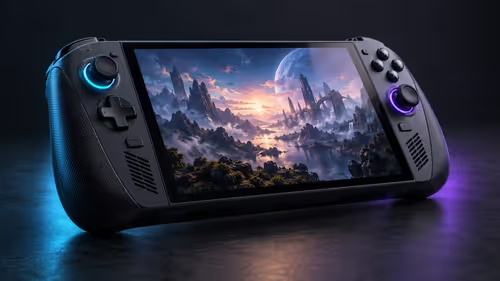
If you allocate 6GB to VRAM for textures, Windows and the game engine are left fighting over the remaining 10GB. This causes stuttering in open-world titles. Looking at the current lineup of ASUS handheld consoles, the performance is stellar, but the push toward 32GB and eventually 64GB is inevitable. A 64GB configuration would allow you to dedicate a massive 16GB or even 24GB purely to video memory, letting you crank texture settings to 'Ultra' without turning your frame rate into a slideshow.
Storage Wars: The 4TB Dream
With modern AAA installs frequently exceeding 150GB, a 512GB drive feels claustrophobic. You fit the OS, three big games, and suddenly you are out of space. In a country where redownloading a 100GB game can take days depending on line speed, local storage is king.
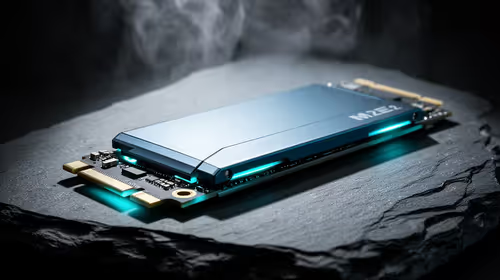
Enthusiasts are already modding devices to fit 2280 NVMe drives, but manufacturers are catching on. Specifically, looking at the larger form factors found on Lenovo gaming handhelds, the physical space for larger, high-capacity drives is becoming a design priority. A 4TB drive means you don't just have a selection of games; you have your entire backlog ready for that long haul flight or a weekend without internet.
Storage Saver Tip 🔧
If you aren't ready to crack open your device to install a 4TB SSD, invest in a high-speed A2-rated MicroSD card. While load times are slightly slower than an internal NVMe, they are perfect for running indie games, emulation libraries, and older AAA titles, saving your fast internal storage for the demanding new releases.
The Intel vs AMD Showdown
The race to the 2025 standard isn't just about capacity; it's about the silicon driving it. While AMD has dominated the space, Intel is fighting back hard. The MSI range of handhelds utilizes Intel's Core Ultra architecture, which relies heavily on fast memory bandwidth to feed its Arc graphics.
As we move toward 2025, we expect to see LPDDR5X speeds hitting 8533MT/s paired with 64GB capacities. This bandwidth is crucial for high-resolution gaming on portable screens. It ensures that textures load instantly and that switching between a heavy game and your desktop doesn't crash the system.
Is It Worth Waiting?
Technology moves fast, but waiting forever means you never get to play. The current generation of devices is already capable of running Cyberpunk 2077 and Elden Ring anywhere you go. While the 4TB 64GB handheld gaming PCs of the future represent the "god-tier" spec, today's devices are fully upgradeable and offer incredible value in ZAR terms compared to building a full desktop rig.
If you want to see what is possible right now, browsing the full range of handheld gaming consoles reveals machines that are already reshaping how South Africans play. The future is coming, but the present is already pretty spectacular. ✨
Ready to Game on the Go?
Whether you are looking for the ergonomic mastery of the ROG Ally, the screen real estate of the Legion Go, or the raw power of the MSI Claw, we have the portable powerhouse for you. Shop our Handheld Gaming PC deals and take your gaming anywhere.