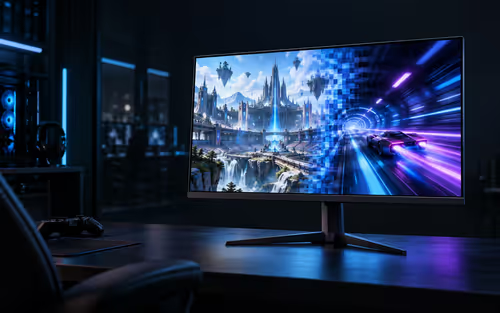
Is your desktop feeling more cramped than a Jozi taxi during rush hour? You're juggling code, design assets, and a dozen browser tabs, and the constant alt-tabbing is killing your flow. It’s time for an upgrade. But which path boosts your productivity more: a single, massive 5K display or a sprawling dual QHD monitor setup? Let's break down the 5K vs Dual QHD debate to find the perfect fit for your South African workspace.
The Case for a Single 5K Monitor: Pixel Perfection ✨
A single 5K monitor offers a seamless, uninterrupted canvas. With a stunning resolution of 5120 x 2880, you're getting over 14.7 million pixels. For creatives, developers, and anyone obsessed with detail, this is huge. Text is incredibly crisp, photos are razor-sharp, and you can edit 4K video at its native resolution with room to spare for your tools.
The main advantage is the lack of a bezel. There's no physical gap breaking your focus or disrupting your view. This creates a more immersive experience, whether you're deep in a complex spreadsheet or exploring the world of Cyberpunk 2077. If a clean, minimalist desk setup and unparalleled clarity are your goals, exploring the world of glorious high-resolution 5K and 4K monitors is your next step.
The Power of Dual QHD Monitors: Sprawling Screen Real Estate 🚀
On the other side of the ring, we have the dual QHD monitor setup. A single QHD (Quad HD) monitor has a resolution of 2560 x 1440. Placing two side-by-side gives you a massive 5120 x 1440 workspace. While that's fewer vertical pixels than a 5K screen, the sheer horizontal width is a multitasker's dream.
This setup allows for powerful workflow separation. You can dedicate one screen entirely to your primary task (like coding in VS Code) and the other to secondary windows (like documentation, Slack, or a browser preview). For many, this physical division is more intuitive for organising tasks than window snapping on a single screen. Plus, buying two excellent QHD PC monitors can often be more budget-friendly than a single 5K display.
5K vs Dual QHD: The Head-to-Head Breakdown
So, how do they stack up in key areas? The best choice really depends on your specific needs.
Pixel Density and Clarity
The 5K monitor is the undisputed winner here. On a 27-inch 5K screen, you get a pixel density of around 218 PPI (Pixels Per Inch). A typical 27-inch QHD monitor sits at about 109 PPI. The difference is noticeable, especially with text. The 5K screen provides a "Retina" quality experience where you can't distinguish individual pixels, making it easier on the eyes for long sessions.
Multitasking and Workflow
This is where the dual QHD setup often shines. The physical separation helps your brain compartmentalise tasks. It's perfect for streamers who need one screen for the game and another for their OBS and chat, or analysts comparing two large datasets side-by-side. While a 5K screen offers more than enough space, it requires more disciplined window management.
Productivity Pro Tip ⚡
On Windows, use the PowerToys FancyZones utility to create custom snap layouts. It's a lifesaver for managing multiple apps on a single large monitor, letting you perfectly organise your code editor, terminal, and browser on a 5K screen without constantly dragging windows around.
The Gaming Experience
For gaming, the debate gets interesting. A 5K monitor provides incredible detail, but driving all those pixels requires a seriously powerful graphics card. A dual QHD setup is awkward for gaming across both screens due to the bezel in the middle. However, you can game on one QHD screen—which is less demanding than 5K—while using the other for Discord or guides. For pure immersion, many gamers prefer single-screen solutions, and it's worth seeing how immersive curved monitors can offer a best-of-both-worlds feel. Ultimately, you'll want a display built for performance, so be sure to check out our full range of gaming monitors to see what fits your rig.
Desk Space and Ergonomics 🔧
A single 5K monitor on its stand has a smaller footprint than two QHD monitors. A dual-monitor setup almost always requires a dual-monitor arm or stand for proper alignment and ergonomic positioning. Investing in quality monitor accessories is crucial to avoid neck strain and keep your desk tidy, regardless of your choice.
The Cost Factor in ZAR
In South Africa, budget is always a key consideration. Generally, a dual QHD monitor setup will be significantly cheaper than a single 5K monitor. You can often find two high-quality 27-inch QHD monitors for less than the price of one premium 27-inch 5K display. Always keep an eye out for the best PC monitor deals to maximise your value.
What About Other Options?
The 5K vs dual QHD debate isn't the only conversation. Ultrawide monitors (like a 34-inch 3440x1440 screen) offer a seamless, wide view without the extreme pixel count of 5K. And for those who need productivity on the move, versatile portable monitors can add a second screen to your laptop setup anywhere.
The Verdict: Which Setup Is Right for You?
Choosing between a 5K and a dual QHD setup comes down to your primary use case and budget.
- Choose a 5K Monitor if: You are a creative professional (video editor, photographer, designer) who needs ultimate colour accuracy and pixel density. You prioritise a clean, minimalist setup and want the sharpest text possible.
- Choose a Dual QHD Monitor Setup if: You are a power-multitasker (developer, trader, streamer) who benefits from physically separate workspaces. You're working with a more conscious budget but still demand a huge amount of screen real estate.
Both options will dramatically boost your productivity compared to a single, smaller screen. The key is to match the monitor to your workflow.
Ready to Upgrade Your View? Whether you need the pixel-perfect clarity of 5K or the multitasking muscle of a dual QHD setup, the right monitor is waiting for you. Explore our massive range of PC monitors and find the perfect display to conquer your workload.