You’ve carefully chosen every component for your R10,000 gaming PC, but are you leaving free performance on the table? Before you even install a game, there’s a crucial step many gamers miss: tweaking the BIOS. These aren't scary, complex settings anymore. With a few clicks, you can unlock the full power of your hardware. Even the best gaming PC deals can get a boost from the right BIOS settings for gaming performance. Let's get you those extra frames. 🚀
First, What is the BIOS and Why Does It Matter?
Think of the BIOS (Basic Input/Output System) or its modern successor, UEFI, as the control panel for your PC's hardware. It’s the first thing that loads when you press the power button. It tells your processor, RAM, and graphics card how to talk to each other.
For gamers, this is ground zero. By optimising your BIOS for gaming, you ensure your components are running at their advertised speeds, not just their safe, default settings. This is where you can find significant performance gains without spending an extra Rand.
The Single Most Important BIOS Setting for Gaming Performance
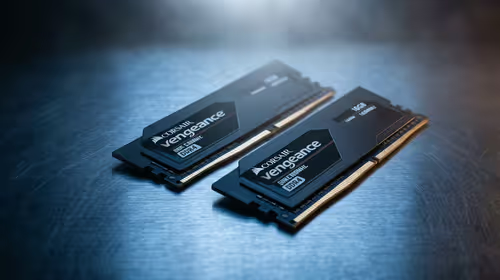
If you only change one thing, make it this: Enable your RAM’s performance profile.
Your RAM has a default speed (JEDEC) and a faster, advertised speed. The BIOS won't use the faster speed unless you tell it to. This is the most common reason gamers don't get the performance they paid for.
- For Intel systems: Look for XMP (Extreme Memory Profile).
- For AMD systems: Look for DOCP (Direct Over Clock Profile) or EXPO (Extended Profiles for Overclocking) on newer platforms.
Simply find this setting (usually on the main or "Tweaker" page), enable it, and select the profile with the highest speed. Save and exit. That’s it! You’ve just unlocked your RAM's true potential, a critical step for all PCs, especially budget gaming PCs where every frame counts.
Safety First! 📸
Before you change a single setting, whip out your phone and take a picture of each BIOS screen. If your PC fails to boot after a change, you can easily enter the BIOS again and revert to the settings you photographed. It’s a simple trick that can save you a massive headache.
Fine-Tuning Your Rig: Other Key Settings
Once XMP is enabled, a few other tweaks can further refine your gaming experience. These BIOS settings for gaming performance are about stability, cooling, and efficiency.
Custom Fan Curves 🔧
Your PC fans are likely set to a "Silent" or "Standard" profile. This is fine for browsing, but not for a heavy Apex Legends session. In the BIOS, find the fan control section (often called "Q-Fan," "Smart Fan," or similar).
Instead of a preset, create a custom curve that ramps up the fan speed more aggressively as your CPU temperature rises. A cooler CPU means less thermal throttling and more consistent performance. It might get a bit louder, but your frame rate will thank you. Many of our pre-built PC deals come with these profiles already optimised for you.
Enable Resizable BAR (Re-Size BAR)
If you have a modern CPU and GPU (e.g., AMD Ryzen 5000+ and Radeon 6000+, or Intel 10th Gen+ and NVIDIA 30-series+), this is a must. Resizable BAR allows your CPU to access the entire GPU memory at once, rather than in small chunks. This can provide a noticeable FPS boost in many modern games. Look for "Re-Size BAR Support" or "Above 4G Decoding" and enable them.
When BIOS Tweaks Aren't Enough
Optimising your BIOS settings for gaming performance is the best way to max out the hardware you already own. You can squeeze every last drop of power from your R10,000 rig and get a fantastic experience.
But eventually, you'll hit a hardware ceiling. When you're ready for a bigger leap in visual quality and frame rates, it's time to look at an upgrade. The next logical step could be one of the powerful systems you can find in our PCs under R20,000 category. And for those who want to push into 4K gaming or high-refresh-rate 1440p, exploring the world of PCs above R20,000 opens up a whole new level of performance. ✨
Ready to Level Up Your Hardware?
Optimising your BIOS is a massive win, but hardware is king. When you're ready to push beyond the limits of your current rig, Evetech has your back. Explore our massive range of gaming PC specials and find the machine that will dominate for years to come.