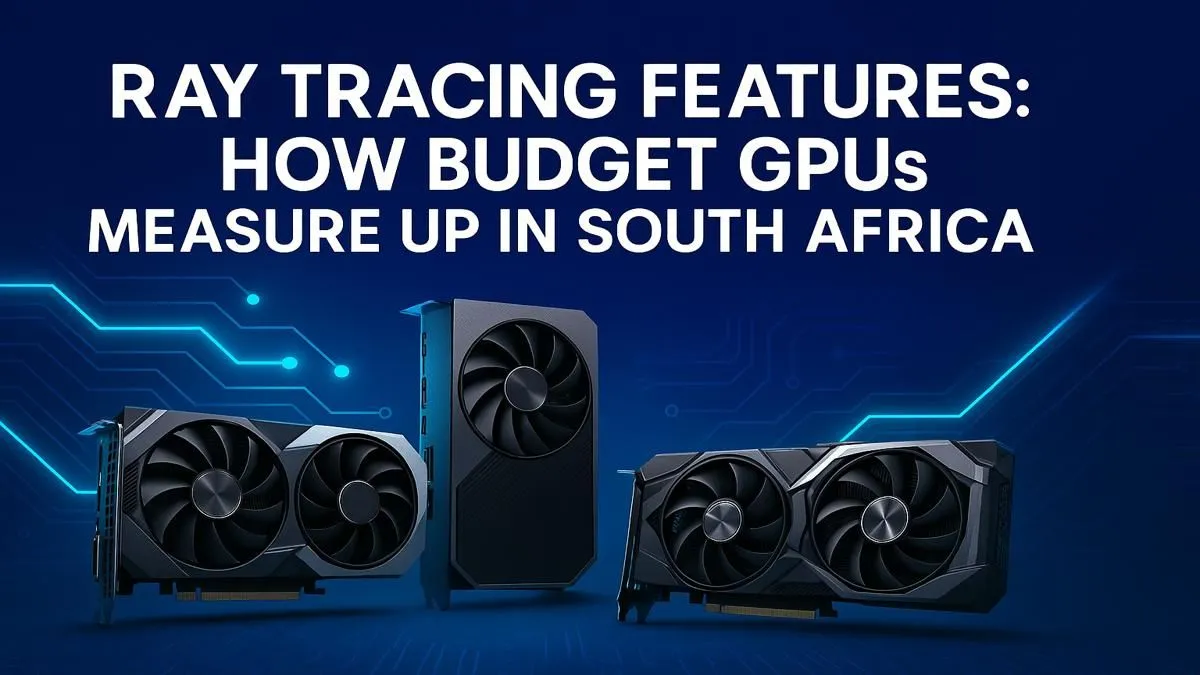
Ray tracing... the holy grail of gaming visuals with its stunningly realistic lighting and reflections. For years, it felt like a luxury reserved for those with wallets deeper than a Mponeng gold mine. But what if we told you that a visual upgrade is no longer just for the top 1%? Let's dive into the world of the budget ray tracing GPU in South Africa and see what your hard-earned Rands can actually get you in today's market. 🚀
What Defines a 'Budget' Ray Tracing GPU?
Before we jump into benchmarks, let's set the scene. When we talk about a "budget" or "entry-level" option, we're generally looking at graphics cards that deliver a playable ray-traced experience at 1080p resolution without completely emptying your bank account. In South Africa, this typically means cards falling in the sub-R9000 price bracket.
The main contenders in this space are NVIDIA's lower-end RTX cards, AMD's mid-range RDNA cards, and the disruptive new player, Intel. Each has its own strengths and weaknesses, especially when it comes to performance-boosting technologies like DLSS and FSR.
NVIDIA's RTX Lineup: The DLSS Advantage
NVIDIA pioneered real-time ray tracing, and their biggest advantage in the budget segment is DLSS (Deep Learning Super Sampling). This AI-powered tech reconstructs images from a lower internal resolution, giving you a massive performance boost. For a budget ray tracing GPU, DLSS isn't just a nice-to-have; it's often the key to unlocking smooth frame rates with ray tracing enabled.
Cards like the GeForce RTX 3050 and RTX 4060 are prime examples. While they might struggle with native ray tracing in demanding titles, switching on DLSS (especially in "Performance" or "Ultra Performance" mode) makes games like Cyberpunk 2077 or Alan Wake 2 surprisingly playable. Exploring the full range of NVIDIA's RTX graphics cards will show you the various options available.
AMD's RDNA Cards: Raw Power Meets FSR
Not to be outdone, AMD offers compelling hardware that often provides excellent traditional rasterization performance for the price. When it comes to ray tracing, their cards are capable, but generally trail their direct NVIDIA competitors. To close the gap, AMD has FSR (FidelityFX Super Resolution), an open-source upscaling technology that works on almost any GPU.
This makes AMD Radeon graphics cards like the Radeon RX 6650 XT or RX 7600 fantastic value propositions. You get a card that excels at 1080p gaming and can capably handle ray tracing effects when paired with FSR, giving you a taste of next-gen visuals without the premium price tag. ✨
The Wildcard: Are Intel Arc GPUs a Good Choice?
Intel shook up the market with their Arc series, and they've proven to be surprisingly competent, especially with ray tracing. Cards like the Intel Arc A750 and A770 often punch above their weight class in ray-traced workloads, sometimes outperforming more expensive rivals.
While their driver support had a rocky start, continuous updates have massively improved performance and stability. For tech enthusiasts willing to try something new, Intel Arc graphics cards represent incredible value and are a legitimate option for a budget ray tracing GPU build in South Africa.
Optimise Your Settings 🔧
Don't just turn ray tracing 'On' or 'Off'. Most games offer granular control. Start by enabling RT Reflections or RT Shadows only, as these often provide the biggest visual impact for the lowest performance cost. Leave Global Illumination for higher-end cards. This lets you enjoy the eye candy without tanking your FPS!
Setting Expectations: 1080p is the Sweet Spot
It's crucial to have realistic performance expectations. A budget ray tracing GPU in South Africa is primarily a 1080p machine. You'll be able to enjoy beautiful, realistic lighting in the latest titles, but you'll need to leverage upscaling tech like DLSS or FSR and might have to settle for medium settings instead of ultra. Pushing to 1440p is possible in less demanding games, but 1080p is where these cards truly shine.
When choosing a specific card, looking at popular MSI models or other trusted brands can ensure you get a quality cooler and reliable performance. It's also important to differentiate these gaming cards from specialised workstation graphics cards, which are designed for professional applications like 3D modelling and video rendering, not gaming.
The verdict? Absolutely. Getting into ray tracing has never been more accessible. You no longer need a top-tier card to see what all the fuss is about. With smart choices and a little settings optimisation, you can build a fantastic gaming rig that handles next-gen visuals beautifully.
Ready to Light Up Your Gaming World?
Finding the right balance of price and performance is key to a great build. With options from NVIDIA, AMD, and Intel, your first step into ray tracing is closer than ever. Explore our massive range of graphics cards and find the perfect GPU to conquer your favourite games.