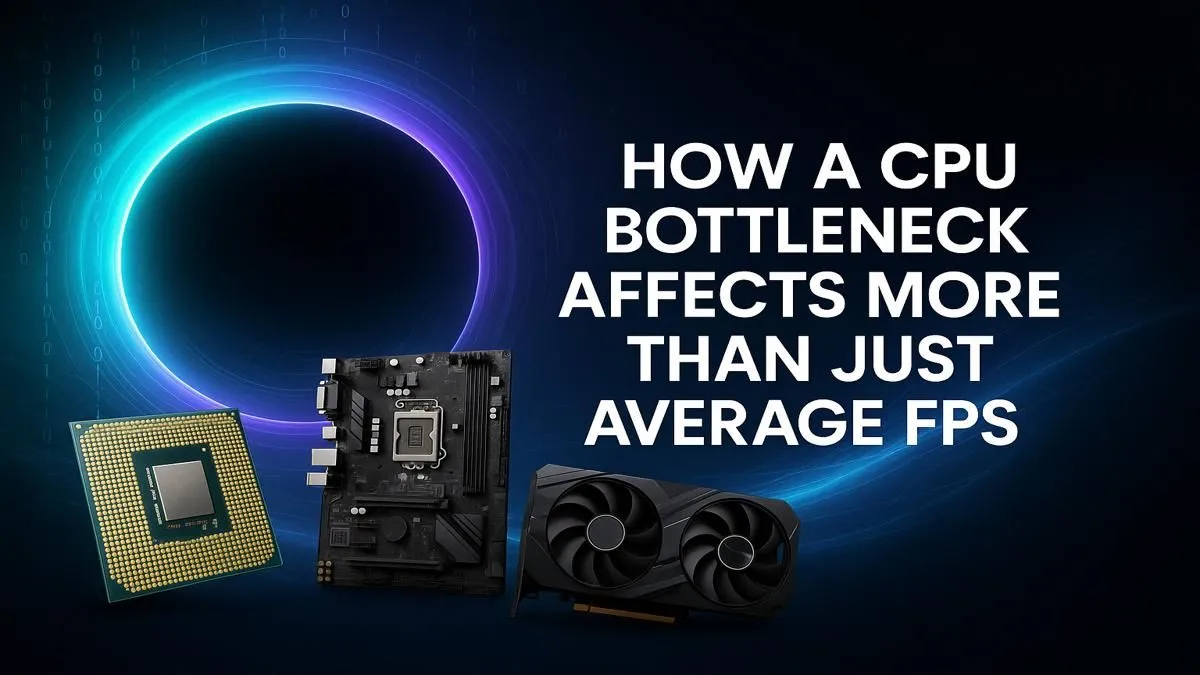
You've just dropped a serious amount of ZAR on a shiny new graphics card, expecting silky-smooth gameplay. But when you fire up Apex Legends or Helldivers 2, something's off. The average frame rate is okay, but you’re getting annoying stutters and lag. What gives? Chances are, you're experiencing CPU bottleneck effects, a sneaky performance thief that does more than just lower your average FPS. It ruins the entire feel of your game. 📉
Beyond Low FPS: The Hidden Symptoms of a CPU Bottleneck
Most gamers think a bottleneck just means a lower number on their FPS counter. The reality is far more frustrating. The most common CPU bottleneck effects manifest as poor frame consistency. This is where your frame rate might average 100 FPS, but it constantly dips and spikes, causing jarring micro-stutters that make aiming impossible.
Other sneaky symptoms include:
- Input Lag: A noticeable delay between moving your mouse and seeing the action on-screen.
- Poor 1% Lows: This metric shows the framerate of the slowest 1% of frames rendered. If this number is drastically lower than your average FPS, it's a huge red flag for stuttering caused by a CPU bottleneck.
- Underutilised GPU: Is your brand-new GPU sitting at 60-70% usage while your CPU is sweating at 100%? That's wasted potential right there. Your CPU simply can't prepare frames fast enough for your powerful GPU to render.
Why Your CPU is Holding Your GPU Hostage
Think of your PC as a production line. Your CPU (Central Processing Unit) is the manager, handling game logic, physics calculations, and telling the GPU what to draw. The GPU (Graphics Processing Unit) is the powerful worker that actually draws the pretty pictures. If the manager is too slow, the worker is left waiting around with nothing to do. That’s a bottleneck. Choosing the right CPU processor is crucial for a balanced system that delivers smooth, responsive gameplay. 🔧
Quick Bottleneck Check ⚡
Use a monitoring tool like MSI Afterburner with its RivaTuner Statistics Server overlay. In-game, watch your per-core CPU usage and your overall GPU usage. If one or more CPU cores are constantly hitting 90-100% while your GPU usage is well below 95%, you've almost certainly identified a CPU bottleneck.
Identifying and Fixing the Bottleneck
So, the monitoring software confirms your fears. What now? While you can sometimes ease the CPU bottleneck effects by lowering CPU-intensive in-game settings (like object detail, physics, and shadow quality), this is just a temporary fix. You’re essentially dumbing down your game to match your weaker CPU, which defeats the purpose of having a powerful graphics card.
The only real, long-term solution is a CPU upgrade. This ensures your processor can keep up with your graphics card, unlocking the smooth performance you paid for. Whether you're looking at the multi-core power of the latest AMD Ryzen CPUs for productivity and gaming, or the raw single-thread speed of powerful Intel Core processors that excel in esports titles, a modern CPU is the key to a balanced and powerful rig. 🚀
Don't let an outdated processor sabotage your gaming experience. The subtle CPU bottleneck effects are often more disruptive than a simple low frame rate, turning a potential victory into a frustrating loss. Upgrading is the best way to ensure every component in your PC can perform at its peak.
Ready to Unleash Your GPU's Full Potential?
A CPU bottleneck is holding your gaming rig back. Don't let an old processor waste your GPU's power. Explore our massive range of CPU processors and find the perfect upgrade to eliminate stutter and boost your frames.