Your UPS is beeping, and you’re wondering if that last-minute PC upgrade could have bought you a few more precious minutes to finish your match or save your work. While your GPU and CPU are the biggest power hogs, what about your RAM? We’re diving into DDR5 power efficiency to see if this next-gen memory offers a secret weapon against the darkness, helping to reduce an unexpected outage's impact on your gaming rig.
The Core of DDR5 Power Efficiency
At first glance, the jump from DDR4 to DDR5 is all about speed. But look closer, and you'll find a fundamental shift in design that directly impacts power consumption. The biggest difference is the operating voltage.
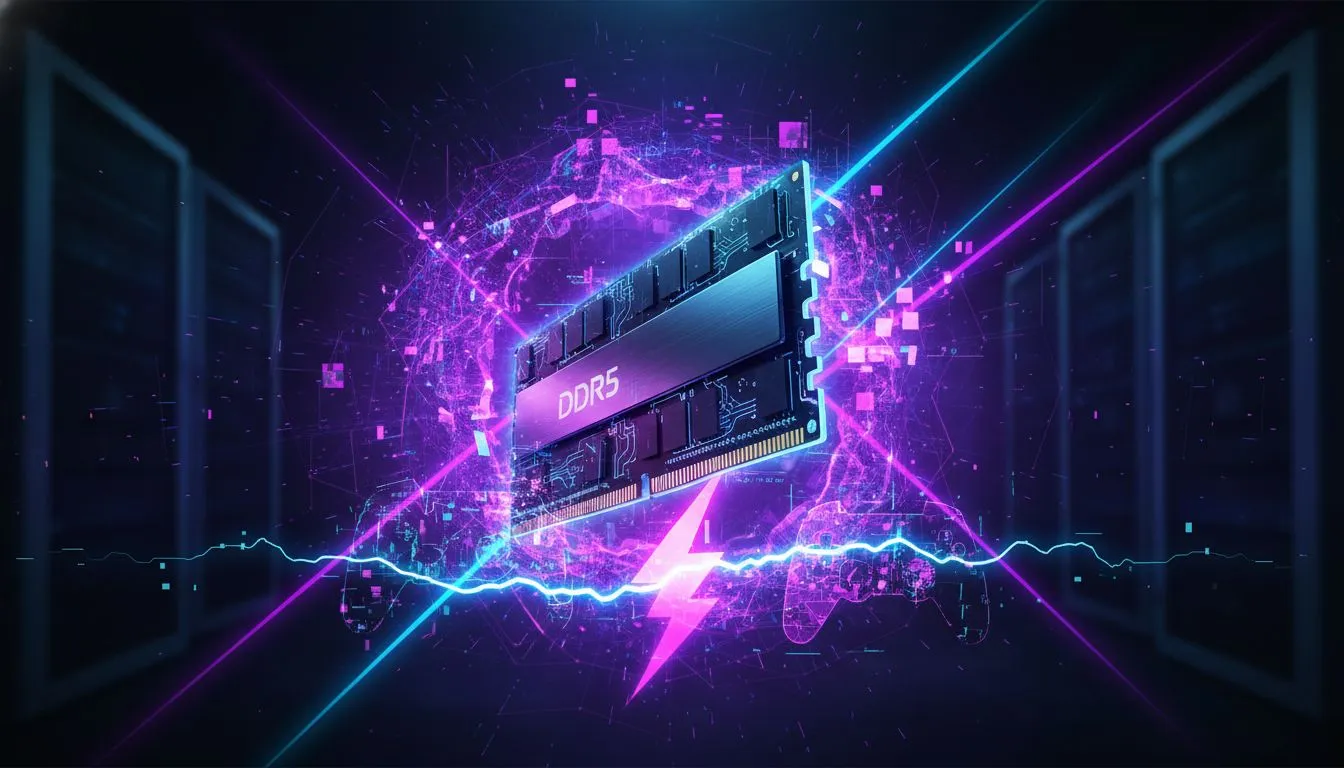
Standard DDR5 modules operate at just 1.1 volts, a notable drop from the 1.2 volts required by DDR4. While 0.1V might not sound like much, it represents a significant reduction in power draw across multiple memory sticks. This inherent improvement in DDR5 power efficiency is a foundational benefit of the new standard.
Furthermore, DDR5 introduces a Power Management Integrated Circuit (PMIC) directly onto the memory module itself. Previously, voltage regulation was handled by the motherboard. This on-DIMM approach allows for much finer, more localised power control, ensuring the RAM chips get exactly the voltage they need, reducing waste and improving stability. It's a smarter, more granular way to manage power. ⚡
From DDR3 to DDR5: An Efficiency Evolution
To truly appreciate the leap DDR5 represents, it’s helpful to look back. Many seasoned builders will remember tinkering with systems running on DDR3 gaming RAM modules, which typically ran at a thirstier 1.5V. At the time, getting a high-capacity 32GB DDR3 kit was a serious investment for any high-end rig.
The move to DDR4 memory brought that down to 1.2V, a welcome improvement that became the industry standard for years. Each generation has not only pushed for higher speeds and greater bandwidth but has also consistently chipped away at power requirements. This steady march towards better performance-per-watt is a cornerstone of PC component evolution, and it’s a trend that benefits every South African PC user trying to get the most out of their system, especially when Eskom isn't playing along. Even top brands like Teamgroup have been part of this journey, pushing efficiency with each new architecture.
Check Your Total Power Draw 🔧
Unsure how big of a UPS or inverter you need? Use an online power supply calculator to estimate your PC's total wattage. Add the power draw of your monitor and any other critical peripherals. This gives you a baseline wattage, helping you choose a battery backup system that won't let you down mid-raid when the lights go out.
Which Everyday Reliability Factors Matter Most?
Let's be realistic. Swapping your RAM won't magically double your UPS runtime. The power saving from RAM alone is measured in single-digit watts. However, thinking of it in isolation misses the point. The true benefit of DDR5 power efficiency is cumulative. ✨
Imagine your entire PC as an ecosystem. A modern CPU, a power-efficient GPU, and low-voltage DDR5 RAM all contribute small savings. Together, these marginal gains add up. They could be the difference between your UPS lasting 10 minutes or 15 minutes… potentially enough time to safely shut down, finish a critical round of Apex Legends, or send that urgent email.
In the context of an unexpected outage, every single watt saved extends your uptime on battery power. So, while DDR5 isn't a silver bullet, it's an intelligent part of a broader power-saving strategy for your high-performance machine.
The Bigger Picture: Performance Per Watt
The final piece of the puzzle isn't just about using less power... it's about getting more done with the power you use. Thanks to its massive bandwidth increase, DDR5 allows your CPU to process data far more quickly. This means tasks are completed faster, and the system can return to a low-power idle state sooner. 🚀
This "race to idle" philosophy is a key aspect of modern PC efficiency. By reducing bottlenecks and letting your components finish their work without delay, you're inherently creating a more power-efficient system. When you invest in a cutting-edge DDR5 memory kit, you're not just buying speed; you're buying a smarter, more optimised platform that respects every watt of electricity it uses.
Ready to Build a More Efficient Rig?
While DDR5 won't solve an unexpected outage, its superior power efficiency is a smart part of a modern, high-performance build. It's about making every watt count. Explore our wide range of DDR5 memory and give your PC the future-proof upgrade it deserves.