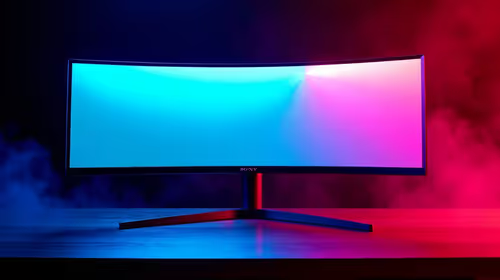
Staring at a gorgeous game world only to have it ripped apart by ugly screen tearing… every South African gamer knows the frustration. It’s a jarring glitch that breaks immersion and can even cost you a match. The solution is adaptive sync technology, but that leads to the big question: in the FreeSync vs G-Sync South Africa debate, which side should you be on? Let's break it down and find the perfect match for your rig and your wallet.
What is Adaptive Sync and Why Does Your PC Need It?
Before we dive into the G-Sync vs FreeSync battle, let's get the basics right. Screen tearing happens when your graphics card (GPU) sends out new frames at a different rate than your monitor can display them. The monitor gets confused, tries to show parts of two different frames at once, and you get that horrible horizontal split.
Adaptive sync is the tech that solves this. It allows your monitor to dynamically adjust its refresh rate to match the frame rate of your GPU. The result? Buttery-smooth visuals, no tearing, and less input lag. It's a non-negotiable feature for any serious gamer today.
Breaking Down G-Sync: The NVIDIA Powerhouse ⚡
G-Sync is NVIDIA's proprietary solution. For years, premium G-Sync monitors included a dedicated hardware module inside them that handled the syncing process. This ensured a super-high standard of quality and performance, but it also added to the cost.
Today, G-Sync comes in a few flavours:
- G-Sync Ultimate: The best of the best, with the hardware module, brilliant HDR, and ultra-low latency. You'll often find this on high-end 5K and 4K monitors designed for elite performance.
- G-Sync: The classic standard, offering a fantastic, tear-free experience.
- G-Sync Compatible: These are actually FreeSync monitors that NVIDIA has tested and certified to work well with their GPUs.
The main takeaway? G-Sync promises a premium, rigorously tested experience, but it locks you into the NVIDIA ecosystem and generally comes with a higher price tag.
Understanding FreeSync: The Open Standard for Everyone
On the other side of the ring is AMD's FreeSync. Unlike G-Sync, FreeSync is built on an open standard (VESA Adaptive-Sync). This means monitor manufacturers don't have to pay licensing fees or install special hardware, making FreeSync monitors much more common and affordable.
Like G-Sync, FreeSync also has tiers:
- FreeSync: The basic tear-prevention standard.
- FreeSync Premium: Adds a requirement for at least a 120Hz refresh rate at 1080p and Low Framerate Compensation (LFC), which keeps things smooth even when your FPS drops.
- FreeSync Premium Pro: Includes everything from Premium, plus support for HDR content.
Because it's an open standard, the quality can vary slightly more than with G-Sync. However, the value proposition is undeniable, which is why you'll find it on many of the best PC monitor deals in South Africa.
NVIDIA User Pro Tip 💡
If you have an NVIDIA graphics card but want the value of a FreeSync monitor, look for the "G-Sync Compatible" badge. This means NVIDIA has officially tested and verified that specific model to provide a solid, tear-free experience. You just need to enable it in your NVIDIA Control Panel!
The Showdown: FreeSync vs G-Sync in South Africa
So, which one wins for the average Mzansi gamer? The decision really comes down to three things: your GPU, your budget, and your performance expectations.
Performance & Quality
Historically, G-Sync's dedicated hardware gave it a slight edge in consistency, especially at very low frame rates. However, modern FreeSync Premium and Premium Pro monitors have closed that gap significantly. For most gamers, the visual experience on a top-tier FreeSync display is virtually indistinguishable from a G-Sync one, especially on immersive curved monitors that pull you into the action.
Budget & Availability
This is where FreeSync lands a major blow. The lack of licensing fees means FreeSync monitors are almost always cheaper than their G-Sync equivalents. For South African gamers, saving a few thousand Rand on a monitor could mean upgrading your RAM or SSD instead. You'll find FreeSync across our entire range of all gaming monitors, from entry-level to high-end.
Compatibility
This used to be simple: NVIDIA GPU = G-Sync monitor, AMD GPU = FreeSync monitor. Now, it's more flexible. Since NVIDIA enabled support for FreeSync monitors (as "G-Sync Compatible"), you can pair a GeForce card with a more affordable FreeSync screen. This is a huge win for consumers. However, you can't use a G-Sync monitor with an AMD graphics card.
So, Which Adaptive Sync Monitor Should You Buy? ����🇦
The FreeSync vs G-Sync South Africa debate doesn't have one simple winner... it has a winner for you.
- If you have an NVIDIA GPU and want the absolute best, guaranteed performance (and budget isn't a major issue): A true G-Sync or G-Sync Ultimate monitor is a fantastic choice.
- If you have an AMD GPU: FreeSync is your only choice, and it's a brilliant one. Aim for a FreeSync Premium or Premium Pro model for the best experience.
- If you have an NVIDIA GPU but are on a tighter budget: A well-reviewed, "G-Sync Compatible" FreeSync monitor offers the best of both worlds and incredible value for money.
Ultimately, both technologies do a great job of eliminating screen tearing. The choice depends on balancing your hardware, your wallet, and your desire for either certified perfection or outstanding value. Whether you're decking out your main rig, looking for a secondary screen, or even grabbing one of the latest portable monitors for gaming on the go, making the right choice is key. Once you've chosen from our wide selection of PC monitors, don't forget to grab the right monitor accessories to perfect your setup.
Ready to Banish Screen Tearing for Good? The FreeSync vs G-Sync debate is all about finding the right fit for your rig. The best news? Smoother gameplay is just a click away. Explore our massive range of gaming monitors and find the perfect screen to conquer your world.