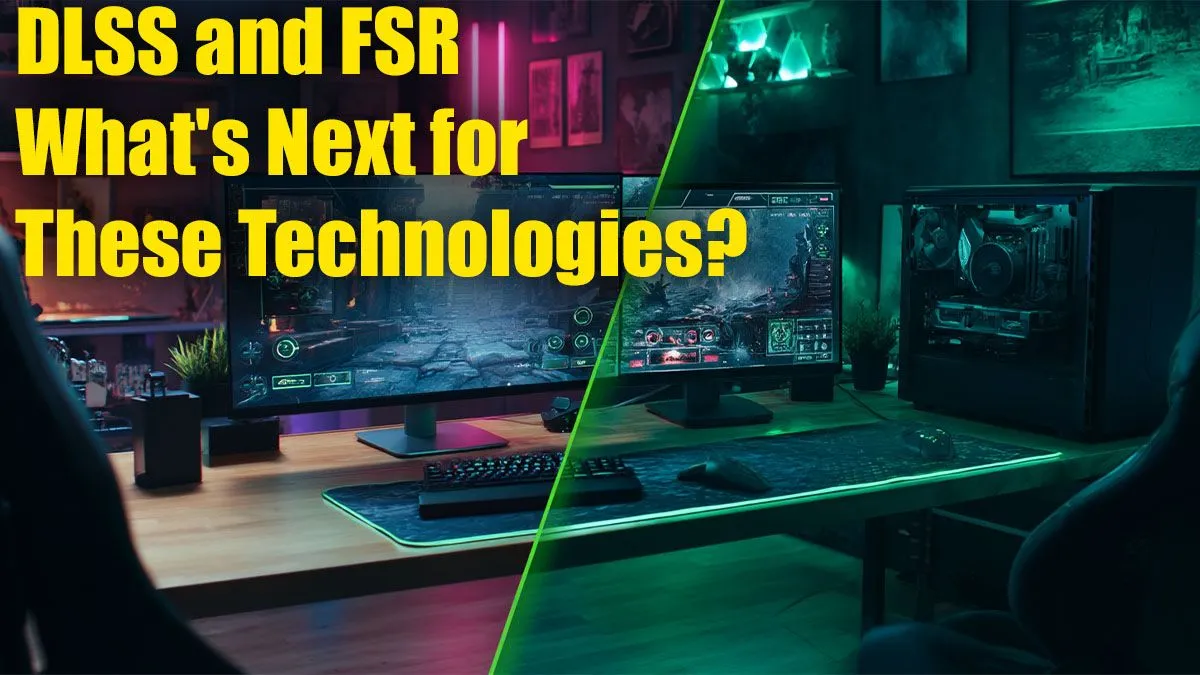
Staring at a stuttering frame rate is enough to make any South African gamer want to throw their mouse. We all crave that buttery-smooth 144Hz+ experience, but top-tier graphics cards can cost a pretty penny. Enter AI upscaling. Technologies like NVIDIA's DLSS and AMD's FSR have been our secret weapons for years, boosting performance for free. But what's next? The future of DLSS and FSR is about to get even smarter. 🚀
The AI Upscaling Revolution: More Frames, More Fun
At its core, AI upscaling is a clever trick with incredible results. Your graphics card renders a game at a lower resolution (like 1080p), and then a sophisticated AI algorithm intelligently scales it up to your monitor's native resolution (like 1440p or 4K).
The result? You get the visual quality of a high-resolution image but the raw performance of gaming at a lower one. This means higher frame rates, smoother gameplay, and the ability to crank up those eye-candy settings like ray tracing without turning your game into a slideshow. It’s the key to unlocking your hardware's full potential.
NVIDIA's Next Play: What's on the Horizon for DLSS?
NVIDIA has always been at the forefront of this tech with its Deep Learning Super Sampling (DLSS). The current DLSS 3.5, with its AI-powered Frame Generation and Ray Reconstruction, is already mind-blowing. It doesn't just upscale pixels; it generates entirely new frames and cleans up ray-traced lighting for stunning clarity.
So, what's next for AI upscaling from Team Green? The road ahead likely involves:
- Smarter AI Models: Expect future versions of DLSS to be trained on even larger datasets, leading to fewer visual artifacts and an image quality that's virtually indistinguishable from native resolution.
- Improved Frame Generation: The biggest challenge with frame generation is latency. NVIDIA will undoubtedly focus on reducing this input lag, making the technology perfect for competitive esports titles.
- Wider Integration: As the technology matures, we can expect to see it integrated more deeply into game engines, making it easier for developers to implement. The current lineup of NVIDIA GeForce cards already offers a massive leap in performance thanks to this tech. ✨
AMD's Answer: The Evolution of FSR
AMD's FidelityFX™ Super Resolution (FSR) has a huge advantage: it's open-source. This means it works not only on AMD cards but also on older NVIDIA GPUs and even Intel's new Arc GPUs. FSR 3 brought its own version of frame generation to the table, making it a serious competitor.
The future of FSR will likely focus on closing the image quality gap with DLSS. We can anticipate:
- Enhanced Upscaling Algorithms: AMD will continue to refine its spatial upscaling techniques, possibly incorporating more machine learning elements to improve edge detection and temporal stability (reducing that "shimmering" effect on fine details).
- Broader Game Support: Thanks to its open nature, FSR adoption could accelerate even faster. We expect to see it become a standard feature in almost every new PC release. The performance gains on the latest AMD Radeon GPUs make them an incredible value proposition for gamers across Mzansi.
Quick Performance Boost ⚡
Not sure if your favourite game supports DLSS or FSR? Most modern titles do! Check the in-game graphics settings for an "Upscaling" or "Resolution Scaling" option. Enabling it on "Performance" or "Ultra Performance" mode can give you a massive FPS boost with just a single click. It's the easiest performance win you'll get.
What the Future of DLSS and FSR Means for Your Next Rig
Here's the bottom line for South African gamers. The rapid evolution of AI upscaling is fantastic news for our wallets. It means you don't necessarily need the absolute top-of-the-line, most expensive GPU to have a phenomenal high-resolution gaming experience.
A powerful mid-range card armed with the latest DLSS or FSR technology can now punch well above its weight, delivering smooth, high-fidelity gameplay that was once reserved for only the most expensive rigs. This makes building a future-proof PC more affordable and accessible than ever. As these technologies improve, the value proposition of a well-chosen graphics card will only get better. Before you build, it's always a good idea to check out the latest graphics card deals to find the sweet spot for your budget.
Ready to Experience AI-Powered Performance?
The future of DLSS and FSR is bright, making high-framerate gaming more accessible than ever. Whether you're Team Green or Team Red, the right GPU is waiting. Explore our incredible graphics card deals and build the rig that will dominate for years to come.