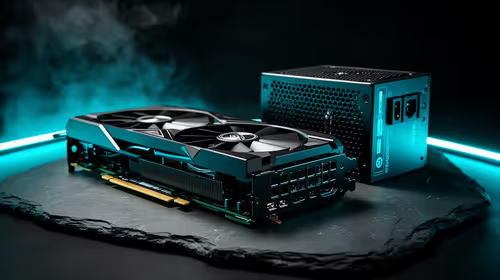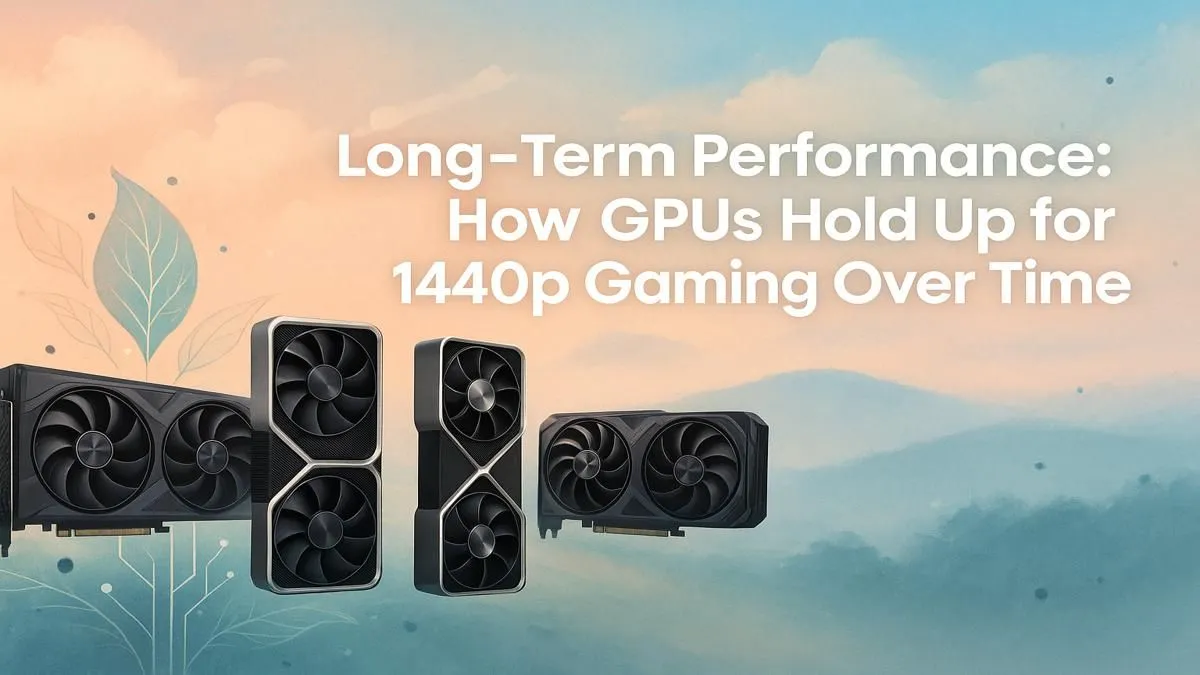
So, you’ve hit the 1440p sweet spot. The visuals are crisp, the performance is smooth… for now. But in the back of your mind, a nagging question lingers: how long until your shiny new graphics card starts to struggle? Choosing a future proof 1440p GPU isn’t just about winning today’s benchmarks; it’s about securing high-framerate, high-settings gaming for years to come. Let's make sure your next upgrade has some serious staying power.
What "Future Proof" Really Means for a 1440p GPU
Future proofing isn't about buying a card that will magically run every game in 2028 on Ultra settings. It’s about choosing a GPU with the right core technologies and specifications to remain relevant and capable long after you’ve unboxed it. Think of it as a strategic investment in your gaming experience.
Here are the key pillars for GPU longevity at 1440p:
- VRAM (Video RAM): This is non-negotiable. Modern games with high-resolution textures are incredibly VRAM-hungry. While 8GB was once acceptable, 12GB is the new baseline for a comfortable 1440p experience. For a truly future proof 1440p GPU, aiming for 16GB provides a massive buffer against future texture-heavy titles.
- Upscaling Technology: Features like NVIDIA’s DLSS and AMD’s FSR are your secret weapons. They use AI to render games at a lower internal resolution and then intelligently upscale the image, giving you a huge performance boost with minimal visual compromise. A card with strong upscaling support will extend its useful life significantly.
- Strong Rasterization: This is the traditional measure of GPU horsepower… how fast it can draw pixels without fancy tech like ray tracing. A card with a powerful core will always have a high performance floor, ensuring playability even if you have to turn down some of the newer, more demanding settings.
Check Your VRAM Usage 🔧
Most modern games have a VRAM usage meter in their graphics settings. Fire up a demanding title like Alan Wake 2 or Cyberpunk 2077, crank the textures to max at 1440p, and see how much memory you're using. If you're already hitting your card's limit, it’s a clear sign that an upgrade with more VRAM will be necessary for future titles.
The Top Contenders for a Long-Lasting 1440p GPU
Navigating the market can be tricky, but a few key contenders stand out when considering longevity. Each team brings something different to the table, from raw power to next-gen features.
Team Green: NVIDIA's Feature-Forward Approach
NVIDIA has built a reputation on its robust feature set, particularly DLSS 3 with Frame Generation. This technology can dramatically boost framerates, making it a powerful tool for extending a card's relevance. Cards like the GeForce RTX 4070 SUPER, with its 12GB of VRAM and excellent efficiency, are prime candidates for a long-lasting 1440p build. While you're browsing NVIDIA's powerful lineup, pay close attention to the VRAM and DLSS version.
Team Red: AMD's Price-to-Performance Kings
AMD often delivers incredible rasterization performance for your Rand. Cards in the Radeon RX 7000 series, like the RX 7800 XT, are famous for offering a generous 16GB of VRAM at a competitive price point. This makes them an excellent choice if you prioritise texture quality and raw horsepower. While their upscaling tech, FSR, is excellent, it doesn't currently match DLSS 3's Frame Generation. Still, for pure, powerful gaming, the value offered by AMD Radeon graphics cards is tough to beat.
Team Blue: The New Challenger 🚀
Don't sleep on the underdog. While newer to the dedicated GPU space, Intel Arc graphics cards are rapidly improving with each driver update. They offer competitive features like XeSS upscaling and often pack more VRAM than their direct competitors at a lower price. For gamers on a tighter budget who are willing to be on the cutting edge, Intel presents a compelling path to a cost-effective, long-lasting 1440p setup.
More Than Just a Game: Creative & Professional Work
A powerful gaming GPU is a versatile tool. The same hardware that pushes pixels in Helldivers 2 can accelerate video editing in DaVinci Resolve or 3D rendering in Blender. However, if your primary use case is professional content creation, animation, or data science, it’s worth noting the difference. Specialised workstation graphics cards are built with certified drivers and hardware optimised for stability and precision in professional applications, which can be a critical distinction for mission-critical projects. ✨
Ready to Secure Your 1440p Future? Choosing a future proof 1440p GPU is about smart investment, not just raw power. It's about ensuring your rig smashes framerates for years to come. Explore our massive range of graphics cards and find the perfect engine for your gaming journey.