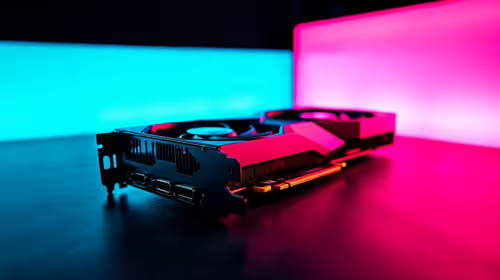
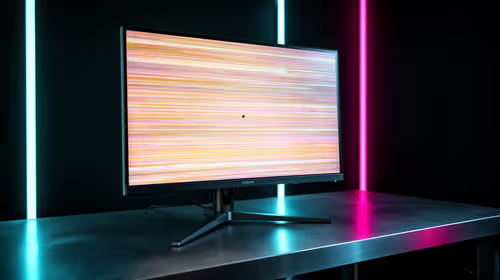
A 4K 144Hz monitor can show beautiful detail and fluid motion, but the panel is only the invitation. Your graphics card has to deliver the frames, and demanding games can make 144fps at 4K a tough target.
Quick Answer
Buy a 4K 144Hz monitor when you have a high-end GPU, value sharp desktop detail and are happy to tune settings or use upscaling in heavy games. Choose 1440p high refresh when you want steadier high frame rates from a mid-range card. You do not need 144fps in every title to enjoy the display.
Match games to the screen
Competitive games can reach high frame rates at 4K with suitable settings, while demanding single-player releases may sit far below the refresh ceiling. Adaptive sync lets the monitor follow changing frame rate and keeps that lower range useful.
The extra pixels also improve text, photos and creation work. At smaller sizes, Windows scaling may be needed. Check how your applications behave with the chosen scale before treating 4K as free desktop space.
Browse the complete screen selection beside popular monitor models. As a dated entry-display reference, the named ViewSonic VA220A-H 22-inch 120Hz cost R1,599 in July 2026. Keep it outside the 4K 144Hz price class.
Check the full connection chain
Your GPU port, cable and monitor input must support 4K at the desired refresh rate. Colour depth and HDR settings can affect bandwidth. Read the monitor manual and GPU specifications, then use the correct certified cable.
Panel response, HDR performance and local dimming matter as much as the 144Hz badge. A weak HDR implementation can look worse than well-tuned SDR. Reviews of the exact model can reveal overshoot, input behaviour and brightness limits.
Budget for the GPU you own, not the one you may buy one day. A 4K screen can run at lower resolution, though scaling may look softer than a native 1440p panel.
Plan for scaling and desk distance
At common desktop sizes, 4K text can be too small at 100 percent scaling. Test 125 or 150 percent and confirm that the applications you use remain sharp. The result should give you cleaner detail, not a battle with tiny menus.
Measure viewing distance too. A larger screen may need a deeper desk or monitor arm to stay comfortable.
Set Windows and the GPU driver to the intended colour depth after connecting the screen. A bandwidth limit can force an unexpected format even when 4K at 144Hz appears selected.
Frequently Asked Questions
Do I need 144fps to use a 144Hz monitor?
No. Adaptive sync makes a wide frame-rate range useful, and lighter games can approach the ceiling.
Is 4K 144Hz only for flagship GPUs?
High-end GPUs suit it best. Mid-range cards can work with reduced settings and upscaling.
What else should I check?
Check panel response, HDR quality, adaptive sync, ports, cable bandwidth and stand adjustment.
Compare 4K 144Hz monitors with the graphics performance you can deliver and choose the panel your whole system can support.