Quick Answer
For competitive gamers, RAM capacity past 32GB rarely buys frames; spend instead on speed and latency. A 2x16GB DDR5-6000 CL30 kit (around R1,900 to R2,600) feeds a 240Hz CS2 or Valorant setup better than a slower 64GB kit.
Why latency beats capacity for esports
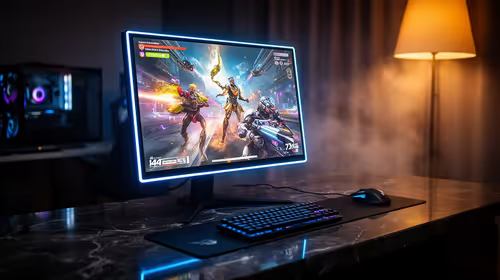
Competitive titles like CS2, Valorant and Apex are CPU-bound at high refresh rates, so memory latency and clock matter more than raw gigabytes. 32GB is plenty; the gains come from running DDR5-6000 at CL30 with the EXPO profile enabled. Going to 64GB adds cost and can even force looser timings on some boards, which is the wrong trade for a 240Hz player.
The competitive sweet spot
On AM5, a 2x16GB DDR5-6000 CL30 kit is the reference point and costs about R1,900 to R2,600. Pair it with a 7600X or 7800X3D and you have the memory subsystem out of the way as a bottleneck. Only consider 64GB if you also stream and run heavy capture software at the same time as the match.
The SA bottom line
For competitive play the verdict is speed over size: 32GB of DDR5-6000 CL30 feeds a 240Hz setup, and the saving over 64GB belongs in a faster CPU. Capacity past 32GB simply does not show up on your frame counter.
FAQ
Does more than 32GB RAM help competitive gaming?
Rarely. Esports titles are CPU-bound, so 32GB of fast DDR5-6000 CL30 feeds a 240Hz setup better than 64GB at slower timings. Spend the saving on a faster CPU or monitor.
What RAM speed is best for 240Hz gaming?
DDR5-6000 at CL30 is the value-to-performance sweet spot on AM5. Enabling the EXPO profile in BIOS is essential, since the kit runs at a slow JEDEC default otherwise.
How much should a competitive gamer spend on RAM?
Around R1,900 to R2,600 for a quality 2x16GB DDR5-6000 CL30 kit. That leaves headroom for a stronger CPU, which matters more for high-refresh frame rates.
Evetech tip
For a 240Hz competitive build, buy a 2x16GB DDR5-6000 CL30 kit and put the saving toward a faster CPU instead of more capacity.