Strip any robot down to its essentials and you find two jobs being done over and over: noticing what is happening, and acting on it. A sensor handles the noticing, reading something physical like light, distance, or temperature and turning it into data, while an actuator handles the acting, taking a command and producing movement. Everything else a robot does sits between those two halves.
Quick Answer
A sensor is an input device that reads the environment and sends data to a controller. An actuator is an output device that takes a command from that controller and produces physical action, such as a motor spinning or a servo rotating an arm. The sensor senses, the controller decides, the actuator moves, and the loop repeats.
The Input Half: Sensors
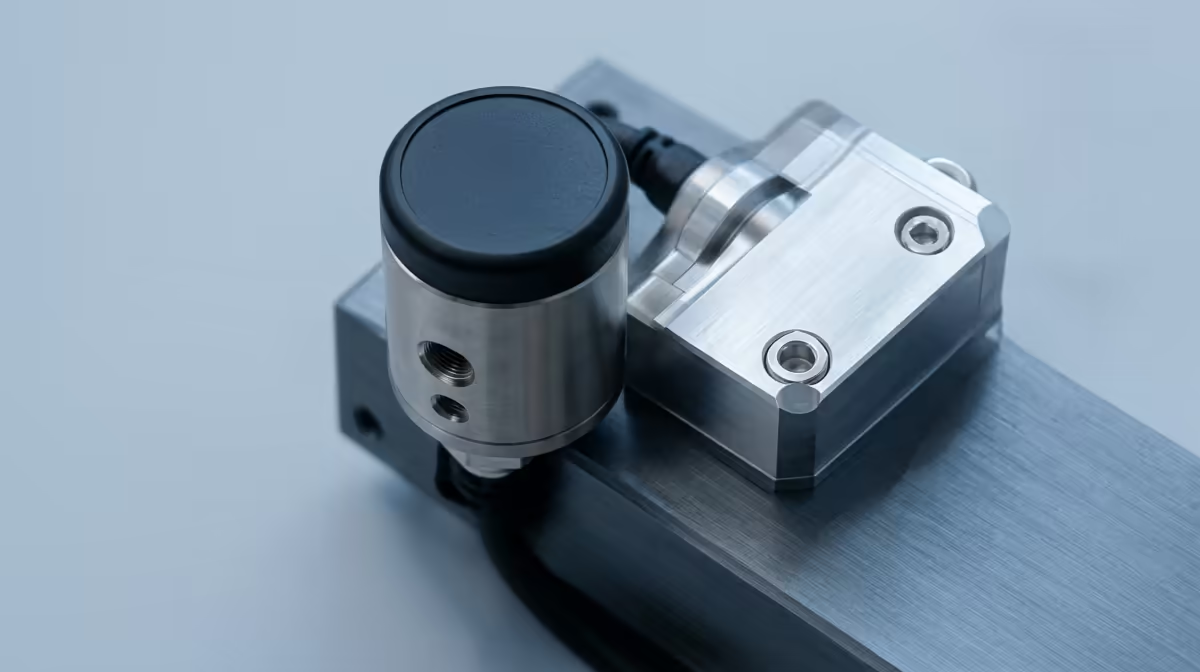
A sensor detects a physical property and converts it into a signal a controller can read. A light sensor turns brightness into a voltage, an ultrasonic sensor measures distance by timing an echo, and a temperature sensor reports heat as a number. None of these do anything on their own. Their entire job is to feed the controller, usually a board like an Arduino or Raspberry Pi, an accurate picture of the outside world.
Think of sensors as the robot's eyes and ears. Without them the controller is blind, running a fixed routine with no awareness of obstacles, light levels, or whether a button was pressed. The richer the sensor set, the more the robot can react to. Many of the controllers and connected gadgets that work this way appear in the smart home and appliances range at Evetech.
The Output Half: Actuators
An actuator does the opposite of a sensor. It takes an electrical command from the controller and converts it into physical action. A DC motor spins a wheel, a servo rotates a robotic arm to a precise angle, and a solenoid pushes a lever. Where a sensor turns the physical world into data, an actuator turns data back into the physical world.
This is the half that makes a robot move, grip, lift, or steer. A controller can hold all the cleverness in the world, but without an actuator nothing visible happens. The motor or servo is what carries the decision out into reality.
How the Two Halves Form a Loop
The magic is in how they connect. A robot reads its sensors, the controller weighs the data against its program, and it then commands the right actuators. Walk into a room and a motion sensor registers you, the controller decides the light should come on, and an actuator flips the switch. In a robot, an ultrasonic sensor spots a wall ahead, the controller decides to turn, and the servo motors steer the wheels away.
That sense, decide, act cycle runs continuously, often many times a second. Understanding which component is doing which job makes building and debugging far easier, because a problem is either a sensor reading wrong, the program deciding wrong, or an actuator failing to move. Beginners can pick up the cables, controllers, and add-ons to wire these projects together from the accessories best sellers.
Frequently Asked Questions
Is a motor a sensor or an actuator?
A motor is an actuator. It takes an electrical command and produces movement, which is the defining behaviour of an output device. Servos and solenoids are actuators for the same reason.
Can one component be both a sensor and an actuator?
Usually they are separate, but some devices combine both functions in one housing. Even then the two roles stay distinct: one part reads a physical property, the other produces an action. Keeping the roles separate in your mind makes circuits easier to understand.
What controller sits between the sensor and actuator?
A microcontroller or single-board computer, most commonly an Arduino or Raspberry Pi in beginner projects. It reads the sensor data, runs your program to decide what to do, and sends commands to the actuators.
Why does the difference matter for beginners?
Because it tells you where to look when something breaks. If a robot ignores an obstacle, the fault is a sensor or the program reading it. If it decides correctly but does not move, the fault is the actuator or its wiring. The split makes troubleshooting logical.