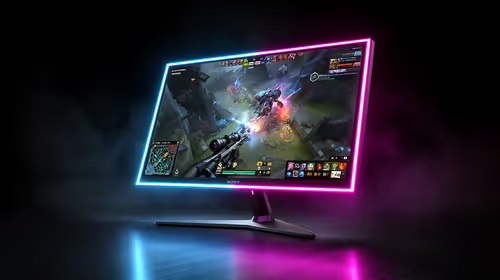
You’re in the final circle in Warzone, sights trained on the last opponent. You pull the trigger, but your screen rips in half for a split second. That tiny, jarring tear is enough… you’re sent to the Gulag. Sound familiar? This is screen tearing, and it’s the enemy of every South African gamer. The solution is adaptive sync, but that leads to the big question: in the FreeSync vs G-Sync battle, which one is right for your rig?
What is Screen Tearing and Why Should You Care?
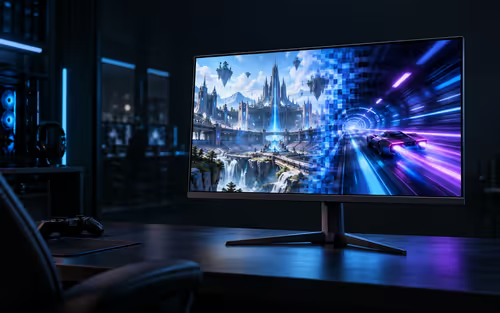
Before we dive into the FreeSync vs G-Sync debate, let's quickly break down the problem they solve. Your graphics card (GPU) renders frames at a variable rate, while your monitor refreshes its image at a fixed rate (e.g., 144Hz). When the GPU sends a new frame before the monitor has finished displaying the last one, you get a "tear"—a horrible horizontal line where two different frames are shown at once.
It’s distracting in slow-paced games and downright disastrous in fast-paced shooters. Adaptive sync technology forces your monitor to refresh exactly when your GPU sends a new frame, creating perfectly smooth, tear-free gameplay. ✨
AMD FreeSync: The Open-Standard Champion
AMD FreeSync is an open-standard technology, meaning any manufacturer can implement it without paying licensing fees to AMD. This is fantastic news for gamers on a budget, as it has led to a massive variety of affordable FreeSync-enabled PC monitors flooding the market.
The Pros:
- Affordability: Generally cheaper than their G-Sync counterparts.
- Wide Selection: You'll find FreeSync on everything from entry-level screens to high-end displays.
- No Vendor Lock-in (Mostly): While designed for AMD GPUs, many FreeSync monitors now work with NVIDIA cards (more on that later).
The Cons:
- Variable Quality: Because it's an open standard, the quality of implementation can vary. To fix this, AMD introduced tiers: FreeSync, FreeSync Premium (guarantees at least 120Hz at 1080p and Low Framerate Compensation), and FreeSync Premium Pro (adds HDR support).
NVIDIA G-Sync: The Premium, Polished Performer
NVIDIA G-Sync is the proprietary solution. Originally, G-Sync monitors required a special hardware module inside the display to handle the communication with the NVIDIA GPU. This module ensures a flawless, rigorously tested experience but also adds to the cost.
The Pros:
- Rock-Solid Performance: The strict certification process means if a monitor has the G-Sync badge, you can be sure of a top-tier, stutter-free experience.
- Advanced Features: Often includes features like variable overdrive for clearer motion.
The Cons:
- Higher Cost: That dedicated hardware and licensing fee means a higher price tag in ZAR.
- Requires NVIDIA GPU: You must have a compatible NVIDIA GeForce graphics card.
Today, there are three tiers for all gaming monitors: G-Sync Compatible (NVIDIA-tested FreeSync monitors), G-Sync (with the dedicated hardware), and G-Sync Ultimate (for the absolute best HDR gaming).
Pro Tip: Enabling 'G-Sync Compatible' 🔧
If you have an NVIDIA card and a FreeSync monitor, dive into the NVIDIA Control Panel. Under "Set up G-SYNC," you might be able to check a box to "Enable settings for the selected display model." It's not guaranteed to be perfect, but it often works brilliantly and gives you smooth gameplay without the extra cost!
FreeSync vs G-Sync: The Ultimate Showdown for SA Gamers
So, how do they stack up for someone gaming in South Africa? Let's break it down.
Performance & Quality
For years, G-Sync's dedicated hardware gave it a clear performance advantage. However, high-end FreeSync Premium Pro monitors have seriously closed the gap, offering an experience that is virtually indistinguishable to most players, especially on high-resolution 5K and 4K monitors where smooth visuals are paramount. For the absolute pinnacle of performance with zero compromises, a true G-Sync display still holds a slight edge in consistency.
Cost & Value for Money 💰
This is where the G-Sync vs FreeSync choice becomes clear for many Saffas. FreeSync monitors offer incredible value. You can get a high-refresh-rate, tear-free gaming experience for significantly less cash. If you're hunting for performance-per-Rand, it's hard to look past the fantastic options available in the best PC monitor deals.
Compatibility
Your GPU is the deciding factor. If you're running a Radeon card, FreeSync is your native choice. If you have a GeForce card, you'll need a G-Sync or G-Sync Compatible monitor. Thankfully, the list of G-Sync Compatible displays is huge, covering everything from standard flat screens to incredibly immersive curved monitors.
The Verdict: Which Adaptive Sync Tech is Right for You?
Ultimately, the best choice in the FreeSync vs G-Sync battle depends on your priorities and your hardware.
- For the budget-conscious gamer or AMD user: FreeSync is the undisputed champion. The value for money is unbeatable, and the performance on Premium-certified monitors is excellent.
- For the NVIDIA user seeking the best value: A G-Sync Compatible monitor is the sweet spot. You get the benefit of NVIDIA's testing on a more affordable FreeSync panel.
- For the competitive esports pro or performance purist: If you have an NVIDIA GPU and your budget allows, a true G-Sync or G-Sync Ultimate monitor guarantees the most responsive, tear-free experience money can buy.
Whether you're setting up for a LAN party with portable monitors or building a multi-screen command centre, making the right choice here is key. And don't forget that a great monitor deserves a great setup—invest in quality monitor accessories to complete your station. 🚀
Ready to Find Your Perfect Match?
Screen tearing shouldn't cost you the win. Whether you bleed team red or team green, the perfect tear-free monitor is waiting for you. Explore our massive range of gaming monitors and find the perfect display to conquer your game.