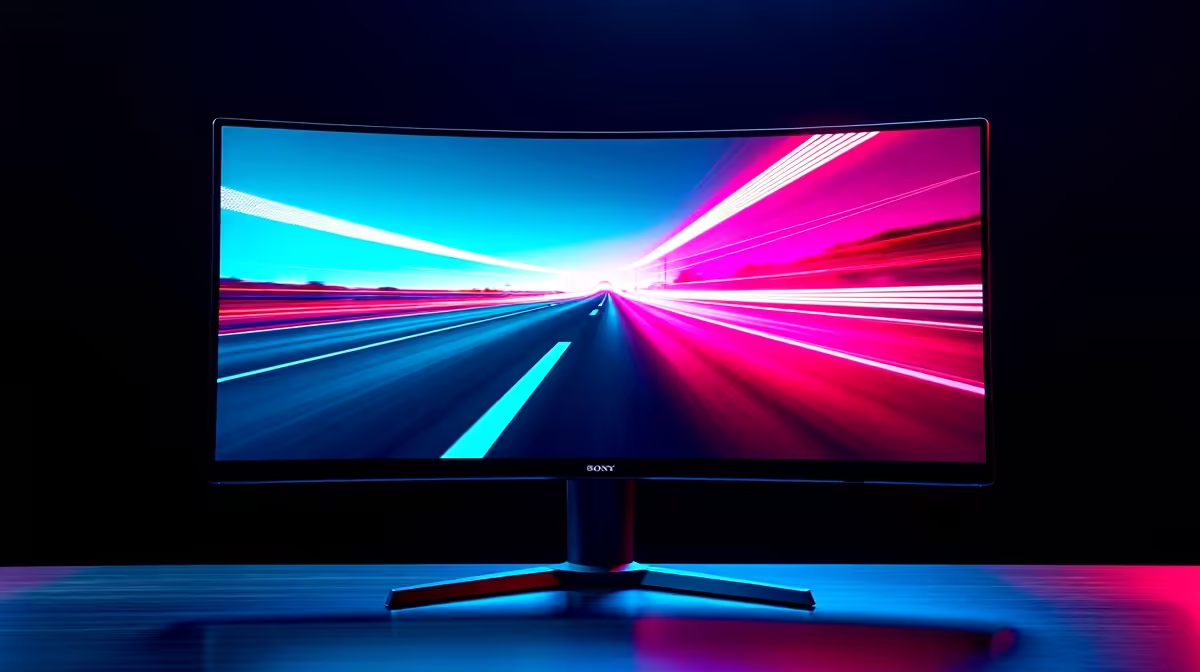
Staring down the final circle in Warzone, you whip your mouse around for the winning shot... and the world tears in half. That jarring horizontal line, that split-second stutter, is screen tearing. For South African gamers, this isn't just an annoyance; it's the difference between a glorious win and a frustrating loss. The solution lies in a technology called adaptive sync, and the two biggest names in the ring are FreeSync and G-Sync. Let's settle the debate.
What is Adaptive Sync and Why Should You Care?
At its core, screen tearing happens when your graphics card (GPU) sends out frames at a different rate than your monitor can display them. It's a mismatch. Adaptive sync technology solves this by allowing your monitor's refresh rate to dynamically match the frame rate your GPU is producing.
The result? 🎯 Buttery-smooth gameplay with no tearing, less stutter, and reduced input lag. It's a non-negotiable feature for anyone serious about their gaming experience. The main battleground for this tech is FreeSync vs G-Sync.
Breaking Down FreeSync: The AMD Standard
Developed by AMD, FreeSync is an open-standard technology. This means monitor manufacturers don't have to pay a licensing fee to use it, which often translates to more affordable prices for you, the gamer.
Because it's an open standard, the quality can vary. To fix this, AMD introduced tiers:
- FreeSync: The basic level, preventing tearing.
- FreeSync Premium: Adds mandatory low framerate compensation (LFC) and at least a 120Hz refresh rate at 1080p.
- FreeSync Premium Pro: Includes everything from Premium plus HDR (High Dynamic Range) support for incredible colour and contrast.
This flexibility makes it easy to find a huge variety of PC monitors that fit almost any budget.
Understanding G-Sync: The NVIDIA Powerhouse
G-Sync is NVIDIA's proprietary solution. For a long time, G-Sync monitors required a special hardware module—a dedicated scaler chip—built into the display. This module handles the sync process, leading to a very strict and consistent quality standard. If a monitor has the official G-Sync badge, you know it has passed NVIDIA's rigorous testing. 🖥️
This hardware requirement typically makes G-Sync monitors more expensive. The main tiers are:
- G-Sync Compatible: These are essentially top-tier FreeSync monitors that NVIDIA has tested and certified to work well with their GPUs. They don't have the dedicated hardware module.
- G-Sync: Features the dedicated NVIDIA processor for a premium, stutter-free experience.
- G-Sync Ultimate: The best of the best, with the dedicated processor plus advanced HDR support for breathtaking visuals.
You'll find these technologies across a wide selection of all gaming monitors, each promising a new level of smoothness.
Check Your Compatibility! ⚡
Just because a monitor is FreeSync doesn't mean it won't work with your NVIDIA card. Many FreeSync monitors are 'G-Sync Compatible'. Before buying, check reviews and official lists from NVIDIA to see if the FreeSync monitor you're eyeing has been certified. You might save a few thousand Rand without sacrificing performance.
The Big Showdown: FreeSync vs G-Sync Head-to-Head
So, how do they stack up for a gamer in Mzansi? Let's get straight to it.
Performance & Quality
Historically, G-Sync's dedicated hardware gave it a slight edge in performance consistency, especially at very low frame rates. However, with the introduction of FreeSync Premium and Premium Pro, that gap has almost completely vanished. For most gamers, the visual experience between a G-Sync monitor and a high-quality FreeSync Premium monitor will be identical. The choice often comes down to your GPU and your budget.
Cost & Accessibility in South Africa 💰
This is where FreeSync has a clear advantage. The lack of licensing fees means you can find fantastic best PC monitor deals on FreeSync displays. If you're building a rig on a budget, a FreeSync monitor is an excellent way to get smooth gameplay without breaking the bank. G-Sync monitors command a premium price for their certified performance.
Which One is Right for Your Rig?
The FreeSync vs G-Sync decision ultimately comes down to your specific setup and priorities.
- If you have an AMD GPU: Go with a FreeSync Premium or Premium Pro monitor. It's a no-brainer.
- If you have an NVIDIA GPU: You have more options. A G-Sync Compatible monitor offers the best value. If money is no object and you want guaranteed top-tier performance for your RTX 4090, a true G-Sync or G-Sync Ultimate display is a fantastic choice, especially if you're looking at high-end 5K & 4K monitors for maximum immersion.
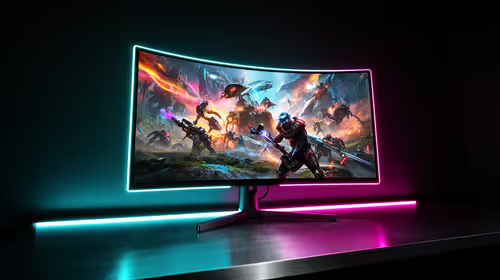
- For Immersive Setups: Both technologies are widely available on stunning curved monitors that pull you right into the action.
- For Gaming on the Go: Even some of the latest portable monitors are starting to incorporate adaptive sync, perfect for LANs or travel.
Once you've chosen your screen, don't forget the right DisplayPort cable and stand; check out our range of monitor accessories to complete your setup. ✨
Ready to Find Your Perfect Match?
The FreeSync vs G-Sync debate shows there's a perfect monitor for every build and budget. Banish screen tearing forever and experience gaming the way it's meant to be played. Explore our massive range of gaming monitors and find the perfect display to conquer your world.