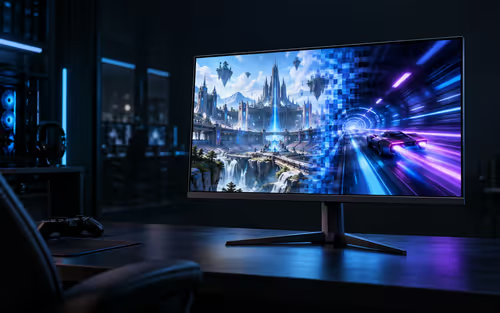
You’re lining up the perfect shot... and just as you click, a jagged line tears across your screen, ruining the moment. That frustration is real for so many South African gamers. The solution is adaptive sync, but it sparks the ultimate question for any PC builder: FreeSync vs G-Sync? Which one is best for your rig and your wallet? Let’s break it down and help you choose the right tech for perfectly smooth gameplay.
So, What is Adaptive Sync Anyway? 🔧
Before we get into the FreeSync vs G-Sync showdown, let's quickly cover what this technology actually does.
In simple terms, your graphics card (GPU) creates images (frames) at a variable rate, while your monitor refreshes its screen at a fixed rate. When these two are out of sync, you get visual glitches like:
- Screen Tearing: The monitor displays parts of multiple frames at once.
- Stuttering: The same frame is shown twice, causing a jerky motion.
Adaptive sync technology forces your monitor to refresh only when the GPU has a new frame ready. This synchronisation creates a seamless, fluid experience, which is vital in fast-paced competitive games.
Understanding G-Sync: The NVIDIA Standard
NVIDIA's G-Sync was the first to the party. It traditionally required a proprietary hardware module inside the monitor, which talks directly to your NVIDIA GeForce graphics card. This ensures a very high standard of quality and performance.
G-Sync Tiers Explained
- G-Sync Compatible: These are actually FreeSync monitors that NVIDIA has tested and certified to work well with their GPUs. It’s a great entry point.
- G-Sync: The classic version with the dedicated hardware module, offering a fantastic variable refresh rate (VRR) range.
- G-Sync Ultimate: The top-tier experience, guaranteeing brilliant HDR, ultra-low latency, and premium image quality, often found in high-end 4K and 5K monitors.
The main takeaway? G-Sync offers a premium, tightly controlled experience but often comes at a higher price and locks you into the NVIDIA ecosystem.
Breaking Down FreeSync: The AMD Open Standard
AMD FreeSync is the main competitor to G-Sync. Its biggest advantage is that it’s built on an open standard (DisplayPort Adaptive-Sync). This means monitor manufacturers don’t need to pay licensing fees or install special hardware, making FreeSync monitors much more common and affordable. You'll often find them featured in our best PC monitor deals.
FreeSync Tiers Explained
- FreeSync: The base level, which eliminates tearing and stutter.
- FreeSync Premium: Adds a requirement for at least a 120Hz refresh rate at 1080p resolution and includes Low Framerate Compensation (LFC).
- FreeSync Premium Pro: Includes everything from Premium, but adds optimised support for HDR content.
Because it's an open standard, the quality can vary more than with G-Sync. However, a good FreeSync Premium Pro monitor offers an experience that is virtually indistinguishable from G-Sync for most gamers.
Check for LFC! ⚡
When choosing a FreeSync monitor, look for one that supports Low Framerate Compensation (LFC). This feature prevents stuttering when your game's frame rate drops below the monitor's minimum refresh rate by duplicating frames. It’s a key feature that brings FreeSync performance much closer to the G-Sync experience, especially in demanding games.
FreeSync vs G-Sync: Which is Best for Your SA Gaming Rig? 🏆
So, the million-rand question: which one should you buy? The G-Sync vs FreeSync decision really boils down to three things: your GPU, your budget, and your performance expectations.
The Deciding Factors
- Your Graphics Card: This is the most important factor. If you have an AMD Radeon GPU, FreeSync is your only choice. If you have an NVIDIA GeForce GPU, you can use a G-Sync monitor or a certified G-Sync Compatible (FreeSync) monitor.
- Your Budget: In South Africa, every Rand counts. FreeSync monitors are almost always cheaper than their G-Sync counterparts with similar specs. This allows you to either save money or put those savings towards a better GPU or other PC components.
- Your Desired Experience: If you want the absolute guaranteed best-of-the-best performance with zero hassle, a true G-Sync or G-Sync Ultimate monitor is a safe bet. However, for 99% of gamers, a quality FreeSync Premium Pro monitor will deliver an incredible, smooth experience.
Ultimately, both technologies are fantastic. The competition has pushed innovation forward, giving us a huge selection of all gaming monitors to choose from, whether you're after immersive curved monitors or even a handy portable monitor for your on-the-go setup. Just don't forget the right stands and cables from our monitor accessories section to complete your battle station! ✨
Ready to Banish Tearing for Good?
The FreeSync vs G-Sync debate comes down to your GPU and budget. But one thing is certain: a smooth display is non-negotiable. Explore our incredible PC monitor deals and find the perfect screen to give you the competitive edge in South Africa.