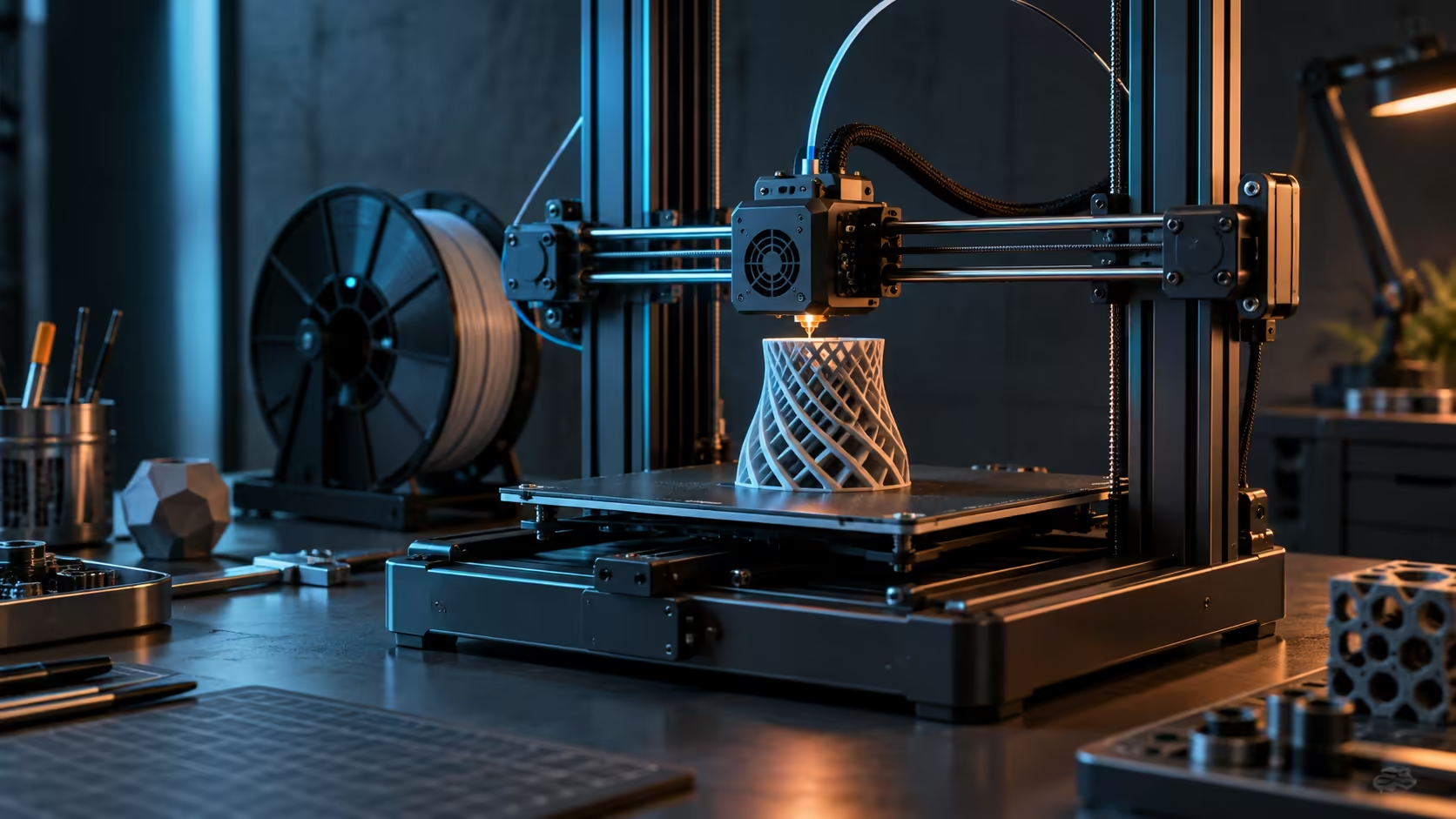
A linear rail looks like a simple steel bar with a block riding on it, and the engineering hiding inside that block is where most of the actual benefit comes from. Linear rail axes carry load through rows of tiny recirculating ball bearings inside a precision-ground groove, and that construction changes print quality in ways that go beyond the obvious "it feels sturdier" impression. Creality fits one to the X-axis of the Ender-3 V3 KE specifically, in place of the wheels that axis carried on older Ender-3 machines.
Quick Answer
A linear rail carries load on recirculating ball bearings running inside a ground groove, which keeps a toolhead square through hard direction changes and shows up as cleaner corners at speed. The R5,799 Ender-3 V3 KE carries one on its X-axis by name, the axis where Creality specifically swapped wheels for a rail against the older Ender-3 line; other axes and other printers are not implied by price or top speed alone, so check each one on its own terms.
🔬 What is actually inside the carriage block
A linear rail assembly has two halves: the rail itself, a hardened steel bar with a precisely ground groove running its length, and a carriage block that rides along it, packed internally with small steel balls arranged in rows. As the block moves, the balls at the front roll along the groove, reach the end, recirculate back through an internal channel inside the block, and re-enter at the rear, continuously supporting the load rather than a fixed set of bearings simply sliding along.
Many rail assemblies also carry a small amount of built-in preload, often as little as 0.005mm of interference, meaning the balls sit under a tiny amount of constant pressure against the groove even with no external load applied. That preload removes any looseness inside the assembly itself before a single print even starts, which is part of why a rail-equipped axis tends to feel noticeably more solid to push by hand than a V-wheel axis does.
🎯 Precision means repeatable, not just tight
"Precision" in this context is less about how tightly a single measurement comes out and more about how consistently the axis returns to the same position time after time, a property engineers call repeatability. A rail's ground groove and preloaded bearing rows hold an extremely small, consistent position error across thousands of direction changes, which matters more for print quality than any single measurement ever could, since a print is really thousands of tiny repeated moves stitched together.
A wheel-based axis can still measure accurately when new, but its repeatability degrades as the wheels wear unevenly over 6 to 12 months of use, introducing small, inconsistent position errors that a rail's hardened, ground surfaces resist far longer.
⚙️ Friction, stiction and why it matters for microstepping
A stepper motor moves in small, discrete increments, often 1.8 degrees per full step and much finer once microstepped, and how cleanly those increments translate into actual toolhead motion depends partly on the friction the axis presents. Rolling friction inside a linear rail stays low and consistent throughout the whole range of travel, which lets a stepper's fine microsteps translate smoothly into position changes rather than fighting through resistance that varies as the carriage moves.
A V-wheel axis instead relies on the friction between polycarbonate wheels and an aluminium extrusion surface, and that contact can exhibit a small difference between static friction, the resistance to starting from a standstill, and kinetic friction, the resistance once already moving. That difference, called stiction, can cause a very slight hesitation right at the start of a direction reversal, which is subtle enough to go unnoticed in daily use but shows up under close inspection as tiny irregularities in corner geometry that a rail's more consistent rolling friction avoids.
🖼️ What actually shows up on a finished part
The practical result of lower, more consistent friction and better repeatability is corners and curves that hold their intended shape more faithfully at speed, and a surface finish on vertical walls that stays consistent from the first layer to the last rather than drifting subtly as wheels wear in over the printer's lifetime. This is most visible on tall prints with many repeated direction changes per layer, where small, cumulative position errors have the most opportunity to compound into something visible.
None of this replaces good tuning elsewhere in the system, and a rail-equipped axis with loose belts or poor acceleration settings still produces a mediocre print. Read axis type as one line among several when sizing up the 3D printer range against an Elegoo or any other brand, and keep a basic tool kit on hand regardless of which axis type a machine uses, since both still benefit from periodic checks even if the specific maintenance task differs.
Belt condition sits alongside the axis type as an equally important variable, and it is worth stressing that a worn or loose belt undermines even the best rail hardware. A rail can hold a carriage perfectly square through a direction change, but if the belt driving that carriage has stretched or lost tension, the position error simply moves from the axis itself to the belt, and the finished print shows the same kind of inconsistency either way. Checking belt tension periodically is a five-minute habit that protects whatever axis hardware sits underneath it, rail or wheel alike.
Frequently Asked Questions
Which axis on the Ender-3 V3 KE actually has the rail?
The X-axis. Creality names it directly as the axis that replaced wheels with a linear rail compared with older Ender-3 models, without extending that claim to the Y-axis or Z-axis.
Does a linear rail need any adjustment over time?
Far less than a V-wheel axis. Occasional lubrication of the rail keeps the internal bearings running smoothly, but there is no equivalent to tightening an eccentric nut.
What does preload actually do?
It removes internal looseness in the carriage block before any external load is applied, which is part of why a rail-equipped axis feels solid even when pushed by hand.
Is stiction a real problem on V-wheel printers?
It is subtle rather than severe, showing up as very slight irregularities at direction reversals rather than an obvious print defect, but it is a genuine, measurable difference from rail-based friction.
Does a linear rail guarantee better print quality on its own?
No. It removes one source of inconsistency, but belts, acceleration settings and frame rigidity all still need to be correct for the rail's advantage to show up in the finished part.
How do I check whether a specific printer uses linear rails?
Open the case and look, or listen while it runs: a rail axis moves with a smooth, almost silent roll, where a V-wheel axis has a faint, consistent hum from the wheel-to-extrusion contact even when everything is correctly adjusted. Neither price nor speed rating tells you this on their own.
Ready to understand what is actually driving your toolhead?
Check the axis type in the specification sheet, and remember that good tuning still matters whichever type you have.