


PCIe 5.0 vs PCIe 4.0 for Video Editing in 4K in SA
PCIe 5.0 and PCIe 4.0 differ most in lane support, compatibility, and upgrade value for video editing in 4k. SA buyers should match the choice to their actual hardware and games.
Read moreDiscover essential mini pc cybersecurity strategies to protect your business assets. Mini PCs offer incredible power in a small footprint, but they can be vulnerable. Learn how to lock down your network, secure data, and prevent breaches with our expert guide. 🛡️ Don't let their size fool you; secure your compact powerhouse today!

Thinking of upgrading your office with a sleek, space-saving Mini PC? These little powerhouses are brilliant for South African businesses, but their small size can hide a big risk. Without proper mini PC cybersecurity, you could be leaving your company's sensitive data dangerously exposed. Don't worry, we're here to show you how to lock down that compact rig and protect your hard work from digital threats. 🛡️
It's easy to see a Mini PC and underestimate it. But inside that tiny chassis is a full-featured computer, complete with the same vulnerabilities as a giant desktop tower. For a small or medium-sized business in South Africa, where every rand and client counts, overlooking mini PC cybersecurity can be a costly mistake.
Whether you're using them for point-of-sale systems, digital signage, or as workstations for your team, these devices are gateways to your network. A single breach could lead to ransomware locking up your files, theft of customer data, or financial loss. The threat is real, but the solutions are straightforward. Building a strong defence starts with understanding that the security of your compact PC is just as critical as the server in your backroom. Inside these devices are powerful Mini PC components that require robust protection.
Securing your Mini PC doesn't require a massive IT budget. It starts with implementing fundamental best practices that create a strong first line of defence. Getting these basics right is the most important part of your mini PC cybersecurity strategy.
First, let's talk about the most obvious risk: theft. A Mini PC is small enough to slip into a bag.
Your device's software is its digital frontline. Keeping it hardened against attacks is crucial.
When you're ready to invest in a new device, you can explore our full range of Mini PCs to find a model with the latest security features built-in.
Many business-grade Mini PCs come with Windows 11 Pro, which includes BitLocker Drive Encryption. Enable it! Go to Settings > Privacy & security > Device encryption. This scrambles the data on your drive, making it unreadable to a thief even if they steal the physical device. It’s a powerful layer of data protection that costs you nothing extra.
Once you've locked down the device itself, the next step is to secure its connection to the outside world and the data it holds. This is where you can truly fortify your business against more sophisticated threats and ensure operational continuity. 🚀
A comprehensive approach to mini PC cybersecurity involves thinking about the entire ecosystem, not just a single machine. For businesses looking for cost-effective solutions, there are excellent Mini PCs for under R22,000 that support these advanced security measures.
Protection is vital, but so is preparation for the worst-case scenario. A reliable backup strategy means a ransomware attack is an inconvenience, not a catastrophe.
By combining physical security, software hardening, and smart network practices, you can transform your Mini PC from a potential liability into a secure and productive business asset.
Ready to Secure Your Business with a Compact Powerhouse? A Mini PC is a smart investment for any South African business, offering power without the bulk. Choosing a secure foundation is the first step. Browse Evetech's huge selection of Mini PCs and find the perfect machine to protect and grow your operations.
Yes, mini PCs can be highly secure for business if you implement proper cybersecurity measures. This includes using strong passwords, regular software updates, and robust mini pc endpoint security solutions.
The primary cybersecurity risks of mini PCs include physical theft due to their size, malware infections, and unauthorized network access. A thorough vulnerability assessment is crucial for mitigation.
To improve security, enable full-disk encryption, install reputable antivirus software, configure a firewall, and follow compact pc security best practices like disabling unused ports and services.
Absolutely. A properly configured firewall is a critical first line of defense, controlling network traffic to protect your business data on mini PCs from unauthorized access and external threats.
Yes, many businesses repurpose powerful mini PCs as dedicated firewalls, VPN servers, or network intrusion detection systems, significantly enhancing their overall security posture.
Physical security is vital. Because of their small size, mini PCs are easy to steal. Securing them with physical locks or in locked cabinets is a key step in protecting business data.
PCIe 5.0 and PCIe 4.0 differ most in lane support, compatibility, and upgrade value for video editing in 4k. SA buyers should match the choice to their actual hardware and games.
Read more
ATX 3.1 and ATX 3.0 differ most in connector handling and GPU power design. For SA gamers, the choice comes down to your graphics card, PSU quality, cable clearance, and whether a newer 12V-2x6-ready unit makes sense for the build.
Read more
80+ Platinum or 80+ Titanium for cinematic should be shortlisted around the job it must do. South African buyers should compare fit, performance, compatibility, and upgrade room, warranty path, and upgrade room before treating any pick as best.
Read more
AM5 and AM4 can both work for competitive esports, but the real-world difference is platform headroom. SA players should compare CPU choices, memory speed, latency goals, monitor refresh, and future upgrade plans.
Read more
LGA 1851 and LGA 1700 differ most in CPU support, compatibility, and upgrade value for couch co-op gaming. SA buyers should match the choice to their actual hardware and games.
Read more
DLSS 4 and DLSS 3 differ most in game support, compatibility, and upgrade value for streaming on twitch and youtube. SA buyers should match the choice to their actual hardware and games.
Read more
Tests reported audio capture and local-network scanning on a specific LG television with its screen off. LG says supported standby modes can keep voice and connected-device features active, so owners should review model-specific settings.
PCIe 5.0 and PCIe 4.0 differ most in lane support, compatibility, and upgrade value for video editing in 4k. SA buyers should match the choice to their actual hardware and games.
Real world difference between b850 b650 mmo live service games sits in stability, networking, storage, and upgrade room. SA players should compare LAN quality, USB layout, RAM support, and SSD slots for always-updated games.
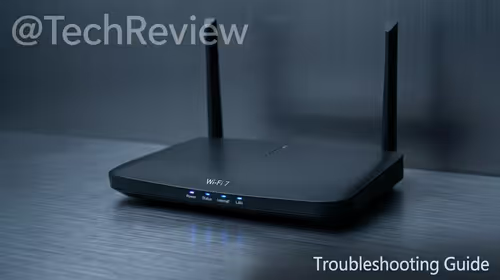
Dead Pixel on Wi-Fi 7 Router is likely a display-path or source-title issue, so check the screen, cable, driver state, and related system symptoms before blaming the device itself.
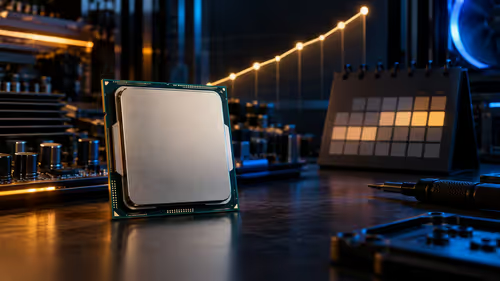
Industry reports point to another roughly 10 percent Intel processor increase from 5 October, but Intel has not published a consumer price list confirming the scope. South African buyers should treat it as a risk signal, not a guaranteed Rand change.
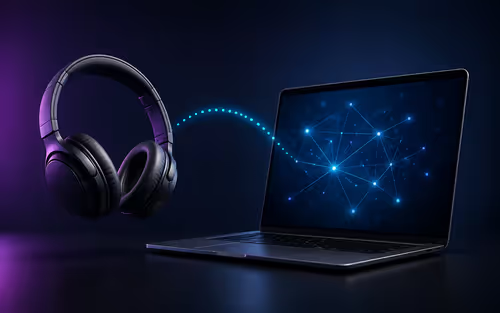
Put the headphones in pairing mode, open Bluetooth and devices in Windows 11, then add the headset. If it fails, remove the old pairing and check charge, range and drivers.
Microsoft says upcoming Windows 11 work will target memory use on 8GB PCs and improve boot and sign-in responsiveness. There is no public release date or measured uplift yet.
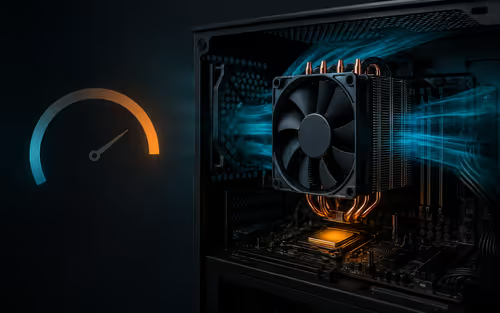
Windows 11 does not show CPU temperature in its standard Settings pages. Use your CPU maker's supported utility or a trusted monitor, then read idle and loaded temperatures in context.
Industry reports point to another roughly 10 percent Intel processor increase from 5 October, but Intel has not published a consumer price list confirming the scope. South African buyers should treat it as a risk signal, not a guaranteed Rand change.
Tests reported audio capture and local-network scanning on a specific LG television with its screen off. LG says supported standby modes can keep voice and connected-device features active, so owners should review model-specific settings.
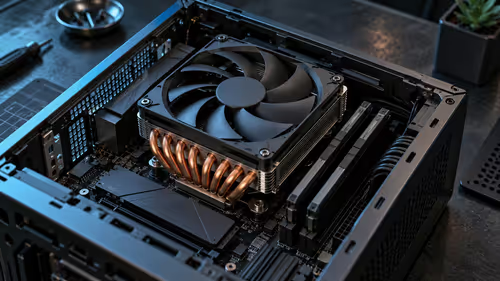
Thermalright's AXP120-X77 is a 77 mm top-down cooler with six heatpipes and a slim 120 mm fan. Local availability is not confirmed, so compact-PC builders should verify case height, memory clearance and socket support before comparing it with stocked coolers.
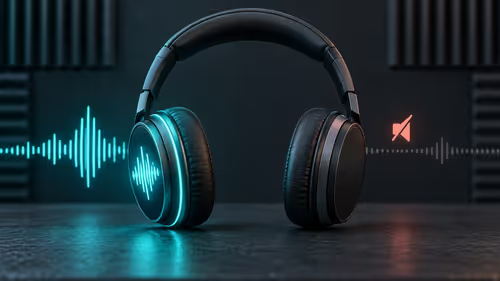
One-sided sound can come from balance settings, a dirty or loose connector, Bluetooth pairing data, firmware, the source device or a failed cable or driver. A short swap test isolates the cause before you reset software or replace the headset.