Building a new gaming rig in South Africa? You're likely staring at motherboard specs, wondering if PCIe 5.0 is worth the extra Rands over the trusty PCIe 4.0. Is it all marketing hype, or will it actually make your games run faster? This guide cuts through the noise. We'll break down the complete history and real-world performance of PCIe 5.0 vs 4.0, helping you make a smart choice for your next build.
A Quick History of PCIe Generations
Before diving into the PCIe 5.0 vs 4.0 debate, let's understand what we're talking about. Peripheral Component Interconnect Express (PCIe) is the high-speed bus that connects vital components like your graphics card and SSD to your motherboard and CPU. Think of it as the N1 highway of your PC... every new generation widens the road and increases the speed limit.
Each major PCIe version has effectively doubled the bandwidth of the one before it:
- PCIe 3.0 (2010): The long-reigning king, offering 8 GT/s (gigatransfers per second).
- PCIe 4.0 (2017): Doubled the speed to 16 GT/s, becoming mainstream with AMD's Ryzen 3000 series CPUs.
- PCIe 5.0 (2019): Doubled it again to a blistering 32 GT/s.
This consistent doubling is the key to understanding its potential. 🚀
PCIe 5.0 vs 4.0: The Real-World Performance Impact
So, what does doubling the bandwidth from 4.0 to 5.0 actually mean for you? The answer depends entirely on the component you're connecting.
For Your Graphics Card (GPU)
Here’s the surprising truth for most gamers: the performance difference is currently almost zero. Even a monster GPU like the NVIDIA GeForce RTX 4090 doesn't fully saturate a PCIe 4.0 x16 slot in gaming scenarios. While benchmarks might show a 1-2% difference in some edge cases, you won't feel it in-game. For now, your GPU is not being bottlenecked by PCIe 4.0.
For Your Storage (NVMe SSD)
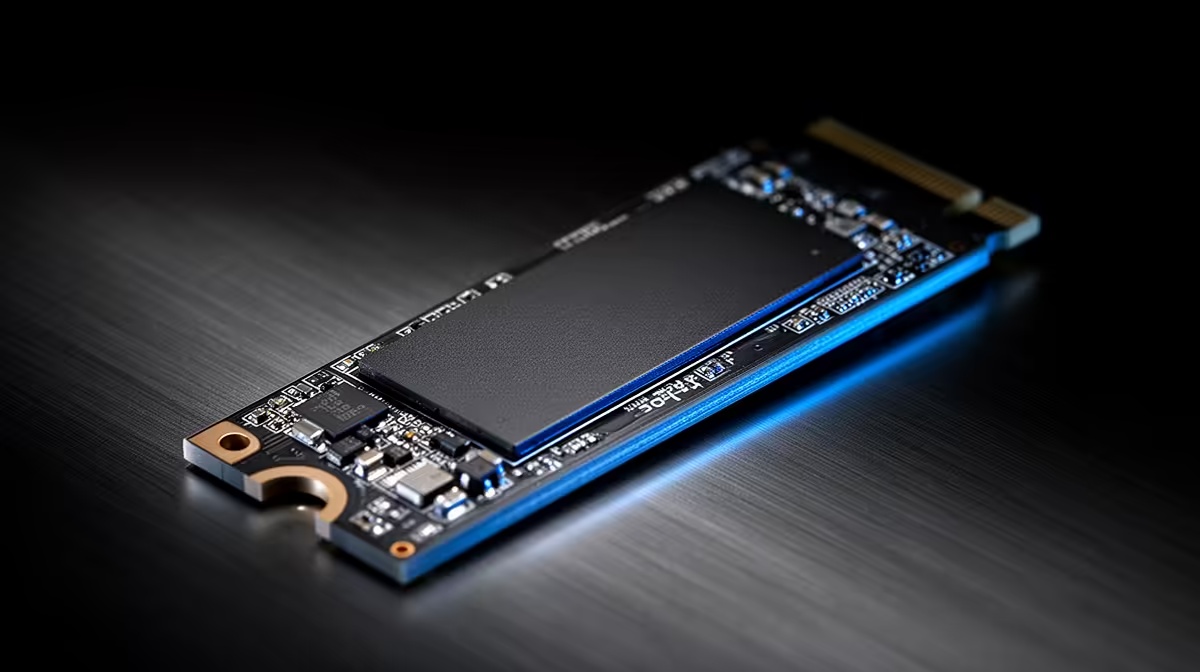
This is where PCIe 5.0 truly shines. ✨ A PCIe 4.0 NVMe SSD can reach read speeds of around 7,000 MB/s. That's incredibly fast. But a PCIe 5.0 NVMe SSD can scream past 12,000 MB/s.
For gamers, this means slightly faster loading times. For content creators, video editors, or anyone moving massive files, this speed is a massive quality-of-life improvement. Transferring huge 4K video files or loading complex project assets happens in a flash.
Check Your Slots! 🔧
Just because a motherboard supports PCIe 5.0 doesn't mean every slot does. Often, only the primary x16 slot (for the GPU) and one M.2 slot (for an SSD) will be Gen 5. Always check the motherboard's official spec sheet to confirm which slots offer Gen 5 speeds before you buy.
So, Is a PCIe 5.0 Build Worth It in South Africa?
This is the big question. The answer depends on your budget and your goals. Let's break down the PCIe 5.0 vs 4.0 decision for different types of builders.
For the Pragmatic Gamer & Value Hunter
If your primary goal is gaming and getting the best performance for your money today, PCIe 4.0 is the smart choice. The ecosystem is mature, more affordable, and delivers 99% of the gaming performance of its newer sibling. You can invest the money you save on a PCIe 5.0 motherboard into a better GPU or CPU, which will give you a much bigger real-world performance boost. There are tons of excellent and affordable motherboards that provide a rock-solid PCIe 4.0 foundation.
For the Future-Proofer & Power User
Are you building a top-tier machine that you don't want to touch for the next five years? Do you work with massive files or just want the absolute fastest tech available? Then PCIe 5.0 is for you. While its benefits for gaming are minimal now, future GPUs might finally leverage that extra bandwidth. Investing in a Gen 5-ready platform ensures you're prepared for whatever comes next.
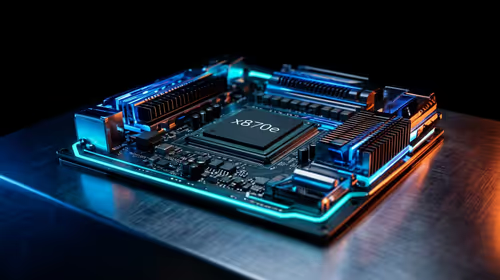
When choosing this path, you'll find powerful options across both major platforms. The latest Intel motherboards offer a mix of DDR4 and DDR5 support alongside PCIe 5.0, giving you flexibility. Meanwhile, many modern AMD motherboards on the AM5 platform have made PCIe 5.0 a standard feature, locking in that next-gen potential.
The verdict on PCIe 5.0 vs 4.0 is clear: 4.0 is the value king for today's games, while 5.0 is the forward-looking choice for elite performance and future-proofing.
Ready to Choose Your Foundation?
The PCIe 5.0 vs 4.0 debate is all about matching the tech to your goals. Whether you're chasing value or future-proofing your rig, the right motherboard is the heart of your build. Explore our huge range of PC components and find the perfect parts to power your passion.