


80+ Gold vs 80+ Platinum for Couch co-op gaming in SA
80+ Gold vs 80+ Platinum for couch co-op gaming is about PSU efficiency, heat, fan behaviour, quality, and wattage headroom, not direct FPS. SA buyers should compare the whole build.
Read moreConfused about monitor refresh rate South Africa? Our deep dive explains everything from Hz to response time and display tech like OLED vs QLED. 🖥️ Understand what matters for silky-smooth gameplay and find the perfect monitor for your setup. Get the competitive edge today! ✨
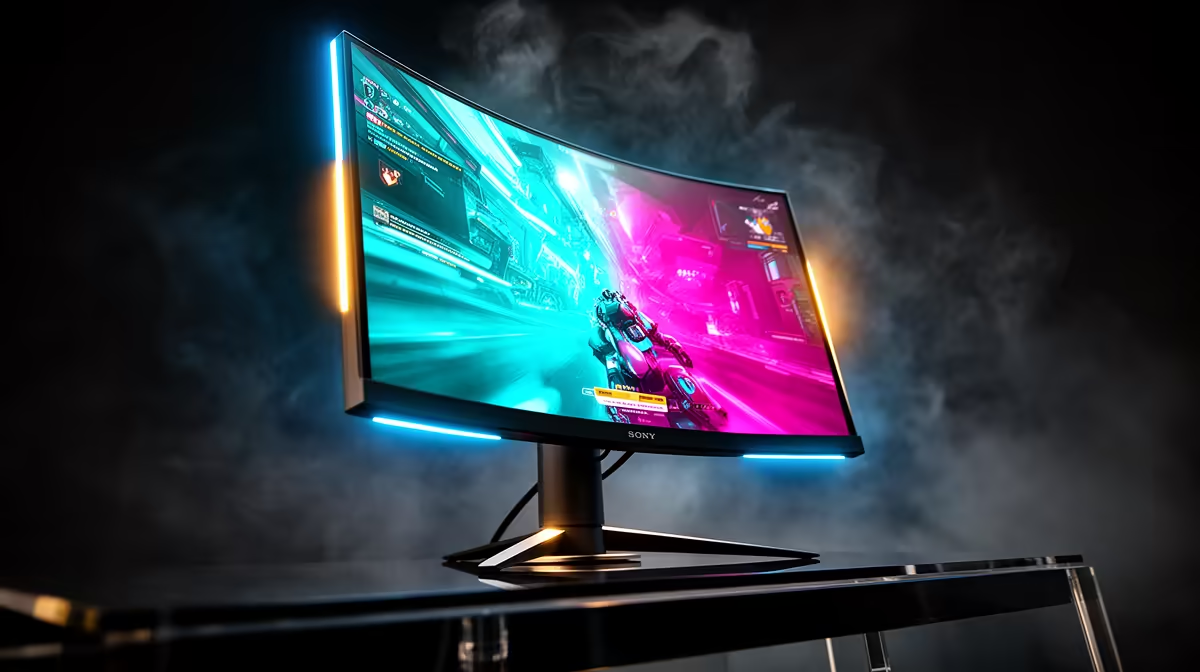
Ever felt like you were a split-second behind in a tense Valorant clutch or a frantic Warzone firefight? You clicked first, you aimed true... but you still ended up spectating. That frustrating moment might not be your skill or your internet connection. It could be your monitor’s refresh rate. Understanding how a high monitor refresh rate in South Africa can transform your gaming experience is the first step toward gaining a real competitive edge. Let's dive in. 🚀
Think of your monitor like a high-tech flipbook. The refresh rate, measured in Hertz (Hz), is simply how many times per second the screen can draw a new image. A 60Hz monitor updates the picture 60 times a second, while a 144Hz monitor does it 144 times. More updates mean a smoother, more fluid image.
It's crucial not to confuse this with Frames Per Second (FPS), which is how many frames your graphics card produces. If your GPU is pumping out 120 FPS but your monitor is only 60Hz, you're effectively throwing away half of those frames. To see the benefit, your monitor's refresh rate needs to match or exceed your GPU's output. This simple concept is the foundation for choosing from the vast range of PC monitors available today.
So, how much of a difference does it really make? The leap from 60Hz to 144Hz is the most significant upgrade any serious gamer can make.
This is the baseline for most office and budget displays. It’s perfectly fine for browsing the web, watching videos, and playing slower-paced, single-player games. But in fast-paced shooters or racing games, 60Hz can feel choppy and blurry during quick movements, putting you at a disadvantage.
This is where the magic happens. Moving from 60Hz to 144Hz is a night-and-day difference. Motion becomes incredibly smooth, aiming feels more responsive, and tracking fast-moving targets is far easier. For most gamers in South Africa, a 144Hz or 165Hz monitor offers the best performance-to-price ratio. It provides a tangible competitive advantage without requiring a top-of-the-line PC to run effectively, making it a key feature across all our gaming monitors.
Are you playing competitively for rank or prize money? A 240Hz or even 360Hz monitor can provide that final fractional edge. The improvement over 144Hz is more subtle but can be the deciding factor in high-level play where reaction times are measured in milliseconds. These ultra-high refresh rate monitors often come with some of the best PC monitor deals when paired with powerful systems.
Not sure what you're running? It's easy to check. On Windows 11, right-click your desktop, go to 'Display settings', scroll down to 'Advanced display', and you'll see your refresh rate listed. Make sure it's set to the highest value your monitor supports! Many people forget to do this after setup.
A high refresh rate is king for gaming, but it's part of a team. To get the best experience, you need to consider these other key specs.
Even for those on the move, you don't have to sacrifice performance. Modern portable monitors are now available with high refresh rates, perfect for a LAN party or a dual-screen laptop setup.
Choosing the right monitor refresh rate in South Africa comes down to your primary use case and budget. For competitive gaming, 144Hz is no longer a luxury... it's the standard.
Ready to See the Difference? A high refresh rate monitor is one of the most impactful upgrades you can make to your PC setup. Stop letting your screen be the bottleneck. Explore our incredible monitor deals and find the perfect display to dominate the competition.
For competitive gaming, 144Hz is the sweet spot, offering a huge leap in smoothness over 60Hz. Pro gamers often prefer 240Hz or higher for the ultimate competitive edge.
Absolutely. A 144Hz monitor provides a significantly smoother and more responsive gaming experience, which is crucial for fast-paced titles and gives you a clear advantage.
Both are adaptive sync technologies that prevent screen tearing. G-Sync is NVIDIA's proprietary tech, while FreeSync is AMD's open standard, often making monitors more affordable.
IPS panels offer the best colour accuracy and viewing angles. VA panels have superior contrast for deeper blacks, and TN panels provide the fastest response times for pro gamers.
OLED monitors deliver perfect blacks and incredible contrast, making games look stunning. QLEDs get brighter and are less susceptible to burn-in, great for mixed-use.
Yes. To take advantage of a high refresh rate monitor, your GPU must be powerful enough to render frames at a rate that matches or exceeds the monitor's Hz.
Response time is how quickly a pixel can change colour. A low response time (e.g., 1ms) reduces motion blur, resulting in a clearer picture during fast-paced action.
80+ Gold vs 80+ Platinum for couch co-op gaming is about PSU efficiency, heat, fan behaviour, quality, and wattage headroom, not direct FPS. SA buyers should compare the whole build.
Read more
80+ Platinum or 80+ Titanium for competitive should be shortlisted around the job it must do. South African buyers should compare fit, performance, compatibility, and upgrade room, warranty path, and upgrade room before treating any pick as best.
Read more
The real world difference between IPS and OLED for AAA single-player gaming is immersion versus versatility. OLED lifts contrast and dark scenes, while IPS can suit bright rooms, mixed PC use, and SA buyers watching total setup cost.
Read more
HDMI 2.1 vs HDMI 2.0 for SA MMO needs a workload-first comparison. For SA buyers, judge real performance, platform fit, warranty path, power needs, and upgrade timing before choosing either side.
Read more
USB4 and Thunderbolt 4 differ for competitive esports through dock, display, and capture consistency. Use this real world difference between usb4 and thunderbolt 4 for competitive guide to keep SA tournament desks tidy without assuming better ping.
Read more
Magnetic switches vs Mechanical switches depends on Competitive esports needs, platform limits, and budget fit. Compare compatibility, latency, upgrade path, and real setup constraints before choosing for an SA build.
Read more
B850 motherboard FPS drops needs a methodical troubleshooting pass. Review drivers, thermals, power settings, background apps, cables and game settings before replacing parts in an SA gaming setup.

Gaming PC FPS drops in South Africa often come from drivers, thermals, background apps, power plans, or in-game settings. Check one change at a time and use the same scene before buying upgrades for your local setup.

Difference between PCIe 5.0 and PCIe 4.0 explained for PC builders starts with bandwidth, lanes, and support. SA builders should match the motherboard, GPU, NVMe drive, and budget before choosing a platform.
Windows 11 mechanical keyboard setups rarely cause display banding directly. Fix color banding by checking HDR, colour depth, GPU range, monitor profiles, and any new RGB utility conflicts.

Steam Big Art Mode enlarges library artwork in Big Picture Mode and on Steam Deck, while the same beta adds configurable screensavers. Both features are optional and currently require the Steam beta client.
Diablo 4 HDR settings work best after Windows and the display are calibrated, then the game's black point, brightness and white point are adjusted in that order. Use visible shadow detail and controlled highlights, not copied values from another screen.

The best HOTAS for Elite Dangerous is a separate stick-and-throttle set with enough analogue axes for pitch, roll, yaw and thrust, plus local support. Evetech's captured flight-simulation sample lists the complete Logitech X56 at R4,999.
Nintendo Switch 2 docked VRR arrives with system version 23.0.0 and also requires a dock update. The connected TV or monitor and the running software must support VRR before the output can follow changing frame rates.
750W for RTX 5080 Super needs a full-build check, not a simple yes. Review GPU guidance, CPU draw, transient load, connectors, PSU quality, and upgrade plans before deciding.
80+ Gold vs 80+ Platinum for couch co-op gaming is about PSU efficiency, heat, fan behaviour, quality, and wattage headroom, not direct FPS. SA buyers should compare the whole build.
ultrawide monitor FPS drops needs a methodical troubleshooting pass. Review drivers, thermals, power settings, background apps, cables and game settings before replacing parts in an SA gaming setup.
80+ Platinum or 80+ Titanium for competitive should be shortlisted around the job it must do. South African buyers should compare fit, performance, compatibility, and upgrade room, warranty path, and upgrade room before treating any pick as best.