Panel type arguments tend to get reduced to "VA is dark, IPS is colourful", which is true and also not the whole answer. A VA panel and an IPS panel trade specific, measurable things against each other, and on a curved ultrawide the curve itself changes which of those trade-offs actually matters to you.
Quick Answer
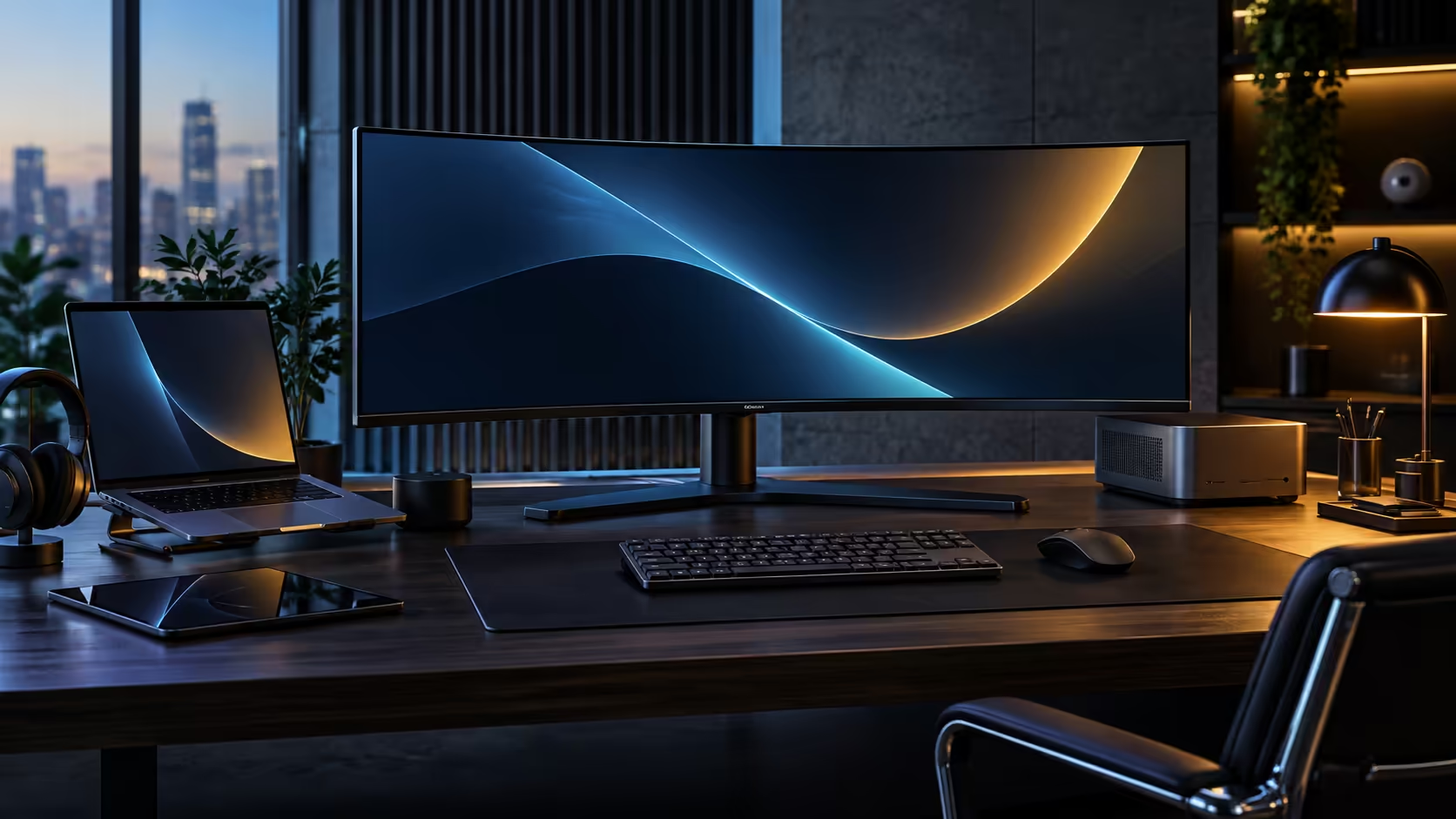
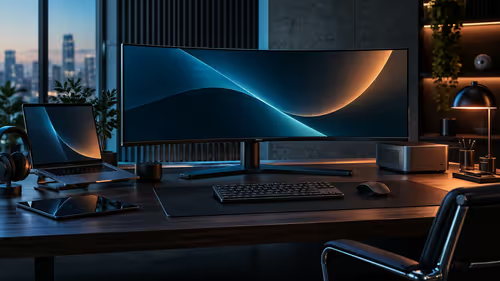
VA panels typically hit static contrast ratios around 3000:1 to 4000:1, against roughly 1000:1 for most IPS panels, which means genuinely deep blacks rather than the greyish black IPS tends to show in a dim room. IPS holds its colour and contrast steadier when viewed from an angle, where VA can shift noticeably. The CU34E4CW is a 1500R VA panel at R7,999, which leans into contrast for film and dark-room use, and the curve itself narrows the angle problem VA is usually criticised for.
⚫ Why VA panels go darker than IPS
The difference comes down to how each panel type blocks light at the pixel level, not just marketing contrast numbers.
A VA panel's crystal structure does a far better job of blocking backlight entirely when a pixel is meant to be black, which is what produces static contrast ratios in the 3000:1 to 4000:1 range on typical VA monitors. An IPS panel's crystal alignment lets more backlight leak through even at "black", which is why IPS monitors commonly sit closer to 1000:1 static contrast and show a slightly grey cast in a dark room rather than true black.
This matters most in dim or dark viewing conditions: a night-time film, a dark game level, or any room with the lights off. In a bright office with daylight hitting the screen, both panel types wash out enough that the contrast gap matters far less.
👁️ Why IPS holds colour steadier off-angle
Viewing angle is the trade IPS wins, and it is worth being specific about why.
IPS panels align their liquid crystals horizontally, parallel to the screen surface, which keeps colour and brightness far more consistent as you move off the direct centre viewing position. VA panels can show colour shift and contrast drop-off at wider angles, particularly noticeable on a large panel where the edges are naturally further from centre on a flat screen.
This is exactly where curvature works in VA's favour. A curve with a 1500mm radius, like the one on the CU34E4CW, bends the panel so every point on the screen sits closer to the same distance and angle from a centred viewer, which reduces the off-angle colour shift VA is normally criticised for. It does not eliminate the difference between the two panel types, but it narrows the practical gap for a single person sitting centred at a desk, which is the normal use case for this kind of screen.
🎨 Where each type genuinely wins
Match the panel to what you actually do on it, rather than treating one type as universally better.
Choose VA, and the R7,999 CU34E4CW specifically, for a home office or gaming desk where the room gets dark, where one person sits roughly centred, and where deep blacks in film and dark game scenes matter more than colour accuracy at odd angles. Choose IPS instead for print or photo colour work, for a desk where a second person regularly looks over your shoulder from the side, or for any task where colour has to look correct rather than just look good.
VA's other known trade-off is slower pixel response in dark-to-dark transitions, sometimes visible as faint smearing in fast, dark scenes, which IPS generally handles with less trailing. For most productivity work and casual viewing this is not something you will notice; for competitive gaming in dark environments it is worth being aware of before you buy.
🌗 Reading a spec sheet for the real difference
Contrast ratio numbers on a box are easy to misread, so it helps to know what to actually compare before you buy on the figure alone.
A "static" contrast ratio, which is what VA panels usually advertise, describes the darkest black against the brightest white the panel can show at the same time, and it is a genuinely comparable number between two VA panels or two IPS panels. A "dynamic" contrast ratio, sometimes printed as a much larger figure like 50,000,000:1, describes the backlight dimming for an all-dark scene and brightening for an all-bright one, which is a different measurement and not directly comparable to a static figure. When you see a VA panel's 3000:1 sitting next to an IPS panel's headline number that looks far higher, check whether both are static before treating the comparison as fair.
Response time printed on the box, often quoted in milliseconds, is a related but separate spec from panel type. It describes how quickly a pixel changes state and interacts with panel type rather than replacing it: a VA panel with a fast quoted response time still carries VA's characteristic slower dark-to-dark transition in practice, because that particular transition is the hardest one for VA liquid crystal to do quickly, regardless of the number printed on the spec sheet.
For a broader look at both panel types side by side, the curved monitor range and the general monitor category both carry current VA and IPS options, and the office monitor range is the shelf this specific docking ultrawide sits on.
Frequently Asked Questions
Is VA or IPS better for a dark room?
VA, because its higher static contrast ratio produces noticeably deeper blacks than IPS in low light. IPS tends to show a greyish cast where VA shows true black.
Does the curve on a VA monitor fix its viewing angle weakness?
It narrows the problem rather than eliminating it. A tight curve like 1500R keeps every part of the screen closer to the same distance and angle from a centred viewer, which reduces but does not remove VA's off-angle colour shift.
Which panel type is better for colour-accurate work?
IPS, because it holds colour and contrast more consistently at off-centre angles, which matters for photo or print work where a second viewer or an off-centre seat is common.
Do VA panels have any downsides besides viewing angle?
Slower response in dark-to-dark pixel transitions is the other known trade, which can show as faint trailing in fast, dark scenes. It is rarely noticeable outside competitive gaming.
Is a 1500R curve too tight for general office work?
No. A 1500R curve suits normal desk viewing distances of roughly one to one and a half metres, and most people adjust to it within the first few minutes of use.
Ready to pick the panel type that matches how you actually use your screen?
Weigh dark-room contrast against off-angle colour accuracy, then browse the curved monitor range for the fit.