Remember the days of lugging your beige tower to a friend's house for a LAN party, powered by lukewarm Stoney and a dodgy dial-up connection? It feels like a lifetime ago. The evolution of PC gaming hasn't been a slow crawl; it's been a series of explosive leaps in technology. From blocky pixels to worlds so real you can almost feel the rain, the journey has been nothing short of breathtaking. Let's explore how we got here. 🚀
From Pixels to Photorealism: The GPU Revolution
The single biggest factor in the visual evolution of PC gaming is the Graphics Processing Unit (GPU). In the beginning, CPUs did all the heavy lifting. Then, dedicated 3D accelerator cards arrived, and suddenly, games like Quake transformed from a slideshow of polygons into a fluid, immersive experience.
Today, this battle for visual supremacy continues. We've moved far beyond simple textures and lighting. Modern graphics cards bring cinematic techniques like real-time ray tracing to our monitors, simulating how light behaves in the real world for unbelievable reflections and shadows. Technologies like DLSS and FSR use AI to boost frame rates without sacrificing quality. This constant innovation from rivals means gamers always win, whether you're looking at powerful NVIDIA GeForce cards or the incredible performance of AMD's impressive Radeon GPUs.
The CPU's Journey: More Cores, More Power
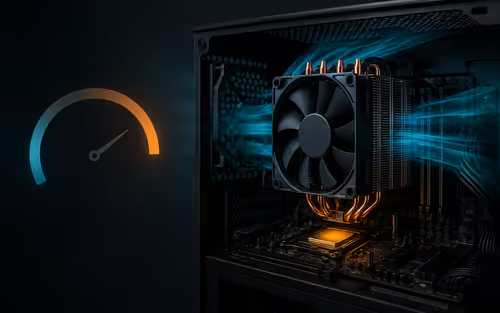
While the GPU handles the visuals, the Central Processing Unit (CPU) is the brain of the operation. It manages everything from enemy AI to physics calculations and game logic. For years, the race was all about clock speed... who could hit the highest GHz?
The real shift in PC gaming's evolution came with the move to multi-core processors. Instead of one brain doing everything faster, PCs now had multiple brains working in parallel. This allowed for more complex simulations, larger game worlds, and smarter NPCs. The fierce competition between Intel's latest gaming processors and the multi-threaded dominance of AMD's multi-core Ryzen CPUs has pushed performance to incredible new heights, making lag a thing of the past.
Check Your XMP/EXPO Profile! 🔧
Your RAM might not be running at its advertised speed out of the box. A quick trip to your PC's BIOS to enable XMP (for Intel) or EXPO (for AMD) can unlock a significant, free performance boost.
Killing Loading Screens for Good ⚡
What good are amazing graphics and a powerful CPU if you're stuck staring at a loading screen? The evolution of storage and memory has been just as crucial. We've gone from clunky, mechanical Hard Disk Drives (HDDs) that took ages to find data, to silent, lightning-fast Solid-State Drives (SSDs). An NVMe SSD today can load a massive open-world game in seconds, not minutes.
Similarly, RAM (Random Access Memory) has become faster and more efficient. The jump to new standards means the CPU can access game assets almost instantly. This combination of fast storage and high-bandwidth memory is why modern gaming feels so seamless. Exploring the capabilities of systems built with DDR5 shows just how far we've come from the days of waiting for the next level to load.
The Modern Rig: What Evolution Looks Like Today ✨
So, what is the result of all this progress? The evolution of gaming PCs means that incredible performance is more accessible than ever before. You no longer need to be a hardware wizard to own a beastly machine.
This progress has created a fantastic range of options for every South African gamer:
- Accessibility: High frame-rate 1080p gaming is now within reach for most, with brilliant accessible budget gaming PCs that deliver amazing value.
- Convenience: Don't want the hassle of building? You can get expertly assembled pre-built PCs that are optimised and ready to play straight out of the box.
- Budget Flexibility: Whether you're looking for powerful options under R20,000 or are ready to invest in uncompromising high-end rigs above R20,000, there's a perfect fit for your wallet.
Interestingly, the technology that powers our games has also revolutionised professional fields, with many core components being used in powerful professional workstation PCs for content creation and scientific computing.
Experience the Peak of PC Gaming Evolution Stop dreaming about flawless frame rates and instant load times. The pinnacle of PC performance is here, waiting for you to jump in and play. Shop the best gaming PC deals in South Africa for performance that leaves lag in the dust.