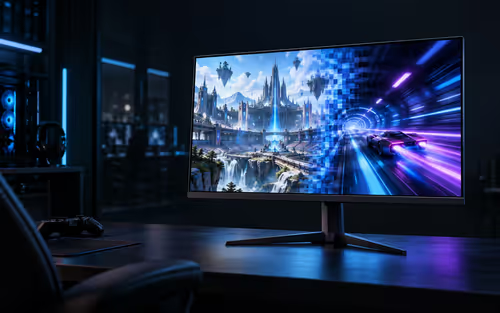
Staring down the barrel of a new monitor purchase in South Africa? You've likely hit the big boss battle: FreeSync vs G-Sync. It’s more than just a brand preference; it’s a choice that directly impacts your gameplay smoothness. A stuttering screen during a crucial clutch in CS2 or a torn landscape in Elden Ring is a frustrating, immersion-breaking disaster. So, which adaptive sync technology keeps its cool when the action heats up? Let's dive in.
So, What is Adaptive Sync Anyway?
Before we pit the two titans against each other, let's quickly cover what we're talking about. Your graphics card (GPU) renders frames at a variable rate, while your monitor refreshes its image at a fixed rate (e.g., 144Hz). When they don't align, you get ugly visual artefacts like screen tearing (where the monitor displays parts of multiple frames at once) or stuttering.
Adaptive sync technology forces your monitor to refresh in lockstep with your GPU's frame output. The result? Buttery-smooth motion, no tearing, and minimal input lag. Both FreeSync and G-Sync solve the same problem, but they take different paths to get there. Choosing the right one depends on your GPU, your budget, and how much you value guaranteed performance across all PC monitors.
Team Green: Understanding NVIDIA G-Sync 🟢
G-Sync is NVIDIA's proprietary solution. For years, "true" G-Sync monitors required a special hardware module installed inside them. This dedicated chip handles the sync process, ensuring a premium, consistent experience with extremely low latency and a wide variable refresh rate (VRR) range.
The G-Sync Tiers:
- G-Sync Compatible: These are essentially top-tier FreeSync monitors that NVIDIA has tested and certified to work well with its GPUs. They don't have the hardware module but meet a high standard.
- G-Sync: The classic experience with the dedicated hardware module.
- G-Sync Ultimate: This adds the requirement for high-end HDR support, delivering incredible contrast and colour on premium displays, like many high-end 5K and 4K monitors.
The main drawback? That hardware module adds to the cost, making G-Sync monitors pricier.
Team Red: Breaking Down AMD FreeSync 🔴
FreeSync is AMD's answer. It's built on an open standard called VESA Adaptive-Sync, meaning any monitor manufacturer can implement it without paying licensing fees to AMD. This is a massive win for South African gamers on a budget, as it makes the technology far more accessible. You'll find it on a huge range of screens, especially when browsing the best PC monitor deals.
The FreeSync Tiers:
- FreeSync: The base level, which guarantees to reduce tearing and stutter.
- FreeSync Premium: Adds a requirement for at least a 120Hz refresh rate at 1080p resolution and includes Low Framerate Compensation (LFC), which keeps things smooth even when your FPS drops.
- FreeSync Premium Pro: Includes everything from Premium, plus strict requirements for low latency and high-fidelity HDR.
Pro Tip: Use G-Sync on a FreeSync Monitor ⚡
Got a FreeSync monitor and an NVIDIA card? You might be in luck! Open the NVIDIA Control Panel, go to "Set up G-SYNC," check "Enable G-SYNC, G-SYNC Compatible," and select your monitor. If it works, you've just saved a bundle. Performance can vary, but it's a fantastic feature for budget-conscious builders.
The Big Showdown: FreeSync vs G-Sync in South Africa
So, for a gamer in SA, which one makes more sense? The FreeSync vs G-Sync South Africa debate really boils down to two key factors: price and performance guarantees.
💰 Price: FreeSync wins this, hands down. The lack of a required hardware module and licensing fees means FreeSync monitors are consistently more affordable. That saving could mean a better GPU or more RAM for your rig.
🏆 Performance: Historically, G-Sync's dedicated hardware offered a more reliable, flawless experience, especially at the lower end of the refresh rate range. However, with standards like FreeSync Premium and Premium Pro, that gap has almost vanished. A certified Premium Pro monitor will give you an elite experience that rivals G-Sync, often for less money. For many, the immersive experience of a curved gaming monitor with FreeSync Premium offers the best value.
Which Sync is Right for Your Rig?
Ultimately, your choice depends on your hardware and priorities.
- If you have an AMD Radeon GPU: Go with FreeSync. It's designed for your card and offers incredible value.
- If you have an NVIDIA GeForce GPU: You have a choice. A G-Sync monitor guarantees a top-tier experience, but a good "G-Sync Compatible" (FreeSync) monitor will give you 99% of the performance for a fraction of the price.
- If you're a competitive esports player: The guaranteed low latency of a true G-Sync or FreeSync Premium Pro monitor is a worthy investment.
- If you're a casual gamer or on a tight budget: A standard FreeSync monitor will still be a massive upgrade over a screen with no adaptive sync.
Even niche displays like portable monitors are starting to incorporate this tech, making smooth gaming on the go a reality. Once you've chosen your screen, don't forget the right monitor accessories like a quality VESA mount or calibration tool to perfect your setup.
Ready to Banish Screen Tear for Good? The FreeSync vs G-Sync debate is all about finding the right balance of price and performance for your setup. The best way to decide is to see the options for yourself. Explore our huge range of gaming monitors and find the perfect screen to conquer your game.