You're staring at your PC build list, and one question keeps popping up: PCIe 5.0 or 4.0? The marketing promises lightning-fast speeds with the newer standard, but what does that actually mean for your gaming in South Africa? Is it the secret to unlocking buttery-smooth frame rates in your favourite titles, or just an expensive number on a box? Let's cut through the hype and find out where your hard-earned Rands should really go. 🚀
Understanding the PCIe Battlefield
Before we dive into the PCIe 5.0 vs 4.0 gaming debate, let's quickly break down what we're talking about. Think of Peripheral Component Interconnect Express (PCIe) as the super-highway inside your computer. It connects your most important, high-speed components—like your graphics card and NVMe SSD—to your CPU.
Each new generation effectively doubles the bandwidth, or the number of lanes on that highway.
- PCIe 4.0: Offers a bandwidth of up to 16 GT/s (Gigatransfers per second) per lane.
- PCIe 5.0: Doubles that to a massive 32 GT/s per lane.
In theory, more lanes mean data travels faster, which should lead to better performance. But does theory translate to more frames per second (FPS)?
The Real-World FPS Showdown
This is the core of the PCIe 5.0 vs 4.0 gaming question for most builders. If you invest in a pricey PCIe 5.0 motherboard and a compatible GPU, will you see a noticeable FPS boost?
The short answer... not really. Not yet, anyway.
Even the most powerful graphics card on the market today, the NVIDIA GeForce RTX 4090, doesn't fully saturate a PCIe 4.0 x16 slot in most gaming scenarios. Extensive testing by tech authorities like Gamers Nexus and Hardware Unboxed shows the performance difference between running a top-tier card on a PCIe 4.0 vs 5.0 slot is often within 1-2%. That's a margin of error, not a tangible advantage. Your money is currently better spent on a faster CPU, more RAM, or a better graphics card rather than chasing the PCIe 5.0 standard for gaming alone. The foundation of any great build is, after all, a quality motherboard that balances features with price.
Beyond Graphics: The Speed of Next-Gen Storage ✨
While the immediate impact on gaming FPS is minimal, the story changes dramatically when we look at storage. This is where PCIe 5.0 truly starts to flex its muscles.
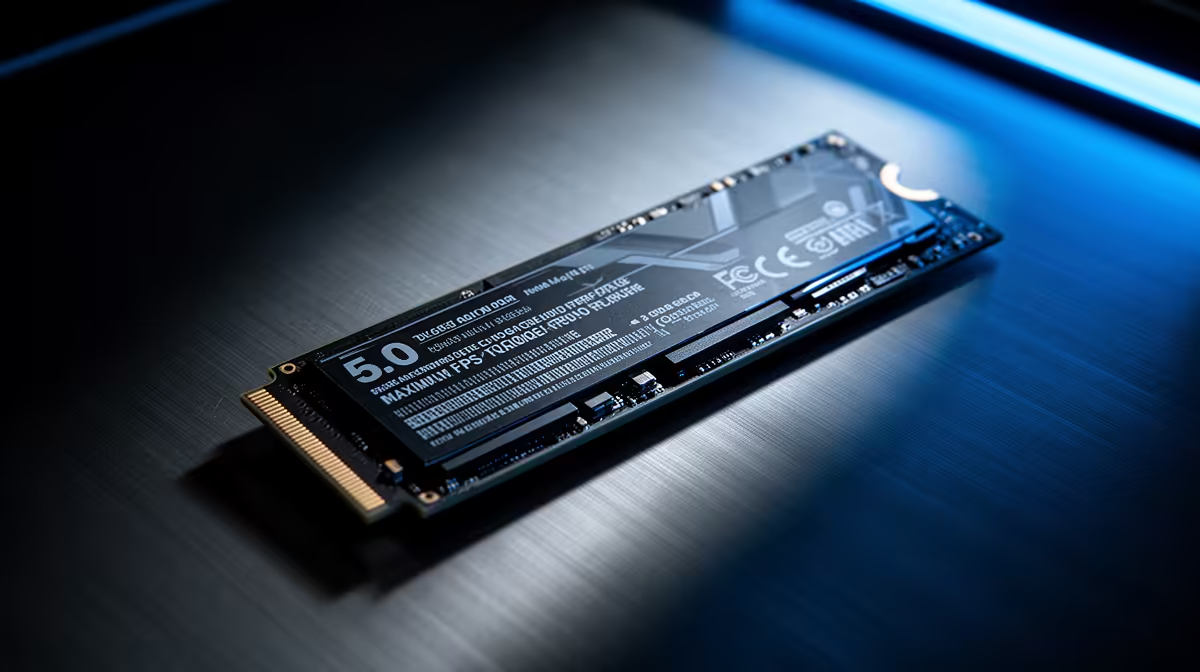
A PCIe 5.0 NVMe M.2 SSD can achieve staggering read and write speeds, often exceeding 12,000MB/s. That's nearly double the speed of the fastest PCIe 4.0 drives. What does this mean for you?
- Insanely Fast Load Times: Games, levels, and applications will load almost instantly.
- Smoother Asset Streaming: Technologies like Microsoft's DirectStorage, which allow the GPU to load game assets directly from the SSD, will benefit hugely. This could lead to more detailed open worlds with less pop-in.
- Content Creation Powerhouse: If you edit 4K/8K video or work with massive files, these speeds will drastically cut down your project load and render times.
Whether you're on Team Blue with the latest Intel motherboards or Team Red with a new AM5 motherboard, choosing a platform with PCIe 5.0 support is an investment in future performance.
Check Your Lanes! ⚡
Not all slots on a motherboard are created equal. Your primary graphics card slot might be PCIe 5.0 x16, but your M.2 slots could be a mix of PCIe 5.0 and 4.0. Always check your motherboard's manual to ensure you're installing your new super-fast NVMe SSD in the correct slot to get the maximum advertised speed.
The Verdict: Which is Right for Your Rig? 🤔
So, should your next build be PCIe 5.0? It depends entirely on your needs and budget.
Go with PCIe 4.0 if...
You are a pure gamer focused on getting the best FPS for your money right now. The performance difference for graphics is negligible, and the cost savings can be channelled into a more powerful GPU or CPU, which will give you a much bigger real-world performance boost.
Go with PCIe 5.0 if...
You are a forward-thinker, a content creator, or a tech enthusiast who wants the absolute latest and greatest. You're building a top-tier rig that you don't plan on upgrading for several years. The investment gives you access to next-generation SSD speeds and ensures you're ready for future GPUs that may finally saturate the PCIe 4.0 interface.
Ultimately, the PCIe 5.0 vs 4.0 gaming debate comes down to value versus future-proofing. For most South African gamers today, a solid PCIe 4.0 system remains the undisputed king of performance-per-Rand.
Ready to Build Your Speed Demon? The motherboard is the heart of your PC's performance potential. Whether you're optimising for today's value or building for tomorrow's power, the right board is waiting. Explore our massive range of motherboards and find the perfect foundation for your ultimate rig.