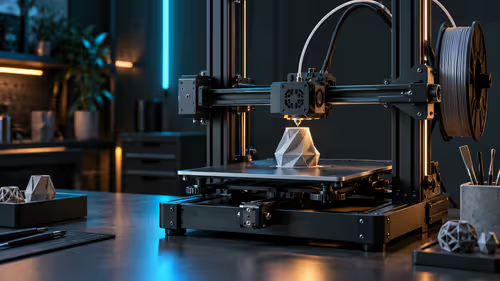
The easiest way to judge a build volume is against real objects rather than raw numbers on a spec sheet. A 220 x 220 x 240mm printer swallows more of the household list than most people expect, and the items that do not fit whole are fewer and more predictable than the number alone suggests.
Quick Answer
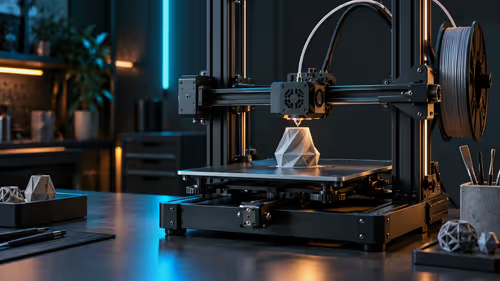
Phone stands, cable trays, board game inserts and planters up to 230mm tall all fit whole inside this volume. Drone frames print flat rather than upright, replacement knobs and small brackets finish inside an hour, and only genuinely large work needs splitting into sections that pin back together. That envelope belongs to the R5,799 Ender-3 V3 KE.
🏠 Around the house, almost everything fits as one piece
A phone stand, a set of cable trays for a desk, a board game insert sized to a standard box, and a planter up to 230mm tall all sit well inside the 220 x 220 x 240mm envelope, with space left over. These are the objects that actually get printed most in a home setting, and none of them come close to testing the limit of this bed size.
Replacement parts follow the same pattern: a broken cupboard knob, a curtain hook, a small bracket holding something together in a garage all finish inside an hour or two rather than needing an overnight job, since these are small, simple shapes well within both the volume and the practical print time most people are happy to wait for. Machines built around this same footprint turn up regularly if you browse the 3D printer range, which makes it a sensible default to plan a first shopping list around.
🎲 Hobby projects that need a little more thought
Miniatures and small model kit pieces sit at one end of this scale, since most kit-scale parts are small enough that a whole batch fits on the bed in a single job rather than testing its limits one piece at a time. The model kits range is a useful place to check scale before committing filament to a display project.
A costume helmet or a lampshade sits closer to the actual limit, and orientation decides whether it fits at all. Standing a tall, narrow shape upright can push past 240mm quickly, where tilting it or splitting it at a natural seam, a visor line or a rim, keeps each half comfortably inside the bed.
📦 What genuinely does not fit, and the honest fix
Furniture-scale pieces and full cosplay armour sets are the realistic exceptions, and they need joining after printing rather than shrinking down to size, since a shrunk functional part usually stops doing the job it was designed for. That joining step is routine rather than an inconvenience: most slicing software adds a locating peg automatically along a chosen cut line, so two separate prints line up and glue into one finished part rather than needing a freehand seam. Keep a spare roll of filament on hand for any project spanning more than one print, since running short partway through the second half costs more time than a small, single print ever would.
Frequently Asked Questions
Will a standard board game insert fit this bed?
Yes, the vast majority of board game box inserts are designed around dimensions well inside 220 by 220mm.
Can I print a full-size drone frame in one piece?
Usually, if printed flat rather than upright. Most consumer drone frames spread wider than they stand tall.
How tall a planter can I print in one piece?
Up to 240mm, the bed's vertical limit, though anything close to that height is worth checking for stability once printed and filled with soil.
What is the simplest way to join a split print?
A locating peg or dovetail built into the split by the slicer, combined with a plastic-appropriate adhesive along the seam.
Ready to see what actually fits before designing around a bigger printer?
Check your object against 220 x 220 x 240mm and consider a flat orientation before assuming it needs splitting.